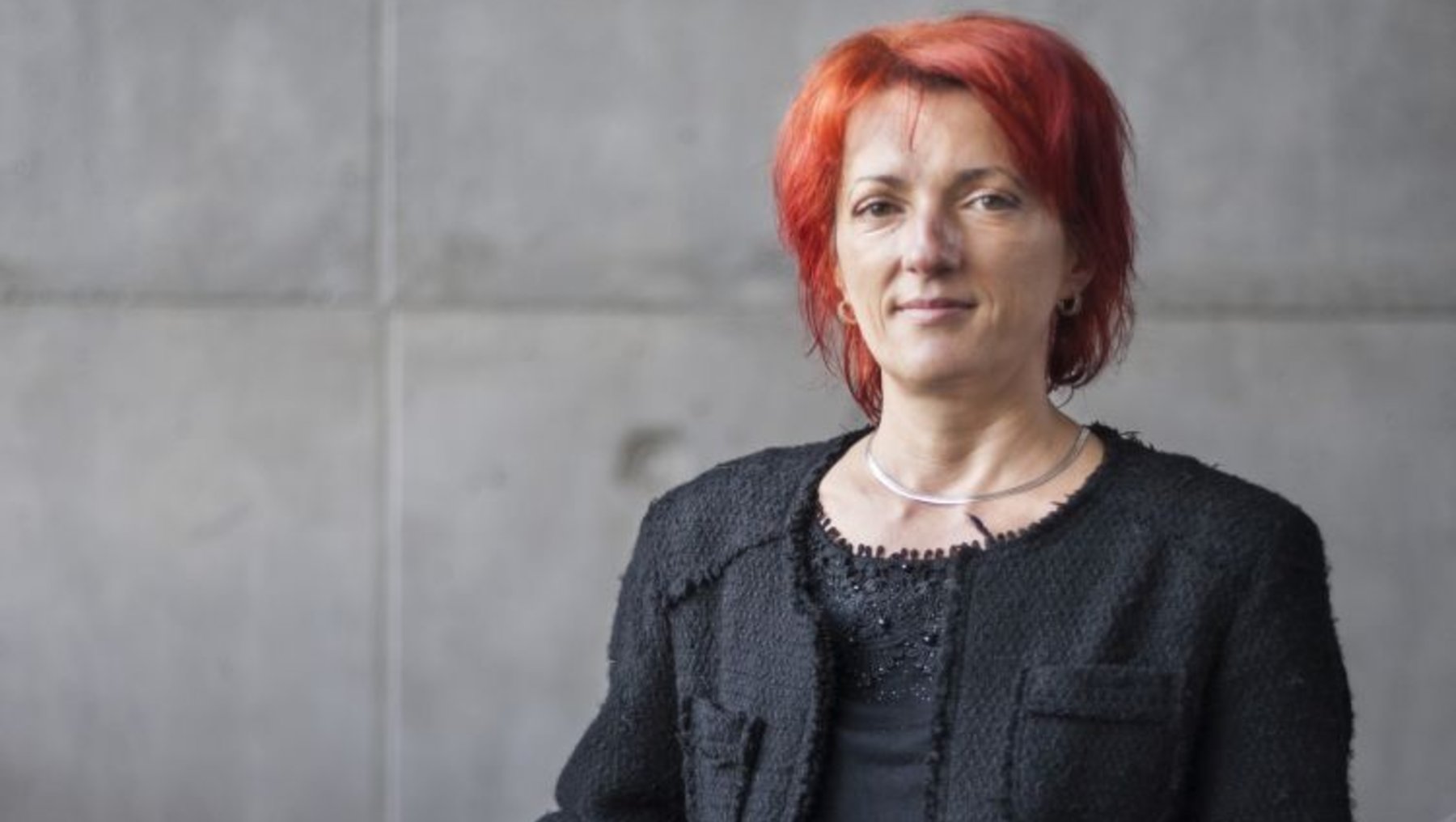
Anyone who is taught by the new Professor Mavric-Scholze for Food Chemistry and Analysis at Anhalt University of Applied Sciences in Köthen can see that all the theory in her subject can be applied in practice and that this combination of subjects is by no means a subject to be feared.
In this interview, Elvira Mavric-Scholze explains what the newly appointed professor thinks about lifelong learning and what important skills her students need to be successful in their careers.
Prof. Mavric-Scholze, what was your first impression since you joined the university?
It was very positive. I was welcomed into a very collegial and appreciative environment. My colleagues were really pleased when I arrived.
Before we turn to your new tasks: How did you get into your field?
I knew I definitely wanted to specialize in the natural sciences. I wavered between chemistry and pharmacy, but I wanted to learn something that was closer to people. That's when I decided on food chemistry at the University of Dresden - at the time, it was a subject that wasn't so commonplace. People knew chemistry and pharmacy, but food chemistry was even less well known at that time, in 1995.
How do you remember your studies?
I really enjoyed my studies and then my doctorate. Of course, at the beginning it was like any other degree course: learning the basics first. But later, the scientific work and project work were added and that was great. There were some very exciting things that I like to remember.
What were your most important professional milestones after your doctorate?
My first job left its mark on me. I was employed as a laboratory manager in R&D at Symrise GmbH in Holzminden. I worked on the health properties of blueberry extract, for example, which was a great project and the results were very exciting. I then spent eleven years in quality assurance at anona GmbH and also helped to set up a laboratory for analytics. The company and the laboratory grew a lot during my time there. I learned a lot about management positions and people and supervised employees and students. My last position before Anhalt University of Applied Sciences was Head of Quality Management and Quality Assurance at the ODW Frischprodukte GmbH dairy in Brandenburg. I was in charge of 30 employees there.
What was the decisive factor that made you turn your back on industry and choose Anhalt University of Applied Sciences?
The industry was interesting. But I was really looking forward to the teaching and the students. What's more, here in Köthen you have the option of realizing your potential in research. The university offers completely different opportunities than industry.
You were appointed professor in the field of food chemistry and analysis. What fascinates you about your field?
I find it exciting how it is still possible to find out new things. For example, how the effect between two foods changes when they are combined - for example, iron combined with vitamin C improves bioavailability. The fascinating thing is that we can investigate the functional properties of foods. This is also a wish for my research here at the university.
Do you already have specific ideas for your field of research?
As I said, I am interested in functional foods. For example, I would be interested in finding out more about the functions of medicinal mushrooms. That would be a possible area of research. In addition to algae research here at the university, which I also find very exciting, brewing is another major area of research at the site. I could also imagine starting there. There is still great potential for further research in brewing. For example, in the area of the Maillard reaction, which is a browning reaction that occurs when heated.
In your opinion, what is a particularly important skill that students should take away from their studies for their professional future?
The skills for students need to be different depending on where they end up in their careers. But regardless of where they end up, one thing is very important: students should be able to link content. That's why acquiring the basics is so important, it requires a lot of knowledge. Only with a good, sound foundation can connections be recognized later in professional life.
Learning is a lifelong task, and I am still learning and continuing my education. But it's easy for me to say that you should always keep learning - because I love what I do and I live it in my private life too. If you live what you learn, then you'll be successful in your career later on.
Now you've almost anticipated the motto I wanted to ask you about at the end. But back to the apprenticeship. What would you like to focus on?
I teach food chemistry and analysis and have the impression that this is a bit of a "fear subject" for students. But it doesn't have to be. It's not that difficult in itself. I would like to show that the subjects can be very good to understand. The great thing is that you can apply everything you learn in theory! It's more than just learning dry formulas and content. I would like to convey this to the students.
What discovery, invention or insight would you like to see in your field in the next ten years?
I am observing a trend in the industry where the focus is increasingly on maximizing profits and less on quality. I very much hope that quality will come to the fore again. That fewer additives, carriers and colorants are used and more natural substances. That is possible, but it makes production more expensive. Quality and cheap don't go together.
Doconsumers also need to be more aware of this?A healthier diet could solve many of today's health problems - but we need better education for buyers. I would like to see more research, communication and implementation of the links between food and health.
Now we would like to know: How do you actually eat?
Oh, very special (laughs). I'm not a strict vegetarian, but I rarely eat chicken or fish. But generally very little animal-based food. I make sure to base my diet on vegetables and fruit. Dried and frozen fruit too - but even then I pay a lot of attention to where it comes from.
You already mentioned lifelong learning in the interview. But now let's finish on a more official note: do you have a motto that you would like to pass on to the students on their journey through life?
There is nothing that is impossible. Anything can be made possible with energy and initiative. There is no such thing as a "no", it is always a matter of looking for ways and detours to make possible what at first seems impossible.
Prof. Mavric-Scholze, thank you very much for the interesting interview.
