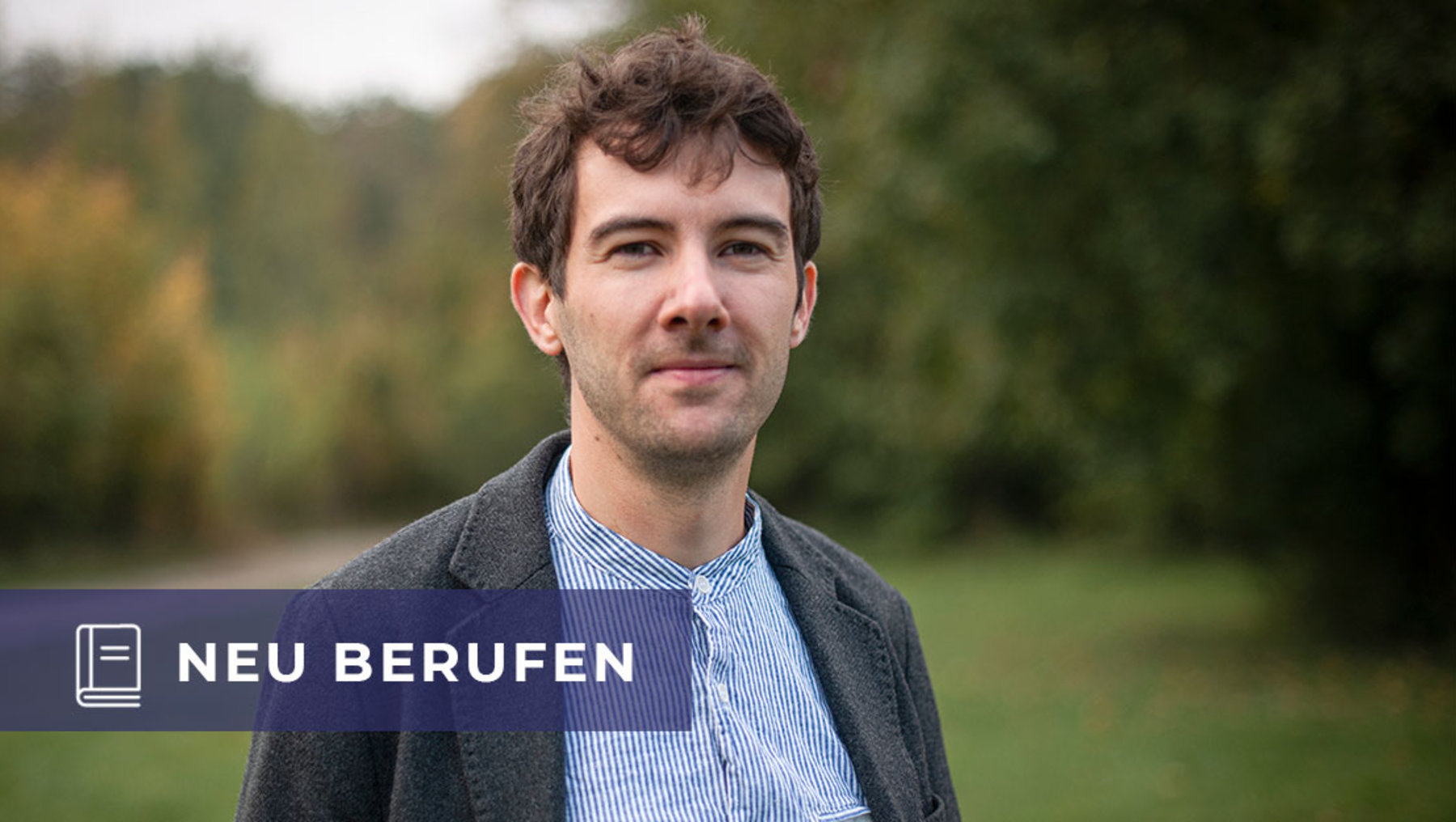
Dr. Markus Meyer has been appointed Professor of National and International Nature Conservation at Anhalt University of Applied Sciences for the winter semester 2021. The international focus of his teaching stems from his own time as a student. Here he gives us an insight into the focus of his teaching and his plans for the Department of Agriculture, Ecotrophology and Landscape Development.
Prof. Meyer, welcome to Anhalt University of Applied Sciences. Before we talk about your new role, let's take a brief look back. What made the biggest impression on you during your own time at university?
What shaped me is a little atypical: I first studied economics at Bachelor's level and then switched to environmental sciences. In hindsight, however, the change brought me a lot. I was able to work better with economists and benefited from familiarizing myself with new things. It's good to try something new and not forget interdisciplinary knowledge. I'm also in favor of students broadening their specialist knowledge. It requires specialist knowledge, but I take a positive view of the unfamiliar and would like to advise students to look a little to the left and right.
The second thing that shaped me was the international orientation of my degree course. I studied environmental sciences at the University of Hohenheim and the Swedish University of Agricultural Sciences. There was less face-to-face teaching than was usual in a traditional German degree program at the time, but more independent work and online events. It was natural to study in English and to interact with very different fellow students in terms of cultural background and working methods. I also find international experience enriching for my students today.
You began your professional career at Ludwig-Maximilians-Universität in Munich. From 2016 to 2017, you worked at the Bavarian State Institute for Forests and Forestry, then became project manager of a research group for agricultural and regional development and junior professor at the University of Twente, most recently at the Bavarian State Office for the Environment. Is there something like a unifying theme that describes your field of research?
Yes, I am interested in the interaction between nature conservation and land use. In other words, the question of how land use affects ecosystem services and biodiversity and how this can be controlled by various policy instruments. What appeals to me is the overarching and integrative work with different stakeholders.
It is important to you that students are able to assess and optimize the interactions between nature conservation and land use in different constellations both professionally and methodically. How would you like to prepare them for this?
Nature Conservation and Landscape Planning, but also Environmental Planning, are at the core of the degree programs. In my opinion, however, it is also important to work together with other stakeholders. Even with those who act against or in competition with nature conservation. We have to look for joint solutions. How can the perspectives of the different actors be seen, understood and taken into account and how can we meet the requirements in a better way. Students should be prepared to understand other perspectives - and this is where I see a great advantage at Campus Bernburg. Here, students can practice this directly with other degree programs such as Agriculture.
Have you set yourself a specific long-term goal for this?
Yes, in the long term, I would like to see more networking with the Agriculture degree program. It would be good if Agriculture and Nature Conservation students came into more contact with each other; this could happen through a joint module or by integrating certain content of each subject more into the other subject.
If you had to describe your way of teaching in three words, what would they be and why?
Firstly, more project-oriented; secondly, more interdisciplinary; and thirdly, and this is also a result of my biography, I would like to add an international dimension to the modules, i.e. shift the perspective away from national nature conservation and more outwards.
What are you looking forward to most about working with the students?
After this long corona period, I'm looking forward to more exchange on site and getting to talk to people in person. I'm also looking forward to developing student projects, working on them together with the students and getting them involved in research.
Please answer with a personal reference or in general: what discovery, invention or insight would you like to see in the next ten years?
What I would like to see is the ability to simulate the resilience of landscapes in relation to external influences such as climate change or local management. With a model of the weak points and tipping points of the landscape and its services, we could improve management. At the same time, we could forecast the effect of individual nature conservation or agricultural policy instruments on a site-specific basis: Then we would know exactly which policy instruments would help and how they should be implemented, waste less public money and have better arguments for a social consensus.
Do you have a motto that you would like to pass on to students?
Change places and perspectives from time to time - good ideas don't always come from your desk.
