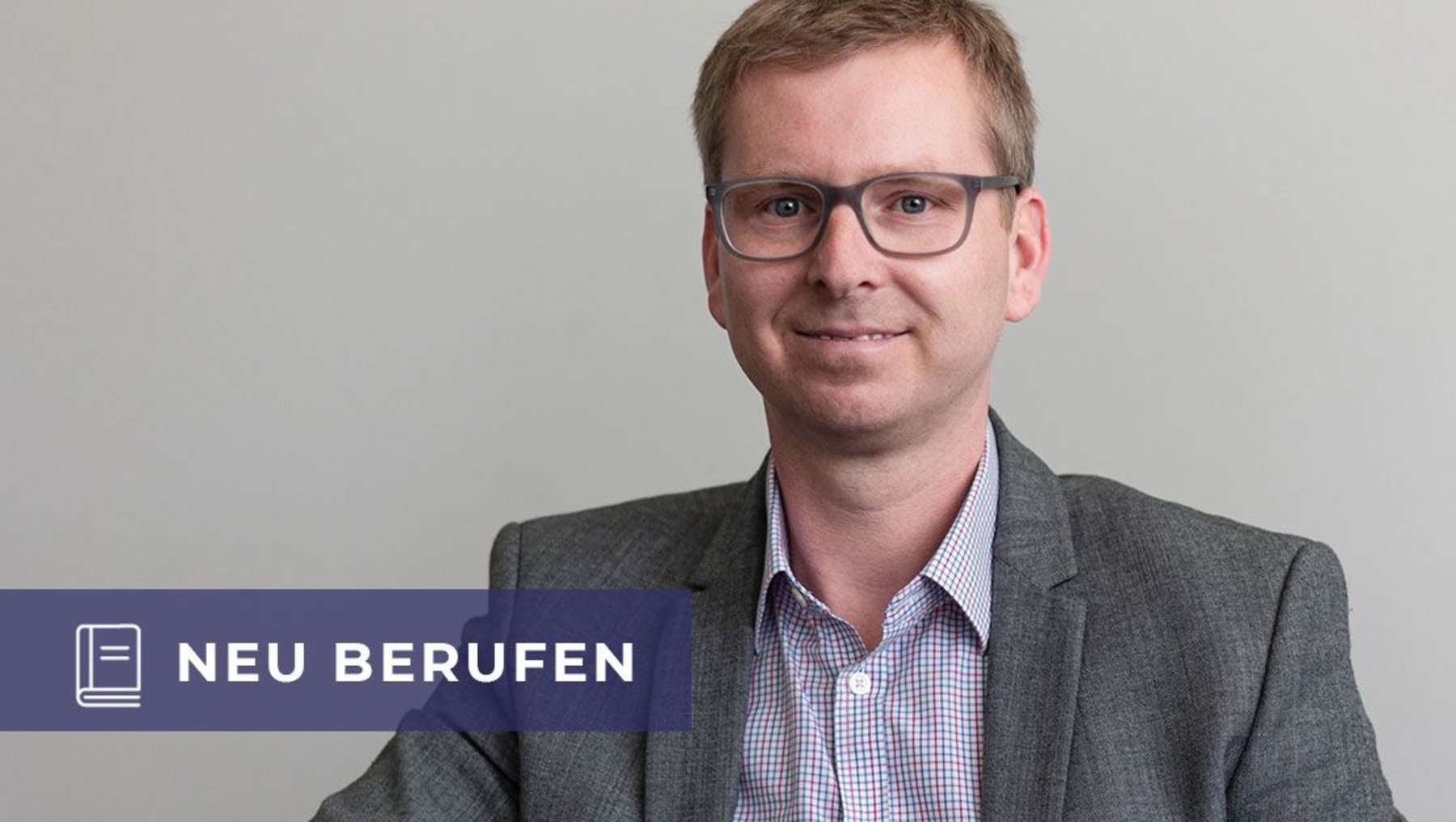
On 1 June 2021, Anhalt University of Applied Sciences welcomed Dr Sebastian Trojahn as the new Professor of Supply Chain, Operation Management and Digitalization at Anhalt University of Applied Sciences. The economist has turned his affinity for logistics and digitalization into a profession. Here he explains the three pillars on which his teaching is based and how students are to be introduced to the content in a practical way.
Professor Trojahn, welcome to Anhalt University of Applied Sciences. You are a qualified industrial engineer and your professional career includes both academic and entrepreneurial activities. What were your most important stations?
I worked in the automotive and chemical industries in both operational and strategic areas. This led me into the political arena, where I worked as a consultant for the commission of the Conference of Transport Ministers on the "Future of Transport Infrastructure Financing". Since 2008, I have been employed as a research assistant and project manager at the University of Magdeburg and the Fraunhofer Institute IFF. Incidentally, Anhalt University of Applied Sciences is not entirely new to me. I have been teaching as a substitute professor in the Department of Economics since 2018.
Now you have been appointed to your own professorship in the Department of Economics. Your field of Supply Chain, Operation Management and Digitalization is part of Logistics and Digitalization. What exactly will be your tasks?
I see my future tasks as consisting of three pillars. The first and most important pillar is teaching and training. The high-quality education and training of students is my top priority. After all, students and graduates are our future and therefore also a location factor for our local companies.
This brings me to the second pillar, support and networking with regional companies. Logistics and digitalization have always played an important role in the world's value creation networks, but especially now. Our very good students and graduates can help companies when they face challenges. They are the innovative power for our companies. As a third pillar, I would like to expand logistics-related research activities with a team. The keywords here are the digitalization and optimization of logistics networks, transport and mobility as well as the planning and management of sustainable, efficient and robust logistics and production systems.
How would you like to implement the three pillars in your practical teaching?
I would like to pay particular attention to interdisciplinary knowledge transfer and use practical, innovative and digital elements. The practical training should help students to understand and retain the knowledge they have been taught better. The connection to companies can also make it easier to start a career. I like to work with business games that can be used to analyze and optimize certain processes in the logistics sector. Mistakes that are made have no negative consequences, so that things can be tried out with an open mind. These experiences of success and failure are better accepted by the participants than if the students only had to believe my explanations. I only teach the theoretical principles afterwards.
In the current summer semester, teaching is taking place digitally or hybrid. What challenges do you see in this?
I would rather see the current developments as an opportunity. After all, we have already been able to gain some experience in digitalized training. Our teaching will perhaps develop in two ways. We will offer theoretical, pre-prepared lecture content more as on-demand offerings, leaving us more time for practical in-depth study and experience. We will hopefully not forget the practical things so quickly, as we will have more time to analyze many different aspects and also increase the breadth of the teaching content we cover. After all, you never forget how to swim.
What research projects are you currently working on to enrich the university?
Research only works in a team. It requires a collegial network with which the challenges of the future can be met. This is where I think we should continue to pool our expertise in Central Germany and work together.
What does that mean in concrete terms?
There is currently a lot of momentum in the field of logistics and digitalization. We need to think about how we can shape the production and logistics networks of the future. Efficient and economical? Or will other aspects of sustainability or robustness be added? Will our mobility behavior perhaps also change? Which new technologies for logistics, production, transport or even digitalization are entering the market? As you can see, there will be many different research approaches. I am currently focusing on the topics of closed-loop supply chains, mobility, green hydrogen and digitalization in logistics.
How can students benefit from this?
Research and education can be mutually beneficial. We need new ideas in research. Old ways of thinking need to be completely thrown overboard. And in teaching, the findings from research form an ideal basis for conveying attractive and new teaching content. Only with this symbiosis can current challenges and solutions from science and practice be conveyed.
Do you have a hobby to balance out your job?
...laughs... Hobbies? I have turned my hobby into a profession. I enjoy working in the field of logistics and digitalization so much every day that I don't even notice that I'm working and hardly need a balance. Where can you find me? At the moment, I live in Magdeburg, where you can find me either in the garden, swimming or jogging. Always happy to have an interesting chat.
Professor Trojahn, thank you very much for the interview!
Prof. Dr. Sebastian Trojahn
-
 © Zerina Kaps
Redaktion
