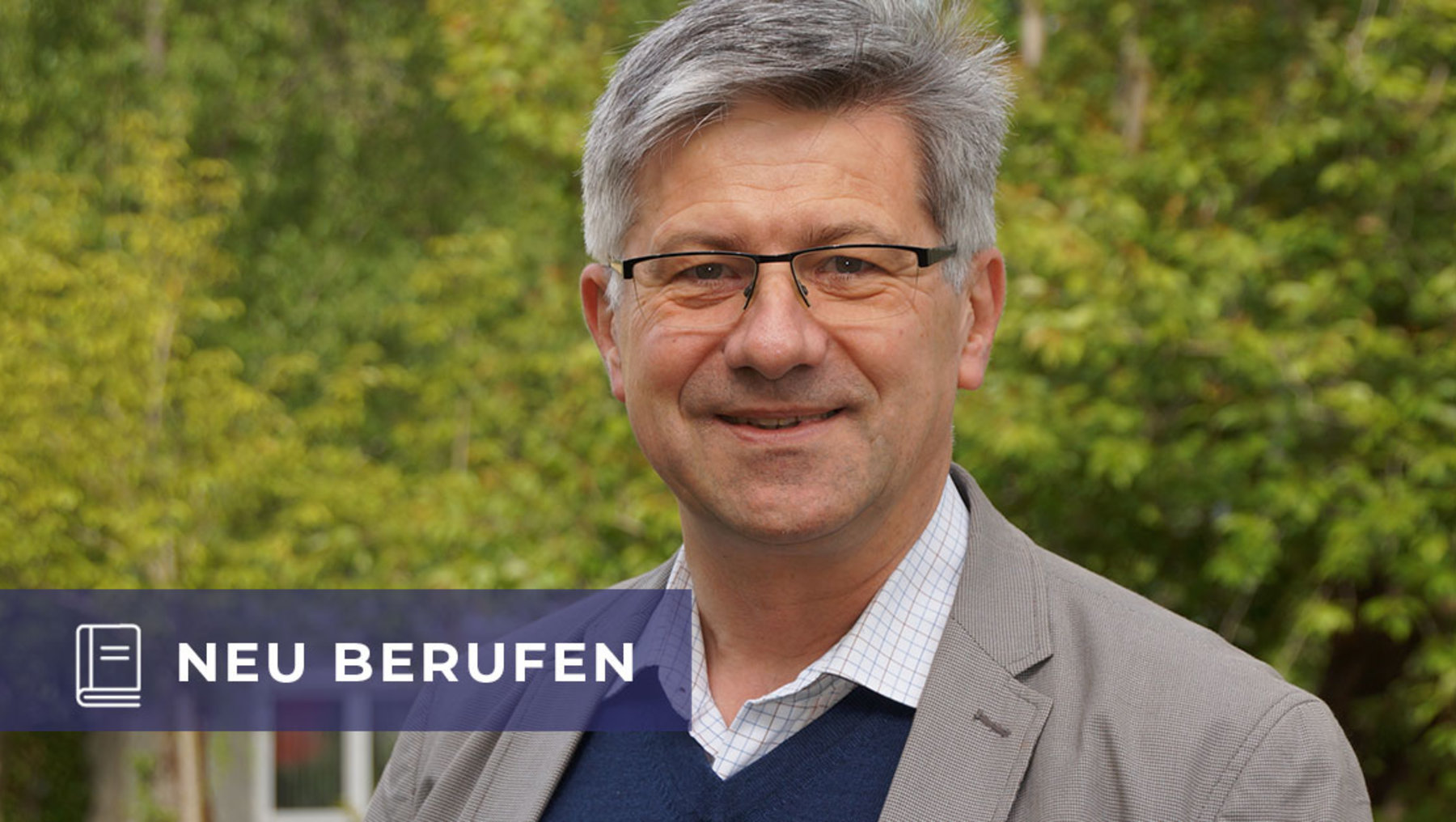
The new Professor of Agricultural Management at Anhalt University of Applied Sciences, Professor Dr. Thomas Tanneberger, is a trained farmer and brings a wide range of skills to the lecture hall with his many years of experience as an editor, consultant and farm manager. In addition to imparting theoretical knowledge, he attaches great importance to his students gaining practical experience and getting hands-on experience. As a part-time farmer, he knows how important it is to feel the ground beneath your feet and experience nature up close. In this interview, we find out more about his vision for the agricultural sector and his educational approach.
Professor Tanneberger, welcome to Anhalt University of Applied Sciences. Before we talk about your new role, let's take a brief look back. What made the biggest impression on you during your own time at university?
Prof. Tanneberger: The time of reunification in East Germany. I started my studies in 1990. The fall of the Berlin Wall, the first free elections, the unification treaty - it was a time of great hope, a time of great optimism. Freedom, opportunities, new worlds! But then disillusionment followed very quickly. Socially and financially, it was not an easy time. Many structures collapsed and my degree course in Rostock was also canceled. I went to the TU Berlin: we had five new students from the East among fellow students from West Germany - that was exciting. Then came the merger of the Department with the Faculty of Agriculture at Humboldt University in 1992. Always new beginnings, upheaval, new things. I had a tutor position alongside my studies, labs every vacation and still finished before the normal program length. It's nice that many students today have more time to study.
Your professional career began in the mid-1990s at Deutscher Agriculturesverlag with a traineeship at the specialist magazine for Agriculture / Agricultural Management "Neue Agriculture". How did that come about?
I always wanted to work at the interface between theory and practice. My career goal was actually to become a research station manager at an academy or university. The traineeship was more of a coincidence - I wanted to do a doctorate and there was no position at my university. So I did a second degree in journalism. It was a good fit, as I soon realized: I was always at the forefront of the field thanks to the editorial work with the authors and my own research, and I soon discovered my love of words and typesetting.
What were your most important career steps after that?
Immediately after my traineeship, I became editor for Agriculture / Agricultural Management at "Neue Agriculture" in 1998. Hardly any other medium has accompanied the market-based transformation of the East German agricultural sector in such an intensive, fair and action-oriented way. In all the project years that followed, "Neue Agriculture" was my professional home, my base. At the same time, we set up a sister magazine in Eastern Europe, which was published in the Russian language of instruction. I was editor there and from 2003 editor-in-chief. As project manager and later as managing director, I also had Economics responsibility. We were a great international team between Moscow and Munich, Kiev and Berlin, Minsk and Hanover. Unfortunately, that's hard to imagine today.
You wanted to do a doctorate, but there were no jobs, you said earlier. How did you end up doing your doctorate?
That was in 2005, when I was able to defend my dissertation on management economics in large East German companies. The topic was chosen deliberately - I didn't want to lose contact with the local Agriculture despite all the work abroad. I succeeded - what a success after eight years of part-time work! In general, the 2000s were a very happy time. Our Eastern Europe project was booming, with annual sales increasing by six figures. Then came the rouble crisis in 2008 and things got tighter again in Economics. We cut costs, handed the project over to our Eastern European colleagues, and they had learned their job well by then. They continued to run the magazine successfully until the outbreak of war in 2022 - one of the most sustainable German agricultural projects, in my opinion.
In 2010, I was appointed editor-in-chief of the "Bauernzeitung", the weekly newspaper for East German farms. Agricultural Management and agricultural policy were also the focus here. A highly interesting time, and again with a great team. I am still grateful today that I was able to work with these people for ten creative years.
But you still wanted to get to know something other than the "press bubble"...?
Exactly, at some point my curiosity got the better of me - I sensed that there was another world out there. So in 2020, at my own request, I went into agricultural consulting: developing investment concepts, building communication strategies, restructuring farms, rebuilding people's morale, doing educational work. I then briefly joined the German Farmers' Association as an agricultural economist through a consultancy mandate before I received the call from Anhalt University of Applied Sciences at the end of last year. I was happy to accept it and am really looking forward to the new task.
Can you give us an insight into your field of research? What fascinates you most about your scientific specialty?
Agriculture in general and agricultural economics in particular thrive on interdisciplinarity. That is why, despite my economic orientation, I have always remained a bit of a generalist. Topics that particularly interest me are
- The structure, economics and sustainability of East German Agriculture compared to other European regions,
- Management methods in large Agriculture enterprises,
- the economics of current development trends in Agriculture, such as digitalization, climate and biodiversity protection.
What focal points of your previous work will you take with you into the lecture hall?
From my time in the press, I will probably take with me the habit of analyzing news soberly and classifying it into objective developments based on facts, politically neutral and free of Economics interests. From my consultancy work, I take with me a focus on utility value: I want to focus on content that can help students in a comprehensible way. And I bring solidarity with me from my association work: In addition to specialist knowledge, our successful development in Agriculture also requires a commitment to one another.
It is important to you to give students a holistic view of their future work. Can you briefly name three specific challenges that you see for students?
Production, environment, science, politics - our agricultural world today is more complex than ever. It is therefore a great challenge for young people not to give in to this variety of information, possibilities, regulations and methods, but to research things systematically and to put the results into context. Secondly, students should not lose themselves in overly detailed factual research, as tempting as it may be. Knowledge of methods and systems is important. Yes, and thirdly, contact with society is very important. Do something, but think beforehand about the impact of what you do!
How would you like to prepare them for this?
We won't be able to avoid some theory. However, I will try to explain this as often as possible using practical examples. Apart from that, the same thing applies as in my earlier phases of life: get into your wellies and get out into the fresh air! I am a part-time farmer, have many contacts with farms and find the new old idea of Living Labs very interesting.
What are you most looking forward to in your collaboration with the students?
That I can pass on some of what I have learned and experienced over the last two and a half decades. And what I also enjoy with my own (four) children: the happy looks when someone has understood something and the meaningful initiatives that put what they have learned into practice. Yes, and in terms of perspective, the best reward would of course be to meet graduates again later as successful company managers.
Do you have a motto that you would like to pass on to the students?
I agree with the British mathematician, physicist and structural analyst John Desmond Bernal (1901 - 1971), incidentally a farmer's son: "Practice without theory is blind, theory without practice is barren". I would only put it in positive terms: "Practice becomes far-sighted with theory, and theory only really sheds light on the darkness with practice."
Prof. Tanneberger, thank you very much for the interview.
