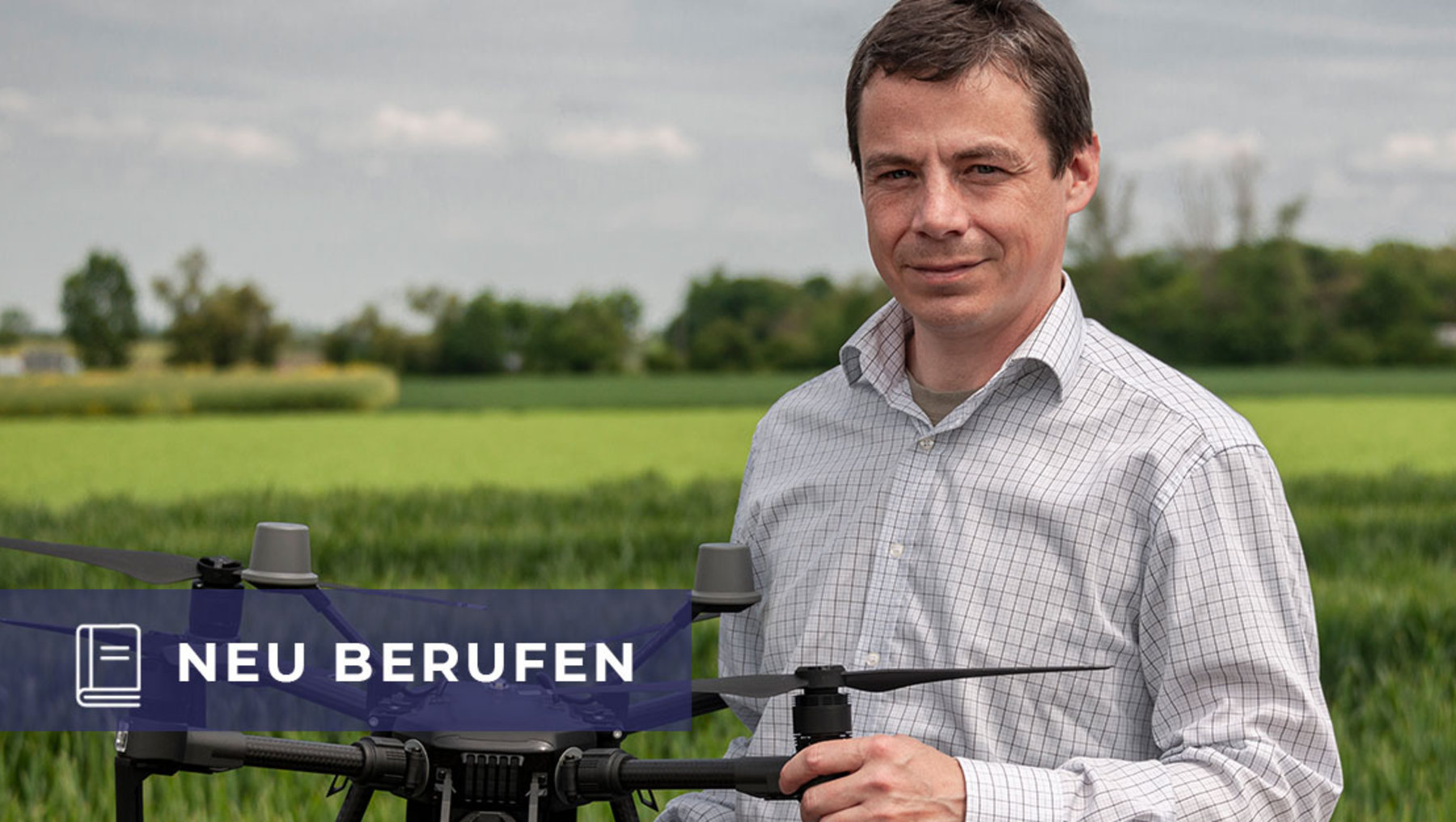
Anhalt University of Applied Sciences welcomes Dr. Uwe Knauer as the new Professor of Digital Technologies in Plant Production. Professor Knauer will promote and further develop digitalization at the Department of Agriculture, Ecotrophology and Landscape Development in Bernburg. Here he talks about the challenges he wants to prepare students for.
Professor Knauer, welcome to Anhalt University of Applied Sciences. You grew up in Berlin and studied computer science there. What did you do after graduating?
I initially worked as a research assistant at Humboldt University and later completed my doctorate there. After a stint as a software developer at an IT company in Magdeburg, I moved to the Fraunhofer IFF in Magdeburg as a research assistant. There, in the Biosystems Engineering department, I specialized in the analysis of hyperspectral data in Agriculture and forestry applications. During this time, I had the opportunity to work on several research projects in Australia. One project, for example, was to carry out aerial campaigns in Australian viticulture.
You have now been appointed Professor of Digital Technologies in Plant Production at the Department of Agriculture, Ecotrophology and Landscape Development. What will be your responsibilities?
In teaching, I will make the field of digitalization a focus in existing and new classes. The use of sensors, data evaluation, the provision of data via information systems, decision support and, of course, the automatic optimization of decisions for plant production will play a key role. Areas of application could be adapted fertilization or the targeted and economical use of pesticides. Very different scales also play a role here: from hand-held sensors to drones and satellites. I see researching and teaching how new technologies can be integrated into existing processes and establishing new procedures in this way as an exciting and challenging task.
What does this mean for Agriculture?
There are currently numerous new developments, for example in the field of field robotics and through modern AI (artificial intelligence) processes in conjunction with powerful sensors, which are becoming increasingly practical and available to farmers. The agricultural sector worldwide is therefore facing a technological upheaval that will permanently change the way plants are cultivated and harvested.
How will you implement this in practical teaching?
By making topics relating to digitalization, sensor technology, data analysis and robotics more important in agricultural studies. Be it as part of existing classes on agricultural engineering, new modules or even new degree programs. Computers and information systems are tools of digitalization, the mastery of which is becoming increasingly important and which I would like to teach using practical and hopefully interesting examples.
What challenges might there be?
Agriculture is not only facing technological upheavals, but also major challenges overall. Clearly, technology alone cannot solve all these challenges, such as changes caused by climate change and the needs of a growing world population. It is a building block that - if used correctly - makes it possible to work more efficiently and at the same time conserve resources. Above all, students must learn to use these new technologies safely and learn to assess their potential. In a rapidly changing environment, it is therefore a great challenge for teaching to impart precisely those skills that will last as long as possible and thus form a good basis for a successful professional life.
What research projects are you currently involved in to enrich the university?
I am currently working on projects with colleagues at the Fraunhofer IFF in Magdeburg on digitalization in fruit and wine growing and on the analysis of remote sensing data in forestry applications. Drones and hyperspectral sensors play a major role here. I would like to continue these topics at the university and also deepen them in new projects. I see great potential for these topics in the collaboration with Prof. Bannehr's working group, which has developed a gyrocopter into a multi-sensor platform at the university.
How can students benefit from this?
I would like to involve students closely in research projects in order to contribute to this. Artificial intelligence and machine learning, for example, need reference data of high quality and in large quantities in order to do justice to the diversity in nature and the different environmental conditions. Students can make a decisive contribution here by helping to collect such reference data and then learn how this data can be used to train AI models, which may then provide farmers with decision-making aids and support as part of future technical systems.
Where do you live when you are not in Bernburg at Anhalt University of Applied Sciences and what is your balance to everyday university life?
I live with my family in Magdeburg. Going hiking together or reading an exciting book are good ways to find a balance.
Professor Knauer, thank you very much for the interview.
