Tim Poturnak has worked his way into the engineering degree program step by step – as a dual-degree student, with international experience and full commitment.
Do it yourself, understand it yourself
-
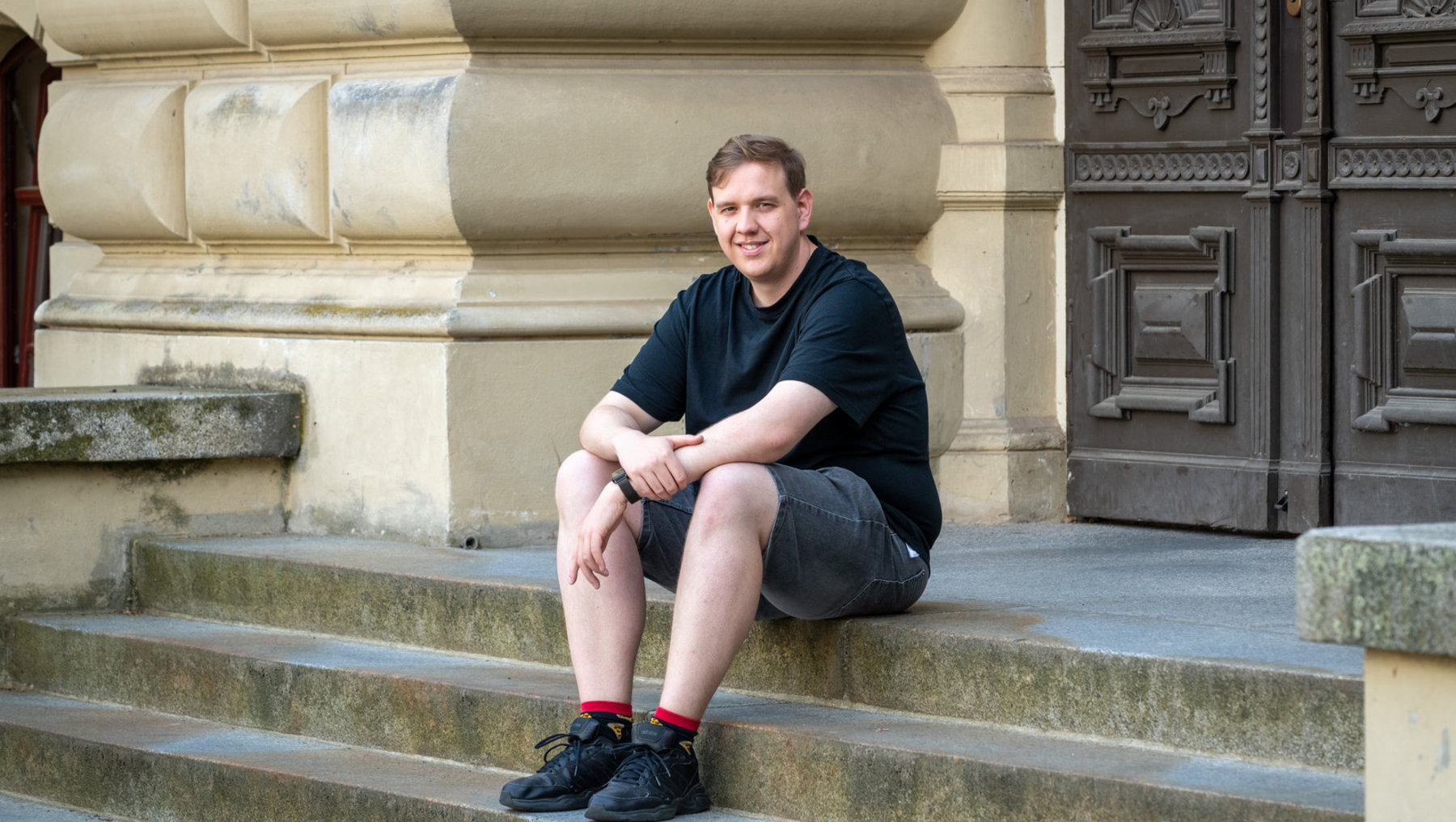 © Hochschule Anhalt - Uwe Jacobshagen
As a child, Tim Poturnak unscrewed his PC’s circuit boards and started tinkering with them. Just as he had done with the model train that his grandfather had given him just before he died. Not because someone made him do it – but because he simply wanted to understand what was happening in there. Tim wanted to understand how it works. As there was no one he could ask, he tried to figure it out himself.
This attitude has never left him
He grew up in Dessau where he also completed his A-levels. Reflecting back on his school days, he quotes the German proverb, "ein gutes Pferd springt nur so hoch wie es muss" – basically, “Work smarter, not harder.” Going to uni? Initially not an option for him. Instead, he completed a training as an electronics technician for devices and systems. And there he met an instructor who didn't explain much, and only helped once you had already tried things yourself. “Sink or swim,” that's how Tim describes this motto. He found it tough at the time. However, today he knows, that's exactly what motivated him.
During his training, it was the same strict instructor who advised him to seriously consider going to uni and pursuing a degree program. And Tim paid attention. He found a position as a dual-degree program student at an engineering service provider, a Deutsche Bahn subsidiary, and began studying at Anhalt University of Applied Sciences.
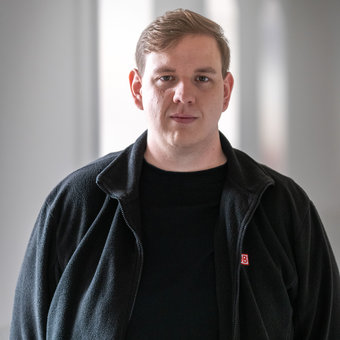
„Ambition pays off!“
Tim Poturnak
Studying in a dual degree program: How it works
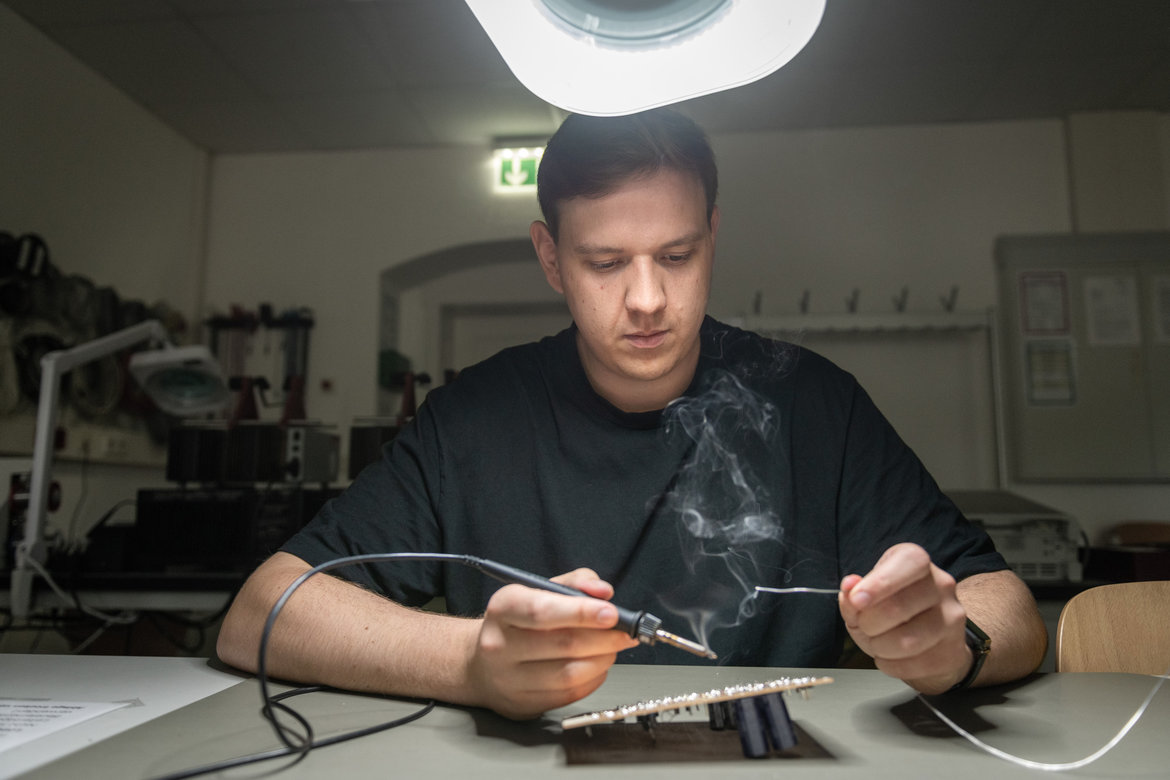 © Hochschule Anhalt - Uwe Jacobshagen
Studying at the university while also working, taking time off for exams, working as a tutor on the side – the dual degree program demands a lot. "You need a certain amount of stamina," says Tim. But it's also fun. As a tutor, he and a fellow student taught other students – and this helped him realize how much he himself learned in the process. What drives Tim is not duty, ticking off things that have to be done. It is genuine interest. Technology that he can touch and understand. It is engaging with a course that doesn't just leave him in a lecture hall waiting to graduate, but instead throws him into the midst of professional life – and also allows him to think outside the box.
He traveled to Turkey as part of the ERASMUS+ project "Designing and Constructing a Solar Updraft Chimney with 3D Printing". Students from Ankara, Zagreb, Rosenheim and Köthen met at TOBB University in Ankara to jointly build chimney prototypes that convert solar energy into electricity. 30 students, five teams, and one week together.
"Ambition pays off"
Before seeing each other face-to-face, they had exchanged ideas online on a weekly basis, but the time in Turkey was a real-life experience: Implementing designs, laying out electronics, testing prototypes. A special feature of the intercultural teams was their interdisciplinarity – architecture students from Ankara and Zagreb encountered engineering students from Germany. According to the task brief they were all given, the focus was on collaboration, not on functionality of the product. But in reality, it was different. While the architecture students enjoyed the creative process, the engineering students quickly turned the project into a functionality sprint. "Creativity came up against the need to control – and everyone lost a bit of sleep," smiles Tim.
Tim still has to complete his Bachelor’s degree – He has yet to write his thesis. But a new engineering position is already on the horizon. And afterwards? A Master's degree program. Tim has plans. "Ambition pays off," he says at the end of the interview. It’s easy to take his word for it.
Where would Anhalt University be without Tim Portunak?
With Tim Poturnak, Anhalt University has gained a student who shows how far you can get with curiosity and perseverance. His eye for what is feasible and his desire to really understand things shape every team in which he works.
Kontakt
Redaktion
Katja Wallrafen
How do dual study programs work?Anhalt University of Applied Sciences offers practice-integrated dual study programs for a wide range of bachelor's degrees, particularly in the STEM fields (Science, Technology, Engineering, and Mathematics).
How does it work?
Students first sign an employment contract with a company or institution. The employer then partners with Anhalt University of Applied Sciences to coordinate and deliver the practical phases of the degree program alongside the academic studies.
Here you can find an overview of the university's dual study programs.
