A three-day “Saxony-Anhalt Day” in Bernburg in early June. Ten creative workshops. Hundreds of conversations with people who aren’t scientists but still had lots of questions. Anhalt University of Applied Sciences was there. Four teams share their experiences.
What happens when research hits the streets?
-
 © hochschule anhalt | uwe jacobshagen
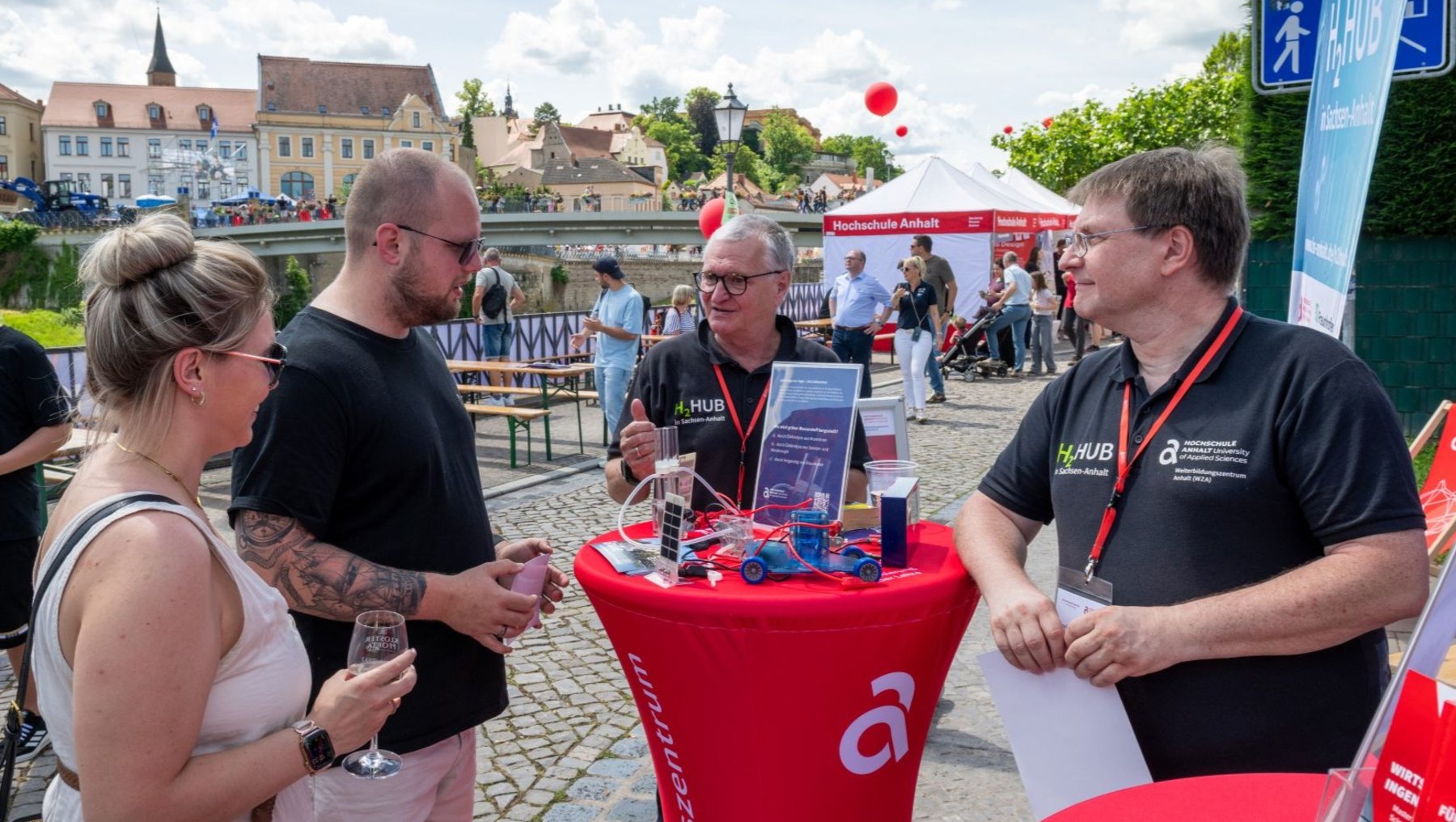
Wasserstoff erklärt: Viele Besucherinnen und Besucher des Sachsen-Anhalt-Tages nahmen sich Zeit für Wissenschaft.
"Why haven't we done this already?"
This was the question the H2HUB team heard most often.
The team from the continuing education program used a model to demonstrate how water is broken down into its components—oxygen and hydrogen—through electrolysis. Hydrogen can be stored and later converted back into electricity, as demonstrated by a fuel cell. The team also regularly launched a small hydrogen rocket.
Hydrogen is considered one of the key technologies for an energy supply that does not rely on fossil fuels. The audience at Saxony-Anhalt Day was also interested in this topic. “The discussions were almost universally open-minded; there is an understanding of this energy source,” says Mario Kabisch. This was especially true for examples from the private sector that he was able to share: two people from his network who have already converted their homes to use a hydrogen system. These are individual cases involving significant investments. But the point was something else: It’s possible if you’re willing to make it happen.
Does science communication work at festivals like Saxony-Anhalt Day? For the H2HUB team, Saxony-Anhalt Day was above all a place to build acceptance—with many open and positive conversations. And an opportunity to highlight the university’s continuing education programs on the hydrogen economy.
"Which ones help the insects the most?"
 © hochschule anhalt
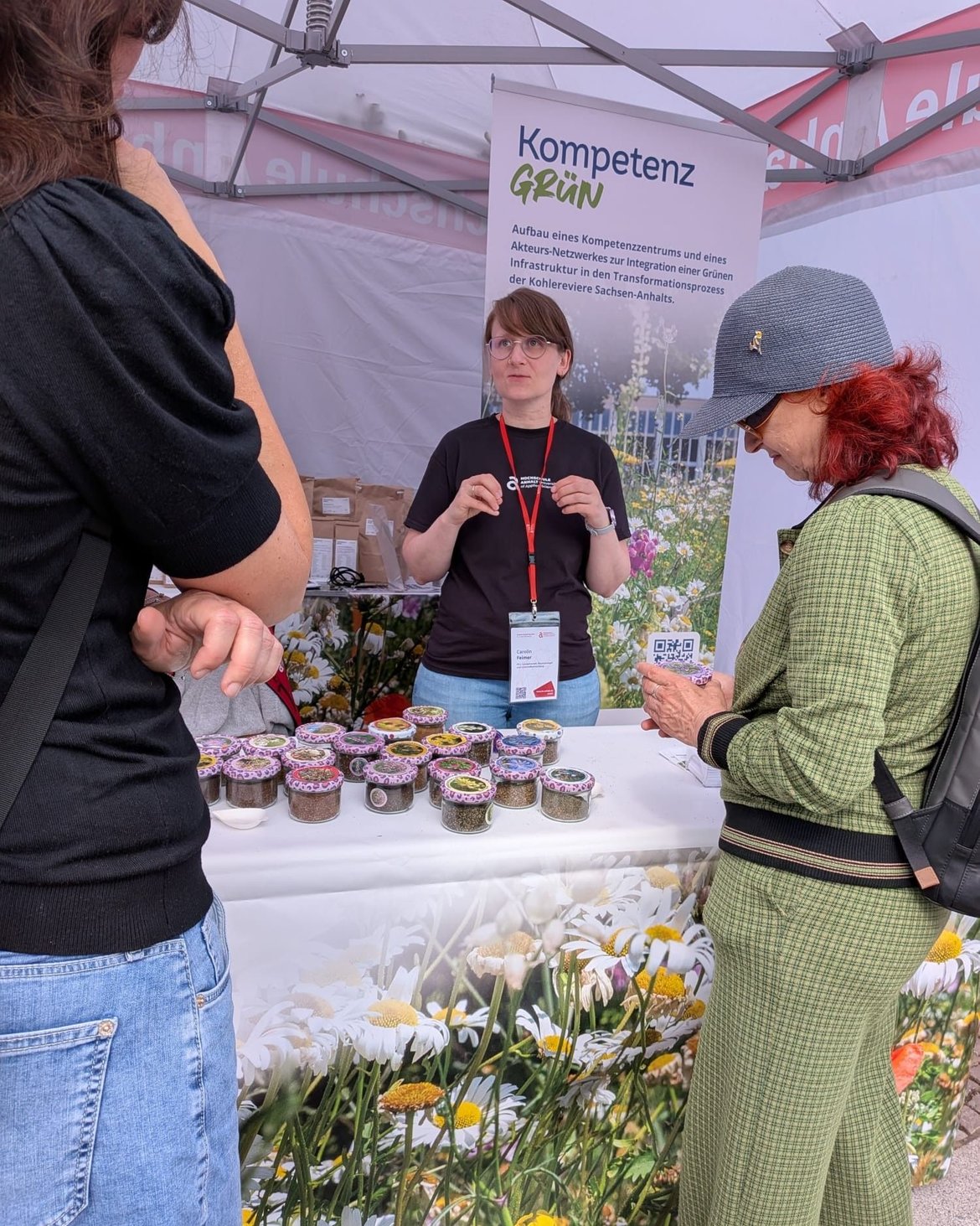
On Sunday—the last day of the state festival—the shelves at the KompetenzGrün project’s booth were almost empty. Many visitors took the opportunity to put together their own seed mix of regional wild plants. The hands-on activity was very good, especially by children. On Saturday alone, the team had 200 conversations. Nearly all the reregistrations on the evaluation forms were positive or even very positive. One child even wanted to know why they couldn’t give the consultation a “Very Good” rating, says Carolin Feimer.
The most common question: “Which ones help the insects the most?” It gets to the heart of what the project aims to convey. Even a small patch of wildflowers in the garden or on the balcony can make a measurable contribution to biodiversity—that is, to the diversity of animal and plant species in a region. Anyone who wanted to could even take home seeds for 50 to 100 square meters, along with instructions for planting and care. The results of this special project initiative are to be documented as comprehensively as possible. “We’d like to find out even more about the development of regional wild plants,” explains Feimer, “because we’ve observed that urban areas develop quite differently depending on site conditions.”
Her conclusion on whether science communication works at festivals like Saxony-Anhalt Day: “Absolutely.” People’s interest in natural spaces was palpable in many cases. So was their willingness to take action themselves.
"Is that a gym?"
 © hochschule anhalt | uwe jacobshagen
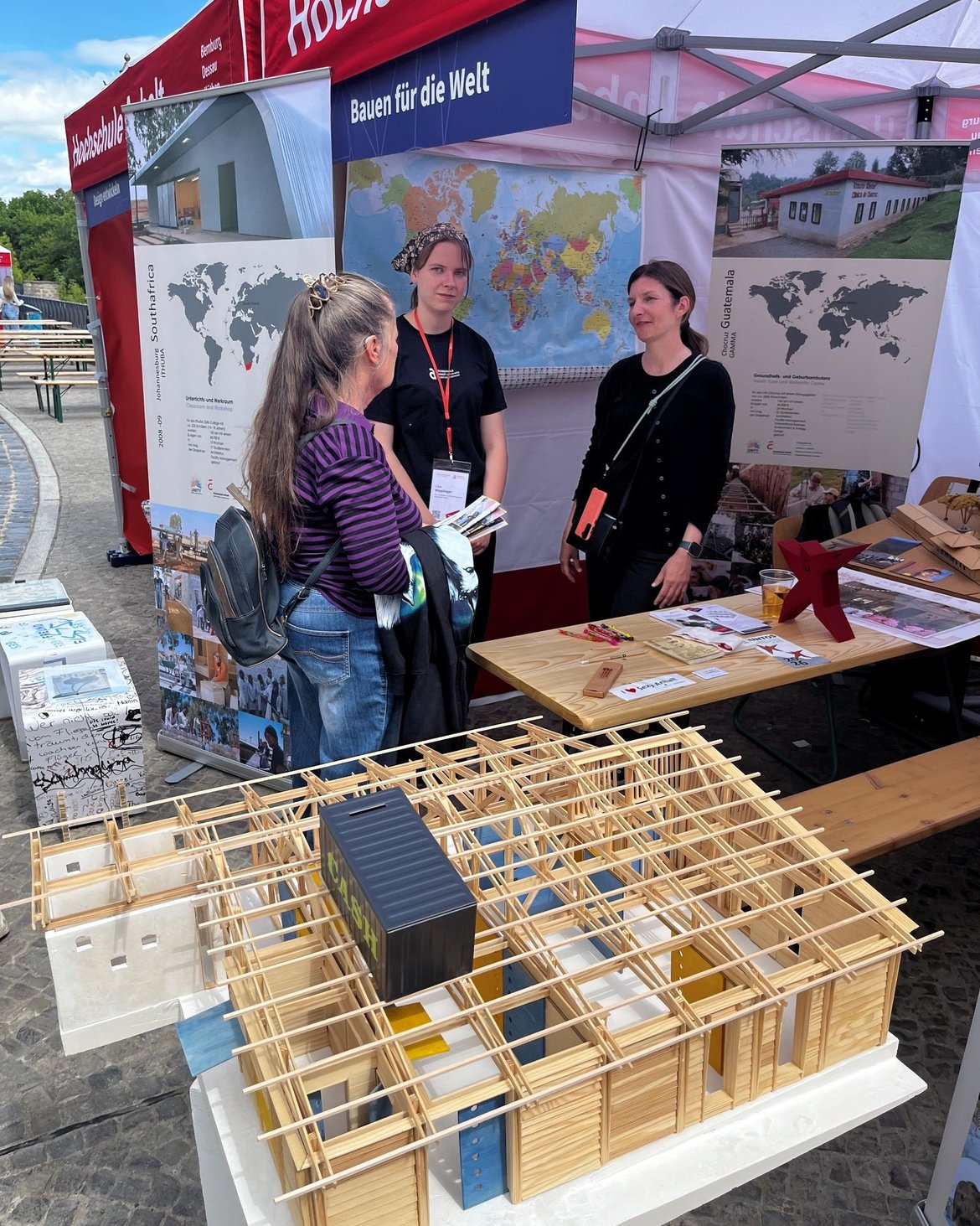
Many visitors asked this question at the “Bauen für die Welt” booth. What they saw on a display stand was a wooden model—the design concept for a preschool building on the island of São Tomé off the west coast of Africa.
Students from Anhalt University of Applied Sciences are planning and building this structure together with the local community and the Leipzig-based nonprofit Mirador e.V. They take on full responsibility: planning, construction management, financing, and securing grants. This approach is known as a “design-build project.” Students don’t just work at the drawing board; they build on-site—and have been doing so for 19 years. In this way, students at Anhalt University of Applied Sciences are involved in projects ranging from kindergartens in South Africa to health clinics in Haiti and school projects in Nepal.
At the booth, the wooden model did exactly what a good exhibit should do: it posed a question. And that question sparked numerous conversations that the team hadn’t initially anticipated. Visitors even made donations for future projects. “That’s the last thing we expected,” says Prof. Dr. Claus Dießenbacher, “but the audience was very receptive, and our projects and stories clearly touched many people,” he concludes positively when asked whether science communication also works at state festivals.
"And where can I buy the perennials?"
 © hochschule anhalt | uwe jacobshagen
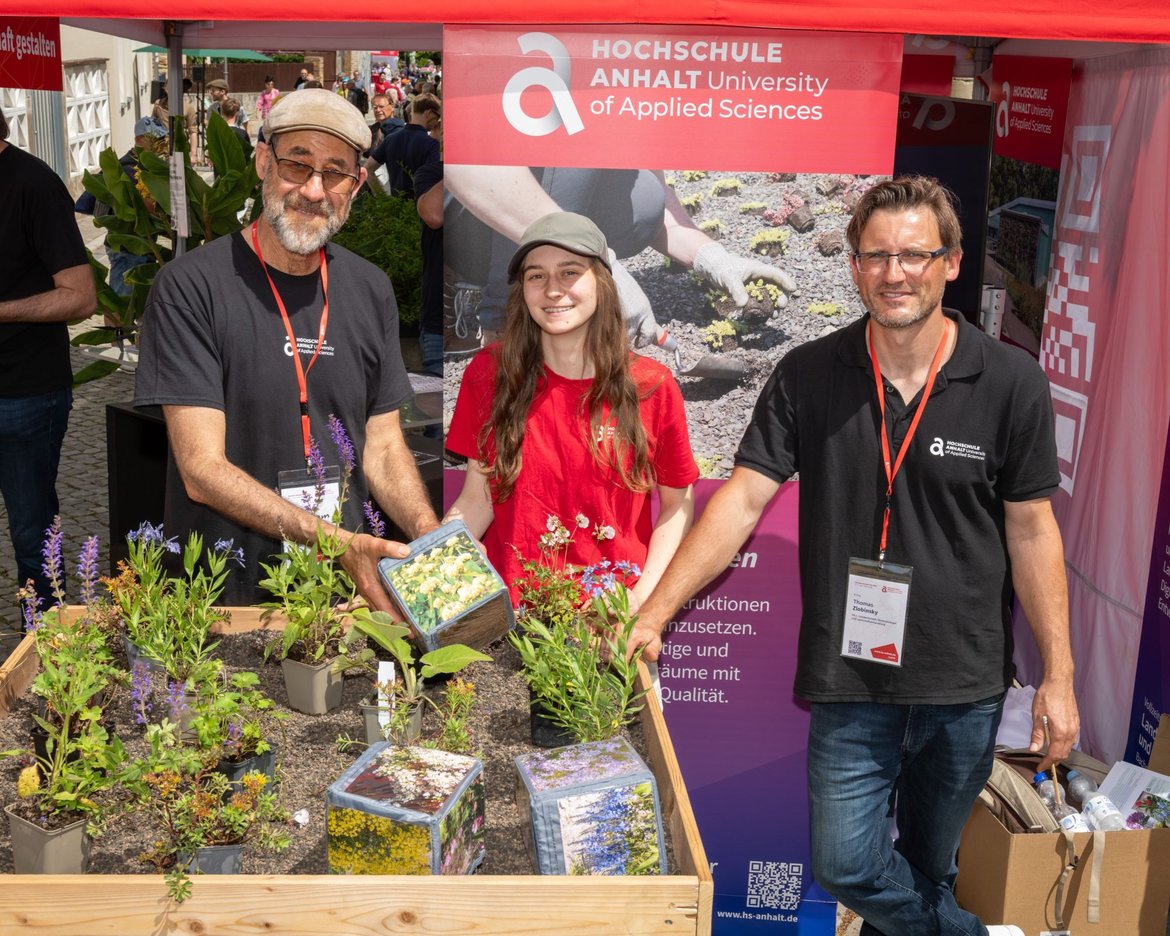
The sides of this die don’t show numbers—they show plants. When you roll the die, you get a main plant for your perennial bed. Prof. Dr. Wolfram Kircher’s team then uses lists to select suitable companion plants. Finally, an app shows what the bed will look like in a year. The whole process takes about ten minutes. The most common reaction afterward is, “So where can I buy these perennials?”
The “Shaping Cities and Landscapes” team had prepared four main topics: a drawing workshop, a planting plan using an interactive game, a visualization using augmented reality—a technology that superimposes digital content onto the real-world view—and a section on remote sensing with drones in landscape planning.
The garden discussions were particularly popular. Visitors sought solutions to specific problems: What should be done with flower beds next to walls? What grows in dry soil? The team hadn’t anticipated so many technical questions. The app was perceived as a serious planning tool and a helpful digital resource. Conclusion: Science communication is good when it offers practical benefits.
What Three Days of a State Festival on Science Communication Teach Us
All four teams reached the same conclusion: science communication was effective at Saxony-Anhalt Day. The topics addressed people’s concerns right where they are—in their gardens, regarding energy management, and in terms of what education might look like in structurally disadvantaged regions.
Three observations can be summarized as recommendations:
Participation beats watching. Mixing your own seeds, rolling dice, drawing, putting on VR goggles—when you do something, you start a conversation.
The right object prompts the right question. The wooden model, the plant cube, and the electrolysis demonstration all sparked questions that the team was then able to answer. The object serves as the icebreaker. This was good at the “Science in Dialogue” booth. The German Rectors’ Conference presented its “Science—and Me?!” format in Bernburg. Each day featured a different thematic focus: ranging from algae-and-goat’s-milk ice cream to 3D metal models to the “MeineWaldKI” app.
Acceptance is fostered through conversation. Brochures can be taken home or left behind. For understanding research, personal conversation remains an important tool—even at festivals like Saxony-Anhalt Day, where science isn’t the main focus.
Anhalt University of Applied Sciences was represented at the 2026 Saxony-Anhalt Day in Bernburg with ten creative workshops. Learn more: Home | Anhalt University of Applied Sciences
Redaktion
Claudia Aldinger
