A machine comes to a standstill because a single component is missing and is no longer being manufactured. What then? Sebastian Gersch, a doctoral student at Anhalt University of Applied Sciences, is developing processes with which such parts can be digitally reconstructed and remanufactured. In this interview, he explains why this is not just a technical argument, but also an ecological one.
When the spare part is no longer available: How 3D printing gives machines a second life
-
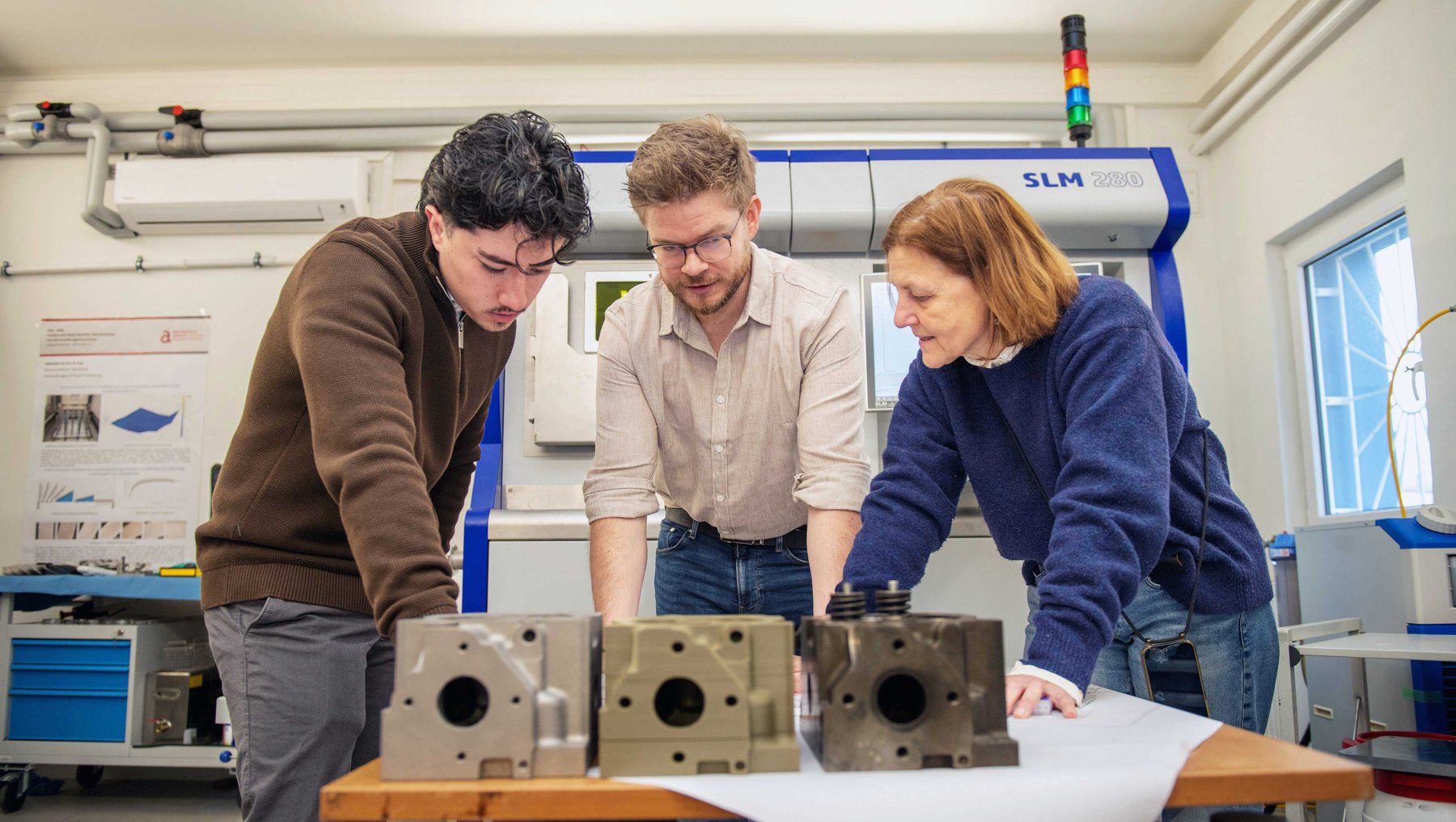 © hochschule anhalt | Uwe Jacobshagen
Die Doktoranden Sebastian Gersch (Mitte), Juan Sebastian Molano Cortes (links) und Simone Keim von den Fachmessen der Hochschule Anhalt besprechen Exponate zur Hannover Messe 2026.
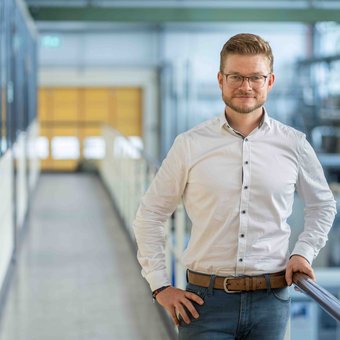
In order for new processes to become more widely accepted, not only must materials and process parameters be further developed, but the downstream process chains must also become more robust and efficient.
Sebastian Gersch
Mr. Gersch, what is mechanical obsolescence and why is it a problem for the climate?
If a manufacturer discontinues a certain component, this can mean that an otherwise fully functional machine can no longer be operated. Technically, therefore, the problem does not lie in the overall system, but in the lack of availability of a single mechanical element. The result is often that machines are shut down or replaced prematurely. This is problematic from an ecological point of view, as it again involves considerable material and energy costs for the manufacture, transportation and commissioning of a new system - even though the existing machine could often be used for years with a suitable replacement part.
How does metallic 3D printing help to solve this problem?
With metallic 3D printing, especially in the PBF-LB process (the laser powder bed fusion/laser beam melting process widely used in industry), components that are no longer available can be digitally reconstructed and manufactured again as required. This is particularly relevant when traditional manufacturing processes reach their economic or logistical limits, for example in the case of small quantities or a lack of tools. An additional advantage is that we can not only reproduce existing geometries, but also use the geometric degrees of freedom of additive manufacturing for design purposes, for example through functionally integrated structures such as additional cooling channels. This means that a spare part can not only be reproduced, but ideally also functionally enhanced.
That sounds like a simple solution. What is the real challenge?
The real challenge is not to reduce additive manufacturing to pure geometry replication. The PBF-LB process is not just about producing a component with the same shape, but also about mastering the process and material side in such a way that the required properties are achieved in the end. On the one hand, this concerns the reverse engineering of existing components, but also the targeted use of additive design freedom, for example for more efficient designs or functionally integrated structures. At the same time, material development plays a central role - in our case, in particular the development of heat-resistant aluminum alloys for the PBF-LB process. Only the interplay of design, material and process control results in a component that is not only manufacturable but also resilient in real-life use.
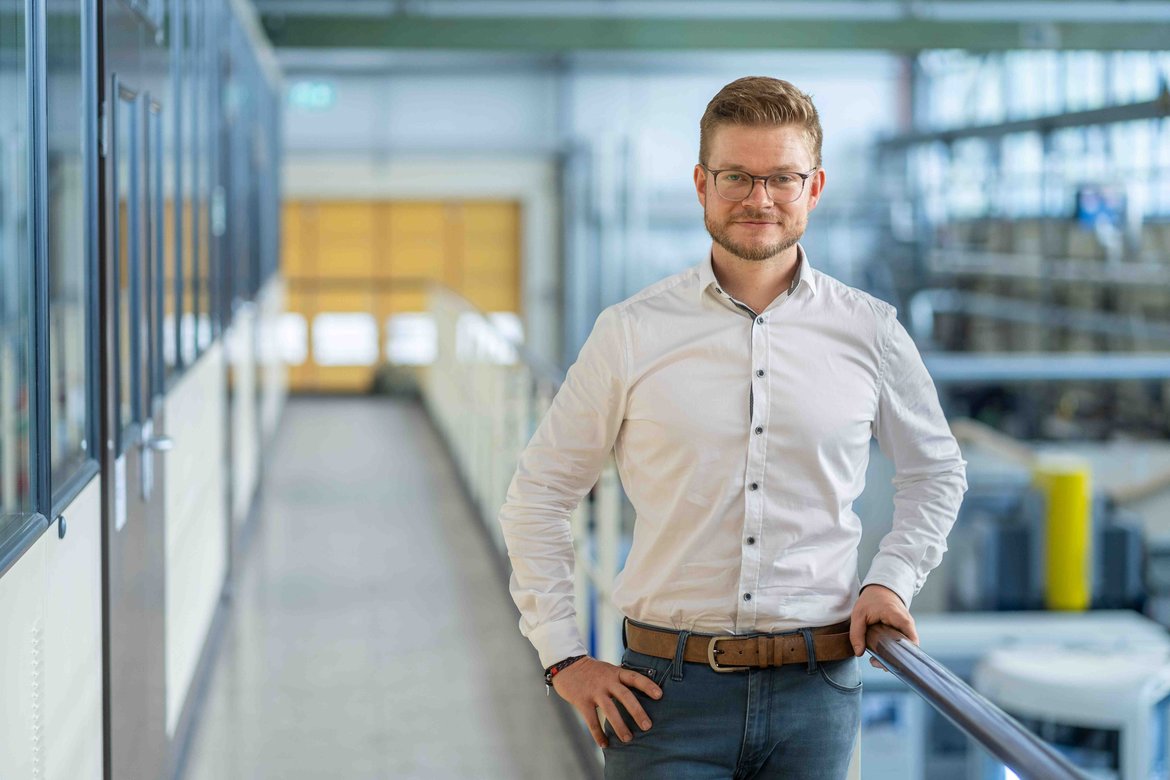 © hochschule anhalt
In your project, you are also working on components for hydrogen engines. What does this have to do with the circular economy?
In our project, we are developing heat-resistant aluminum alloy powders and mixed systems of pure and alloy powders to improve the heat resistance and hydrogen resistance of additively manufactured components. On this basis, we are investigating the production of hydrogen-carrying components, for example cylinder heads for hydrogen combustion engines, following corresponding parameter studies. The link to the circular economy lies in the fact that additive manufacturing is not only interesting for the development of new parts, but also for targeted obsolescence management. If existing engine concepts - for example by converting diesel engines to hydrogen combustion - can continue to be used instead of replacing entire systems, this is also relevant from a resource perspective. Additive manufacturing can help to provide the necessary components flexibly and close to the application.
What does it take for these procedures to become established in practice?
Economics remains a key issue. Although the PBF-LB process offers advantages such as high material utilization and great design flexibility, its industrial implementation is still associated with workload. This applies in particular to powder handling under safety requirements and the often demanding post-processing steps. However, this is precisely where component quality and costs are often decisive. In order for such processes to become more widely accepted, not only must materials and process parameters be further developed, but the downstream process chains must also become more robust, efficient and economical. Technological advances are already showing that these hurdles are increasingly being reduced, but they are currently still a significant limiting factor.
Sebastian Gersch is a researcher at the Doctoral Center Engineering Sciences and Information Technologies at Anhalt University of Applied Sciences. The specific title of his doctoral thesis: "Investigation of the real potential of superposition effects from residual compressive stresses and resulting tensile stresses to optimize the fatigue strength of LPBF-manufactured single tooth geometries"
The project behind his doctoral thesis: "3DAlu: Development of heat-resistant aluminum alloy for 3D-printed components for hydrogen engines". This is associated with funding from the European Union and the state of Saxony-Anhalt as part of the ERDF program.
Find out more on the project page and our LinkedIn focus page Forschung.Transfer.Messen:
https://www.linkedin.com/feed/update/urn:li:activity:7302608496347209728
Redaktion
Claudia Aldinger
Sebastian Gersch... is available for inquiries and requests by phone: +49 (0) 3496 672359 or by e-mail: sebastian.gersch(at)hs-anhalt.de
Current publication: Influence of the Process-Related Surface Structure of L-PBF Manufactured Components on Residual Stress Measurement Using the Incremental Hole Drilling Method / Sebastian Gersch, Ulf Noster, Carsten Schulz, Jörg Bagdahn. Included in: Applied Sciences. Vol. 15 (2025), 18, pp. 1-17. https://doi.org/10.3390/app15189861
Hannover Messe
"CAx + metal 3D printing: spare parts on demand" - this is the title under which Sebastian Gersch will also be presenting his research results at this year's Hannover Messe: from April 20 to 24 at the joint stand RESEARCH FOR THE FUTURE in Hall 11/ Stand B42: https://www.hs-anhalt.de/hochschule-anhalt/aktuelles/fachmessen/hannover-messe.html
