For over 20 years, faculty and researchers at Anhalt University of Applied Sciences have been using bioreactors to produce proteins, enzymes, and valuable materials from waste and byproducts. The results are relevant to food security and the circular economy.
How does a bioreactor work? Students at Anhalt University of Applied Sciences are developing their own model for 99 euros
-
 © hochschule anhalt | uwe jacobshagen
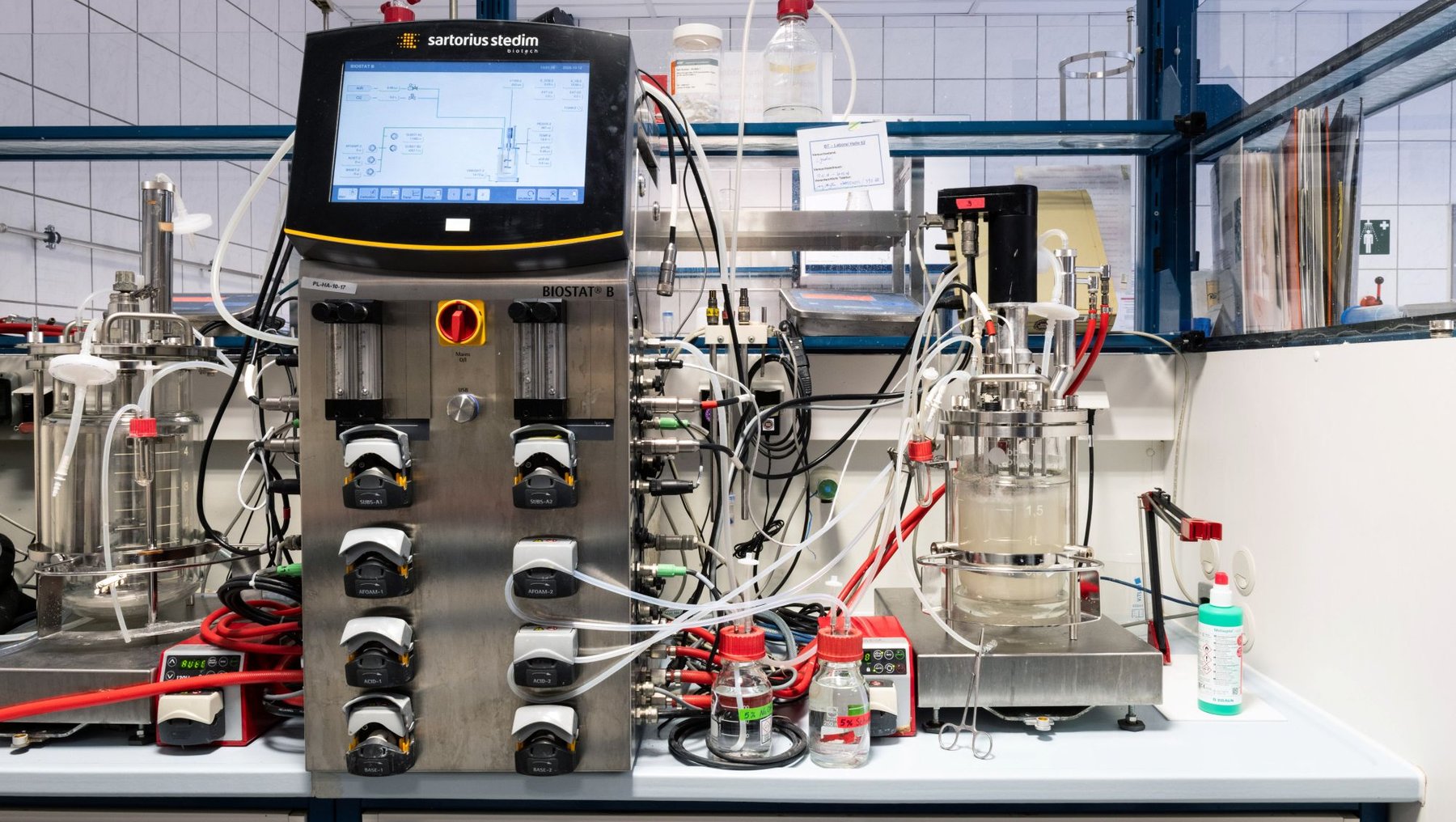
Der Bereich Biotechnologie in Forschungshalle 62: Bioreaktoren bestimmen das Bild.
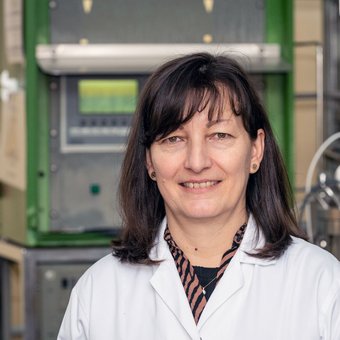
Research Hall 62 at Anhalt University of Applied Sciences welcomes visitors with a friendly hum. Amid tables with shaking flasks and equipment as tall as a person or as high as the hall itself, people quietly go about their work while the bioreactors are in full swing: liquid and solid waste materials are converted into valuable products—such as vegan chitosan, rose fragrance, or protein-rich meat substitutes—with the help of various microorganisms, while rapeseed concentrate is refined for food applications. Three classic stainless-steel bioreactors, as well as a variety of laboratory reactors, are located here and are used for teaching and research. “I, too, studied here and gained my first experience with bioreactors,” says Dorit Beck, who has been a research assistant at Anhalt University of Applied Sciences for more than 20 years. She is currently working in the Biotechnology and Bioprocess Engineering research groups led by Prof. Dr. Jana Rödig and Prof. Dr. Claudia Grewe, which are part of the Department of Applied Biosciences and Process Engineering at Anhalt University of Applied Sciences in Köthen.
Bioreactors offer the great advantage of allowing the production of a wide variety of valuable products under mild conditions near ambient temperature and without the use of harsh chemicals.
Dorit Beck
99 euros, 24 hours, one strain of yeast: The 99-Euro Bioreactor Competition in Dresden
This year, Dorit Beck mentored a team of students in the 99-Euro Bioreactor Competition, which has been held annually at the Technical University of Dresden since 2014. The challenge: Teams of students must build a functional bioreactor on a budget of 99 euros. In 2026, the reactor was supposed to produce single-cell protein (SCP). This refers to the biomass of microorganisms—that is, the totality of their organic matter—which grows in a bioreactor and can be used as a protein source for animal feed or food. The yeast Cyberlindnera jadinii was specified as the organism, and ethanol was designated as the sole carbon and energy source. In the European Union, this yeast is considered safe for use in animal feed and food, making it attractive for industrial applications. The teams had 24 hours to produce as much biomass as possible. The bioreactor at Anhalt University of Applied Sciences was designed and built by Maximilian Perten, a bachelor’s student, and Paul Eger, a master’s student, both in the Biotechnology degree program. “They met rather by chance during a lab and were both enthusiastic about technology,” explains Dorit Beck, who ultimately managed to convince her interns to participate in the competition.
What is a bioreactor?
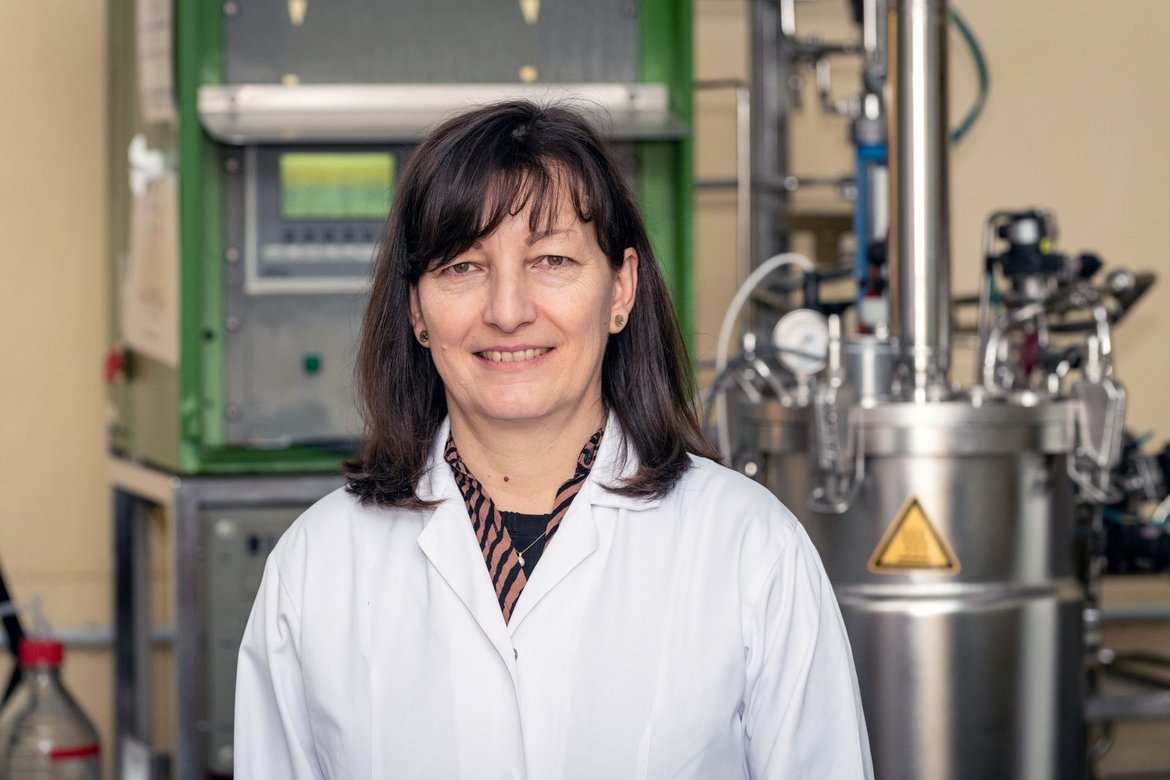
A bioreactor is a closed vessel in which microorganisms or cells grow under controlled conditions. Temperature, pH, oxygen supply, and nutrient supply can be precisely controlled to maximize yields. Biological processes react to even the slightest changes in environmental conditions. The team from Anhalt University of Applied Sciences in Dresden experienced this firsthand.
Although their concept worked in Research Hall 62 in Köthen, it did not work in the laboratory at the competition venue, the Competition Hall in Dresden. “Here, the CO₂ content in the air was apparently so greatly increased by the large number of people present that the control process we developed—which was supposed to regulate the addition of ethanol, the substrate, based on the decrease in CO₂ concentration in the exhaust air—did not work. As a result, the yeast grew only at the beginning of the 24-hour competition and ultimately failed to produce the expected amount of biomass,” explains Dorit Beck, who views this experience as a learning opportunity.
However, the team plans to continue the experiment. They will rebuild the reactor at the university and test it under competition conditions, but using fresh ambient air. They have already overcome one technical hurdle: The probes for temperature and pH did not survive the partially acidic medium unscathed and corroded. As a result, all components had to be reordered.
 © hochschule anhalt | uwe jacobshagen
Food, Chemical Products, Circular Economy
“In recent years, it has become easier to build the bioreactors for 99 euros,” says Dorit Beck. 3D printing, in particular, makes it easier to source specialized parts at low prices. Maximilian Perten even used his own 3D printer to produce the desired components—such as stirrers—with optimized dimensions and geometries overnight. In other projects, students have also collaborated interdisciplinarily with the Department of Electrical, Mechanical and Industrial Engineering, as this department offers a wide variety of specialized 3D printers, expertise, and interested colleagues who are happy to provide interdisciplinary assistance and cooperation.
Bioreactors, as used in industry, are typically assembled today from prefabricated, corrosion-resistant stainless steel components. A simple bioreactor can already be found in municipal wastewater treatment plants, where microorganisms break down organic matter in wastewater. The food industry and the bioeconomy use industrial bioreactors in which yeasts grow or microorganisms produce enzymes, organic acids, and a wide variety of active ingredients. In this context, one principle is increasingly coming to the fore: using by-products and waste streams from industry as substrates for microorganisms. “Bioreactors have the great advantage that they allow us to produce a wide variety of valuable products under mild conditions close to ambient temperature and without aggressive chemicals,” explains Dorit Beck.
For her master’s thesis—at the time while still at Anhalt University of Applied Sciences in cooperation with Otto von Guericke University Magdeburg—she investigated whether landfill leachate from the Bitterfeld chemical industry region could be treated biotechnologically. “It is also this diverse and effective use of microorganisms that makes bioreactors so interesting,” she says of her field of expertise.
Bioreactors in College: Lab Courses at Anhalt University of Applied Sciences
Practical training is an integral part of the curriculum at Anhalt University of Applied Sciences. Dorit Beck supervises student labs in two semesters: Bioprocess Engineering in the fifth semester and Applied Biotechnology in the sixth. In addition, there is a so-called demonstration internship as part of the Bioreactor Engineering course, during which students see the components of a large pilot-scale bioreactor for the first time. Students should be able to understand and apply the principles of bioreactors of various sizes. This includes: identifying the individual components for hands-on operation, preparing the culture medium, autoclaving (i.e., sterilization under pressure and heat), inoculating the culture, and controlling the ongoing process through to harvest. Dorit Beck: “What the students learn in lectures and model and calculate in seminars, they apply here in our lab.”
 © hohschule anhalt | uwe jacobshagen
Rapido and MOOSstart: Bioreactors in Research
And in Research Hall 62, students get to see firsthand what new solutions are being developed. One of Prof. Dr. Jana Rödig’s current research projects is “Rapido,” in which rapeseed kernel concentrate—a byproduct of rapeseed production—is refined through microbial solid-state fermentation. The goal is to develop a new, alternative protein source for food applications. To this end, the research group uses microorganisms to remove unwanted components from the concentrate and enrich valuable components, such as proteins, in the university’s bioreactors. The project is funded by the Federal Ministry of Research, Technology, and Space.
The fact that bioreactors sometimes have to be developed from scratch was demonstrated in Prof. Dr. Claudia Grewe’s MOOSstart project. Funded by the Federal Ministry of Agriculture, Food, and Home Affairs, the project involved an unusual task: cultivating sphagnum moss on a reactor scale to establish paludiculture on rewetted peatlands. This is because only wet peatlands sequester carbon. Until then, there was no established method for cultivating moss in a reactor. One was developed at Anhalt University of Applied Sciences and even received the Hugo Junkers Prize for Research and Innovation from Saxony-Anhalt in 2026.
More articles on the topic of sustainable materials derived from biological sources and waste materials on the KlimaBlog:
Sustainable Materials: How Is Fungal Mycelium Turned Into a Sturdy Box?
Materiability Research Group: Research Takes Shape
What Are Chaff and Knotweed Doing in the Mechanical Engineering Lab?
Paludiculture Building Materials: How the Idea for a New Value Chain Came About
Many thanks to Dorit Beck for the insight into Research Hall 62 and the topic of bioreactors at Anhalt University of Applied Sciences.
