 © Hochschule Anhalt
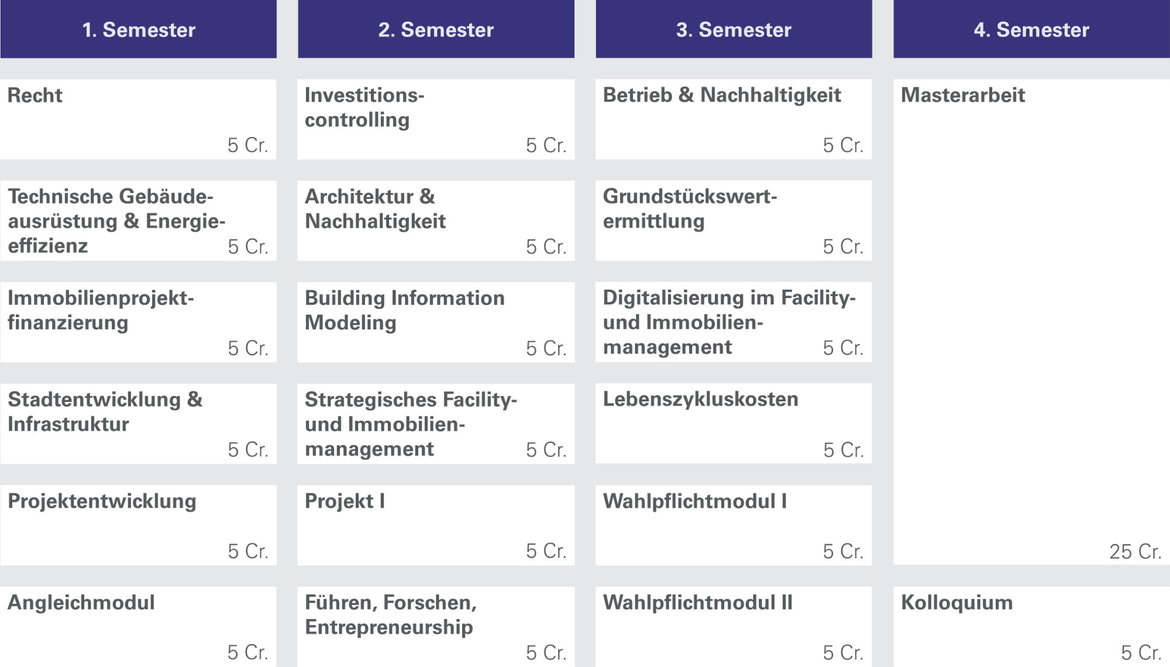
Program sequence (SPO 2018)
The master's degree program in Facility and Real Estate Management lasts four semesters and comprises 120 credits. The program is module-based and includes compulsory modules, elective modules and bridging modules. The first semester includes compulsory and bridging modules. The bridging modules are based on the undergraduate program. Compulsory and elective modules are offered in the second and third semesters. Two elective modules must be completed. The fourth semester includes the preparation of the master's thesis and the colloquium for the master's thesis.
The FM degree programs at Anhalt University of Applied Sciences are characterized by the combination of Architecture, Real Estate Management and Life Cycle Management. Anhalt University of Applied Sciences offers the bachelor's degree program Facility Management and the consecutive master's degree program Facility and Real Estate Management, as well as the certificate program Facility Management as part-time continuing education.
Image brochure of the study area Facility Management
Facility and Real Estate Management graduates are offered a very wide range of tasks in a very large market. The demand for graduates is very high in small and medium-sized companies and corporations as well as in the public sector.
Facility and real estate managers are employed in middle management in leading positions. They can work in all sectors: Automotive industry, Mechanical Engineering, chemical industry, banks, airports, hotel industry, hospitals, educational institutions and leisure facilities such as soccer arenas and adventure pools. Facility and real estate managers can also be employed by real estate companies such as project developers, investment companies, real estate financiers, real estate service providers and facility service companies.
Completion of the master's degree program also qualifies students to take up a doctorate in Facility and Real Estate Management.
The current examination and (degree) program regulations of Anhalt University of Applied Sciences form the basis for your studies.
Examination and (degree) program regulations 2018
(for enrolments from winter semester 2018/19)
Examination and (degree) program regulations 2012
Admission requirements for the Facility and Real Estate Management master's degree program are a qualified university degree in Facility Management, Real Estate Management or comparable degree programs with a normal program length of at least three years.
With regard to the interdisciplinary nature of Facility and Real Estate Management, comparable degree programs include Architecture, Urban and Regional Planning and Business Studies, if it can be proven that equivalent modules have been taken in the Facility and / or Real Estate Management curriculum. The degree program committee decides on recognition as a comparable degree program.
Modules in the 1st semester
Instructor:
Prof. Jens Nävy
ECTS credit points:
5
Semester hours per week:
4
Types of instruction:
Lectures, practical courses, individual and group presentations, time spent independently studying
Learning outcomes:
After completing the module, students will be able to:
. explain facility management (FM) and recognize and characterize the different directions of interpretation and participants
. apply the FM model according to DIN EN 15221 and identify the FM and FS service levels
. identify and calculate the areas inside and outside a building
. derive a space requirement program from the user processes
. analyze the facility service market and know the service companies involved
. identify the user needs and create a service level agreement.
Contents:
1: Facility Management
. Basics of facility management
. Terms and classifications
. Real estate life cycle management
2: Space management
. Fundamentals of space management
. Normative framework/ definition of space
. Life cycle orientation in space management
. Functional areas in space management
. Transparency in space management
. Key figures in space management
3: Service management
. Fundamentals of service management
. FM service companies
. Process management
. FM processes
. Service Level Agreement
. Procurement management
. FM services/ types of contract
. Selected aspects of service management
Coursework:
. Participation in lectures, practical courses, group and individual work
. Assessed work (written exam)
Workload:
5 credits result in a workload of 150 hours per semester, which are divided as follows:
. Classes 15 weeks with 4 SWS ~ 45 hours per semester
. Time spent independently studying including preparation and follow-up ~ 30 hours per semester
. Student research project (working on case studies and practical courses) ~ 50 hours per semester
. Exam preparation ~ 23.5 hours per semester
. Examination (K) ~ 1.5 hours per semester
Note:
Graduates of a Real Estate degree program must complete the Service and Space Management module (A1). Students with a degree in Facility Management must take the module Companies and Markets (A2). If the undergraduate degree was completed in the fields of Architecture and Urban and Regional Planning, students are assigned to the alignment module according to the content of the study committee.
Instructor:
Peter Stolze PhD, MBA (USA)
ECTS learning objectives:
5
Semester hours:
4
Types of instruction:
Lectures, practical courses, time spent independently studying
Learning outcomes:
After successful completion of the module, students will be able to:
. Analyze markets
. to evaluate companies
. Name forms of behavior of market participants
. analyze potentials
Contents:
. economic and Business Studies approach
. Market forms
. Specifics in the real estate sector/facility management
. Company analysis (according to Schlegelmilch)
. From mission to strategy
. Specifics of SMEs
. Specifics of tangible goods and services
. Success concepts for marketing (Closeness To Purchase Scale, ROI)
. Aspects of corporate management
. Brand management
. Management styles in the company
Coursework:
. Participation in lectures and practical courses
. Assessed work (K)
Workload:
5 credits result in a workload of 150 hours per semester, which are divided as follows:
. Classes 15 weeks with 4 SWS ~ 45 hours per semester
. Time spent independently studying, including preparation and follow-up work ~ 95 hours per semester
. Exam preparation ~ 8.5 hours per semester
. Examination (K) ~ 1.5 hours per semester
Note:
Graduates of a Real Estate degree program must complete the Service and Space Management module (A1). Students with a degree in Facility Management must take the module Companies and Markets (A2). If the undergraduate degree was completed in the fields of Architecture and Urban and Regional Planning, students are assigned to the alignment module according to the content of the study committee.
Instructor:
Hon.-Prof. Dr. Steffen Gratz
ECTS learning objectives:
5
Semesterwochenstunden:
3
Types of instruction:
Lectures, practical courses, time spent independently studying
Learning outcomes:
Facility and Real Estate Management encompasses the administration and management of buildings, facilities and equipment and covers the entire life cycle of a property from planning to implementation, the use phase through to refurbishment or demolition in order to optimize all cost-relevant processes. The expanding sector has developed into a separate management area with specific legal issues - particularly in the areas of contract and liability management, construction law, architectural/engineering law and commercial tenancy law, etc. - without knowledge of which the task of a property manager would be impossible. - Without this knowledge, the task of a facility manager can no longer be accomplished.
Upon successful completion of this module, students will have deepened their basic knowledge of Facility and Real Estate Management acquired in bachelor's degree programs. As a result, they will be able to:
. recognize and deal with the specific legal issues of facility management in practice
. consciously weigh up the legal advantages and disadvantages when drafting and implementing contracts and take them into account in practice
. limit or avoid liability risks
. communicate with public building authorities, architects, engineers, construction companies, commercial tenants, etc. in a legally compliant manner.
Contents:
. FM contract and liability management
. Public building law
. Architects' and engineers' law
. Private construction law according to BGB and VOB/B
. Commercial tenancy law
Coursework:
. Participation in the lectures and practical courses
. Assessed work (written exam of 90 minutes)
Workload:
5 credits result in a workload of 150 hours per semester, which are divided as follows:
. Classes 15 weeks with 3 SWS each ~ 33.75 hours per semester
. Time spent independently studying, including preparation and follow-up work ~ 84 hours per semester
. Exam preparation ~ 30.75 hours per semester
. Examinations (K) ~ 1.5 hours per semester
Instructor:
Prof. Clemens Westermann
ECTS learning objectives:
5
Semester hours per week:
3
Types of instruction:
Lectures, practical courses, time spent independently studying
Learning outcomes:
Participants in the degree program are able to evaluate properties (e.g. real estate) from the perspective of facility management in terms of energy efficiency. They will have the knowledge to influence the level of building services operating costs and thus the management costs in both the planning and operating phases of properties.
Contents:
. Fundamentals of energy-saving and energy-efficient construction
. Conceptual understanding of the interaction between the building envelope and building technology
. Contents of European and national legal regulations on building energy efficiency
. Contents and basics of the Energy Saving Ordinance
. Basic information on energy parameters and the energy process chain (useful, final and primary energy)
. Basics regarding the application of measurement, control and regulation technology to optimize the use of building energy consumption
. Calculation and credits for the energy efficiency of buildings using energy certificates based on consumption
. Knowledge transfer with regard to the economic credits for the energy performance of buildings
Coursework:
. Participation in the lectures and practical courses
. Examination result (presentation and colloquium)
Workload:
5 credits result in a workload of 150 hours per semester, which are divided as follows:
. Classes 15 weeks with 3 SWS ~ 33.75 hours per semester
. Time spent independently studying, including preparation and follow-up work ~ 50.75 hours
. Student research project ~ 65 hours per semester
. Examination (PC) ~ 0.5 hours per semester
Instructor:
Prof. Dr. Heribert Pauk
ECTS learning objectives:
5
Semester hours per week:
3
Types of instruction:
Lectures, case studies, group work, time spent independently studying
Learning outcomes:
Successful graduates of the module:
. understand the financing structure of infrastructure and real estate
. have a basic understanding of the financiers' perspective
. are familiar with modern instruments such as covenants
. independently analyze project-related financing.
Participants acquire the skills to represent their employer in financing discussions and to plan project financing independently. The skills taught are aimed at starting a career with large companies and management consultancies.
Contents:
A project is a self-supporting, separable economic unit. Project financing is essentially based on the cash flow generated by the project. In principle, project financing refers to all types of projects, from ships and power plants to research projects. The module defines real estate project financing broadly, from standard real estate such as office buildings to special real estate such as daycare centers, hotels and infrastructure properties.
. Project financing at a glance
. Public Private Partnership
. Structured financing
Coursework:
. Participation in the lectures and case studies
. Assessed work (120-minute written exam)
Workload:
5 credits result in a workload of 150 hours per semester, which are divided as follows:
. Classes 15 weeks with 3 SWS ~ 33.75 hours per semester
. Time spent independently studying including preparation and follow-up ~ 21.25 hours per semester
. Student research project (processing case studies and handout) ~ 75 hours per semester
. Exam preparation ~ 18 hours per week per semester
. Examination (K120) ~ 2 hours per semester
Instructor:
Prof.in Vesta Nele Zareh
ECTS learning objectives:
5
Semester hours per week:
3
Types of instruction:
Lectures, practical courses, time spent independently studying
Learning outcomes:
. After successfully completing the module, students are familiar with the basic processes, methods, framework conditions and challenges of contemporary urban development and their relationship to real estate development and real estate management.
. Students are able to identify different levels of action in urban development, from individual buildings to building ensembles, neighborhoods and districts to cities and urban regions.
. They are familiar with tools and methods for taking stock, researching data and analyzing project-related areas of the city.
. You can create an inventory and analysis based on predefined parameters.
. They are able to define parameters and framework conditions for project-related development concepts. Students can create basic concepts for Architecture and urban development projects.
Contents:
Using interactive lectures, students are introduced to the basic processes, methods, framework conditions and challenges of contemporary urban development and their relationship to real estate development and real estate management. Using practical courses, students learn basic tools and methods for taking stock, researching data and analyzing project-related sub-areas. Practical courses on analyzing project-related parameters at different scales deepen the understanding of inter-scale and interdisciplinary relationships from the building to the urban region. Using a case study, students create concepts for Architecture and/or urban development projects. Accompanying practical courses on analytical reading and writing of texts on Architecture and urban development enable students to think critically and spend time spent independently studying.
Coursework:
. Participation in classes (lectures, practical courses in individual and block sessions)
. Assessed work (presentation and colloquium)
Workload:
5 credits result in a workload of 150 hours per semester, which are divided as follows:
. Classes 15 weeks with 3 SWS each ~ 33.75 hours per semester
. Time spent independently studying including preparation and follow-up work ~ 86.25 hours
. Student research project ~ 15 hours per semester (to present results)
. Exam preparation ~ 14.5 hours (for content preparation of results)
. Examination (PC) ~ 0.5 hours per semester
Instructor:
Prof. Dr. Michael Kuhn
ECTS credit points:
5
Semester hours per week:
4
Types of instruction:
Seminars, practical courses, time spent independently studying
Learning outcomes:
Students are able to understand complex project developments and carry them out in principle. They can carry out first-level location analyses (macro and micro) and prepare market analyses. Students can actively create basic plans for real estate projects and assess and classify them in terms of building regulations. They are able to carry out cost calculations in accordance with DIN 276 and 277. Students are familiar with project risks and risk management and are able to carry out a final risk assessment for the implementation of a project.
Contents:
. Location analysis, market analysis, brainstorming, design planning, TGA approach
. Cost calculation DIN 276, area calculation, usable living space, DIN 277
. Cost estimation, calculation, financing
. Legal processing of the task, such as contracts, easements
. Project management
Literature:
. Brauer, Kerry.-U. (ed.): Fundamentals of Real Estate: Law - Taxes - Marketing - Financing - Portfolio Management - Project Development. Springer Gabler. 10th edition, 2019.
. Blecken, Udo (ed.); Meinen, Heiko (ed.): Praxishandbuch Projektentwicklung: Real Estate Principles - Planning and Legal Framework - Financing and Credits - Marketing and Operation. Reguvis Fachmedien. 2nd, updated and expanded edition, 2020.
Coursework:
. Participation in the seminars and practical courses
. Assessed work (presentation and colloquium)
Workload:
5 credits result in a workload of 150 hours per semester, which are divided as follows:
. Classes 15 weeks with 4 SWS ~ 45 hours per semester
. Time spent independently studying, including preparation and follow-up work ~ 30 hours per semester
. Student research project (without supervision) ~ 64 hours per semester
. Exam preparation ~ 10.5 hours per semester
. Examination (PC) ~ 0.5 hours per semester
Modules in the 2nd semester
Instructor:
Prof. Mario Widmann
ECTS learning objectives:
5
Semester hours per week:
4
Types of instruction:
Lectures, practical courses, time spent independently studying
Learning outcomes:
By successfully completing this module, students will be able to:
. explain the relationship between controlling and management
. present the cross-functional approach of investment controlling
. program a complete financial plan (VOFI) as a controlling tool using EXCEL
. integrate the tax and financial situation of a (fictitious) investor
. use the VOFI to analyze a real estate project on the basis of various key figures and derive an investment decision
Contents:
. Fundamentals of investment controlling
. Investment controlling with a complete financial plan (VOFI)
. Creating a VOFI with Excel for real estate investments with key figure calculation
. Variations in investment parameters and their effects
. Real estate due diligence as the basis for investment controlling
Coursework:
. Participation in the lectures and practical courses
. Assessed work (written exam of 120 minutes)
Workload:
5 credits result in a workload of 150 hours per semester, which are divided as follows:
. Classes 15 weeks with 4 SWS ~ 45 hours per semester
. Time spent independently studying including preparation and follow-up work ~ 57 hours
. Exam preparation ~ 46 hours per semester
. Examination (K) ~ 2 hours per semester
Instructors:
Prof. Alexander Kader, Dr. André Deschan
ECTS credit points:
5
Semester hours per week:
3
Types of instruction:
Lectures, practical courses, time spent independently studying
Learning outcomes:
In this class, students develop their own position in the social discussion on sustainable action. This concerns the topics:
. Conservation of resources, in particular energy-efficient construction
. Healthy use of materials
. Old buildings as a material and cultural resource
. Building in a social context
Contents:
Social responsibility towards the environment is increasingly determining the construction and management of buildings. In the "Architecture + Sustainability" module, this fundamental conviction is the basis for consideration. Ecological, energy-efficient and social topics, which are summarized under the term "Architecture + Sustainability", are the content of the teaching. In relation to the construction and preservation of Architecture, the module deals with the ideal values of our society.
An Economics view of buildings captures the relationship between workload and benefit. However, Architecture is more than the fulfillment of functional and economic requirements.
In simple terms, Architecture is a description of quality that ensures the long-term use of a building.
The lecture series looks at the diversity, differentiation and complexity of building based on historical, cultural, social and ecological aspects.
. Definition as an introduction
. Needs and the satisfaction of needs as a holistic requirement for buildings
. Sustainability
. The resource of old buildings
. Current architectural trends
Coursework:
Participation in the lectures and practical courses
Examination result (presentation and colloquium)
Workload:
5 credits result in a workload of 150 hours per semester, which are divided as follows:
. Classes 15 weeks with 3 SWS each ~ 33.75 hours per semester
. Time spent independently studying, including preparation and follow-up work ~ 85 hours per semester
. Exam preparation ~ 30.75 hours per semester
. Examinations (PC) ~ 0.5 hours per semester
Instructor:
Prof. Axel Teichert
ECTS learning objectives:
5
Semester hours per week:
4
Types of instruction:
Lectures, seminars, practical courses, time spent independently studying
Learning outcomes:
After successfully completing the module, students will be able to
. reproduce the complete BIM-compliant construction process chain
. create, coordinate and edit technical models as parts of an overall BIM model
. model and analyze virtual building models using various BIM application programs
. merge, analyze and administer geometric and alphanumeric data from different construction disciplines
. use models to identify errors in the construction process, manage conflicts and communicate
Contents:
. Introduction to the Building Information Modeling methodology
. Application of the essential BIM tools
. Data and process organization in a virtual environment
. Documentation and evaluation of geometric and alphanumeric digital building data / attributes
. Coordination of BIM-based technical models, interface definition
. Data validation of BIM technical models for conflict and completeness checks
Coursework:
. Participation in lectures, seminars and practical courses
. Examination result (design concept/ paper)
Workload:
5 credits result in a workload of 150 hours per semester, which are divided as follows:
. Classes 15 weeks with 4 SWS ~ 45 hours per semester
. Time spent independently studying including preparation and follow-up work ~ 47 hours
. Student research project ~ 47 hours per week per semester
. Exam preparation ~ 8 hours per semester
. Examinations (E/ B) ~ 3 hours per semester
Instructor:
Dipl.-Wirt-Ing. (FH) Dirk Raßler
ECTS credit objectives:
5
Semester hours per week:
4
Types of instruction:
Lectures, seminars (with student presentations), time spent independently studying
Learning outcomes:
After completing the module, students will be able to:
. characterize CREM
. develop a corporate strategy taking various aspects into account
. analyze the real estate portfolio and the FM organization based on defined criteria
. combine the various aspects (real estate portfolio, facility service, FM organization, real estate costs, user requirements, space optimization) into a FIM strategy
. evaluate the developed strategy based on criteria.
Contents:
Facility and Real Estate Management basics
. Corporate real estate management
. Strategic FM processes
. Organizational orientation
. Strategic Real Estate Management
Coursework:
. Participation in seminars
. Examination result (presentation and colloquium)
Workload:
5 credits result in a workload of 150 hours per semester, which are divided as follows:
. Classes 15 weeks with 4 SWS ~ 45 hours per semester
. Time spent independently studying, including preparation and follow-up work ~ 15 hours per semester
. Student research project ~ 80 hours per semester
. Exam preparation ~ 9.5 hours per semester
. Examinations (PC) ~ 0.5 hours per semester
Person responsible for the module:
Prof. Mario Widmann
ECTS learning objectives:
5
Semester hours per week:
3
Types of instruction:
Consultations, time spent independently studying, possibly workshop with practice partners
Learning outcomes:
Students acquire in-depth and extended knowledge of a freely chosen topic. The knowledge corresponds to the state of the art in specialist literature and they have a critical understanding of the most important theories, principles and methods in the chosen field. Students will be able to work on interdisciplinary projects independently or in an interdisciplinary team. Collaboration with a practice partner is strongly encouraged. Students are able to explore new topics and define a methodical approach. They have the ability to interpret their knowledge and to develop and apply independent ideas. If the topic is worked on together with a practice partner, students recognize the practical suitability of the developed concepts and solution approaches and their problem areas. Their written documents (protocols, reports, plans, etc.) are comprehensible and formulated according to scientific standards. By applying moderation techniques and creating a meaningful presentation, they can communicate the knowledge they have acquired to experts and laypersons and exchange ideas and solutions.
Content:
. Topics from the scientific disciplines
. Architecture
. Business administration
. Engineering
. Law
. Urban planning
. Economics
and from the management disciplines
. Construction Project Management
. Corporate Real Estate Management
. Facility Management
. Real Estate Management
. Portfolio Management
. Public Real Estate Management
. Project Development
. Individual project completed in terms of content
. Suitable topic for independent scientific or practical elaboration
. Possibility of interdisciplinarity within a project
Coursework:
. written elaboration, handout
. Examination result (presentation and colloquium)
Workload:
5 credits result in a workload of 150 hours per semester to work on the project including supervision, preparation of the handout, presentation and examination (PC ~0.5 hours)
Instructors:
Leading: Dr. G. Dietmar Rode
Research: Dipl.-Ing. Henning Dürr
Entrepreneurship: Nico Steinborn, M.A.
ECTS learning objectives:
5
Semester hours per week:
4
Types of instruction:
Lectures, interactive practical courses in teams, time spent independently studying
Learning outcomes:
By successfully completing this module, students will be able to:
. Identify knowledge of leadership, leadership theories and leadership tools and apply these in appraisal interviews and conflict situations
. develop research topics, identify research funding opportunities and formulate research proposals
. develop company-specific strategies, recognize and outline a business model and apply knowledge of corporate management criteria
Contents:
A) Management
. Introduction
. Leadership theories
. Management tools
B) Research
. Methods for developing research ideas
. Objectives of research funding
. Funding instruments and project sponsors
. Guidelines for the preparation of project outlines/proposals
C) Entrepreneurship
. Business model and corporate strategy development
. Formalities of setting up a company
. Corporate financing and financial planning
. Innovation processes and business model canvas
Coursework:
. Participation in the lectures and interactive practical courses in a team
. Examination prerequisite: proof of performance (two presentations in the sub-modules "Research" and "Entrepreneurship")
. Examination result (PC): in the sub-module "Leadership"
Workload:
5 credits result in a workload of 150 hours per semester, which are divided as follows:
. Classes 15 weeks with 4 SWS ~ 45 hours per semester
. Time spent independently studying, including preparation and follow-up work ~ 45 hours per semester
. Coursework ~ 50 hours per week per semester
. Exam preparation- 9.5 hours per semester
. Examination (PC) ~ 0,5 hours per semester
Instructor:
N.N.
ECTS credit points:
5
Semester hours per week:
3
Types of instruction:
Lectures, practical courses, time spent independently studying
Learning outcomes:
After successfully completing this module, students will be able to compare and contrast different properties in terms of their profitability, support costs and risk.
Contents:
. Development of building land (FNP and B-Plan)
. V + E plan
. Measures for urban land-use planning (change ban, pre-emption rights)
. Types of use
. Federal emissions law for industrial plants (traffic, noise, emissions, etc.)
. Distance rules
. Environmental impact examination - for large projects
. Comparison of different types of real estate projects (apartments, office/commercial/shops, hotels, trade fair buildings, airports and infrastructure)
. Real estate as an investment - also in comparison to other products on the capital market
. Asset formation strategy with real estate
Coursework:
. Participation in lectures and practical courses
. Assessed work (paper)
Workload:
5 credits result in a workload of 150 hours per semester, which are divided as follows:
. Classes 15 weeks with 3 SWS each ~ 33.75 hours per semester
. Time spent independently studying including preparation and follow-up ~ 33.75 hours per semester
. Examination (paper) ~ 82.5 hours per semester
Person responsible for the module:
Prof. Mario Widmann
ECTS learning objectives:
5
Semester hours per week:
3
Types of instruction:
Consultations, time spent independently studying, possibly workshop with practice partners
Learning outcomes:
Students acquire in-depth and extended knowledge of a freely chosen topic. The knowledge corresponds to the state of the art in specialist literature and they have a critical understanding of the most important theories, principles and methods in the chosen field. Students will be able to work on interdisciplinary projects independently or in an interdisciplinary team. Collaboration with a practice partner is strongly encouraged. Students are able to explore new topics and define a methodical approach. They have the ability to interpret their knowledge and to develop and apply independent ideas. If the topic is worked on together with a practice partner, students recognize the practical suitability of the concepts and solution approaches developed and their problem areas. Their written documents (protocols, reports, plans, etc.) are comprehensible and formulated according to scientific standards. By applying moderation techniques and creating a meaningful presentation, they can convey the knowledge they have acquired to experts and laypersons and exchange ideas and solutions.
Content:
. Topics from the scientific disciplines
. Architecture
. Business administration
. Engineering
. Law
. Urban planning
. Economics
and from the management disciplines
. Construction Project Management
. Corporate Real Estate Management
. Facility Management
. Real Estate Management
. Portfolio Management
. Public Real Estate Management
. Project Development
. Individual project completed in terms of content
. Suitable topic for independent scientific or practical elaboration
. Possibility of interdisciplinarity within a project
Coursework:
. written elaboration, handout
. Examination result (presentation and colloquium)
Workload:
5 credits result in a workload of 150 hours per semester to work on the project including supervision, preparation of the handout, presentation and examination (PC ~0.5 hours)
Modules in the 3rd semester
Instructor:
Tobias Recha, M.Sc.
ECTS learning objectives:
5
Semester hours per week:
3
Types of instruction:
Seminar-style lecture, group work, time spent independently studying
Learning outcomes:
After successfully completing this module, students will be able to understand the basic procedure for developing facility management development concepts and to incorporate and evaluate aspects of economic, ecological and social sustainability. They will be able to formulate specifications for their own properties and incorporate these into tender documents or in-house concept developments.
Contents:
The sustainable operation not only of real estate, but of facilities in general, is increasingly becoming the focus of users: Economic sustainability enables the long-term nature of the actions themselves, taking into account the ecological effects of their own actions and the social aspects of low-paid work of some facility services.
. Outline of the most important facility services
. Facility management concepts
. FM process design in concrete application
. Economics of sustainability: "Simple overhead calculation" and "cost center-based hourly rate calculation" as a calculation tool for facility services
. Further aspects of sustainability in operational management (ecological and social sustainability)
. Sustainable construction from an operational perspective
Coursework:
. Time spent independently studying
. Participation in lectures and practical courses
. Assessed work (presentation and colloquium)
Workload:
5 credits result in a workload of 150 hours per semester, which are divided as follows:
. Classes 15 weeks with 3 SWS ~ 33.75 hours per semester
. Literature study before the start of the module in time spent independently studying ~ 44 hours per semester
. Student research project (research, preparation, writing the paper) ~ 62 hours per semester
. Exam preparation ~ 9.75 hours per week per semester
. Examination (PC) ~ 0.5 hours per semester
Instructors:
Prof. Dr. Maik Zeißler, Thore Simon M.Sc. MAI FRICS, Dipl.-Ing. Dipl.-Wirt.-Ing. Knut Mollenhauer
ECTS learning objectives:
5
Semester hours per week:
3
Types of instruction:
Lectures, time spent independently studying
Learning outcomes:
Students are able to present the basics of valuation and expert opinions. They are able to select and apply the appropriate valuation method for the valuation of different types of real estate. They will be able to critically research key process input variables and use them in the respective process. Students are aware of the sensitivity of valuation results.
Contents:
. Legal bases of Real Estate Evaluation
. Expert committee system (valuation law according to BauGB)
. Determination of market value according to the principles of the Valuation Ordinance - WertV
. Determination of market value according to non-standardized procedures
Examination results:
. Participation in the lectures
. Assessed work (written exam of 90 minutes)
Workload:
5 credits result in a workload of 150 hours per semester, which are divided as follows:
. Classes 15 weeks with 3 SWS ~ 33.75 hours per semester
. Time spent independently studying, including preparation and follow-up work ~ 104.75 hours
. Exam preparation ~ 10 hours per week per semester
. Examination (K) ~ 1.5 hours per semester
Instructors:
Prof. Jens Nävy, Dipl.-Ing. Michael Heinrichs
Teaching methods:
Lectures, practical courses, seminars (with student presentations), time spent independently studying
Learning outcomes:
After completing the module, students will be able to:
. characterize CAFM, ERP and BIM
. develop a CAFM implementation strategy taking into account various aspects
. develop a suitable solution approach depending on the initial situation and requirements
. implement the basic features of a CAFM system
. derive their own solution approaches for current digitalization topics
Contents:
. Digitization in the Real Estate sector
. Fundamentals of IT in FIM
. FIM application areas
. ERP systems/ CAFM systems
. Selected aspects of the introduction of IT systems (data acquisition, cost-benefit analysis, introduction strategy)
. Building Information Modeling
. Presentation of selected ERP/CAFM systems
. Case studies / practical examples
. Research presentations on selected current topics
. Introduction of a CAFM system using a reference building
. Mapping of structures and processes using an exemplary CAFM system
Coursework:
. Participation in lectures, practical courses and seminars
. Assessed work (presentation and colloquium)
Workload:
5 credits result in a workload of 150 hours per semester, which are divided as follows:
. Classes 15 weeks with 4 SWS ~ 45 hours per semester
. Time spent independently studying, including preparation and follow-up work ~ 22.5 hours per semester
. Student research project ~ 72.5 hours per semester
. Exam preparation ~ 9.5 hours per semester
. Examination ~ 0.5 hours per semester
Instructor:
Prof. Mario Widmann
ECTS learning objectives:
5
Semester hours per week:
4
Types of instruction:
Lectures, practical courses, case studies, time spent independently studying
Learning outcomes:
After successfully completing this module, students will be able to:
. fully determine the construction and usage costs of a building and a building component
. analyze the effects of different planning and design variants of buildings and building components on life cycle costs
. calculate both time and period-related key figures of life cycle costs by applying static and dynamic methods of economic efficiency calculation
. take into account price increases in usage costs when calculating key figures
. compare the advantages of different planning and design variants of buildings and components on the basis of key figures
Contents:
. Life cycle assessment
. Standards: Construction costs DIN 276, utilization costs DIN 18960, life cycle costs GEFMA 200 and 220
. Life cycle cost calculation with cost comparison calculation and annuity calculation
. Comparison and credits of key figures in the case of individual consideration and in the case of variant comparison
Coursework:
. Participation in lectures, practical courses and case studies
. Assessed work (written exam of 90 minutes)
Workload:
5 credits result in a workload of 150 hours per semester, which are divided as follows:
. Classes 15 weeks with 4 SWS ~ 45 hours per semester
. Time spent independently studying including preparation and follow-up work ~ 55 hours per semester
. Exam preparation ~ 48.5 hours per semester
. Examination (K) ~ 1.5 hours per semester
Instructor:
Prof. Dr. Martin Rosenfeld
ECTS credit points:
5
Semester hours per week:
3
Types of instruction:
Lectures, practical courses, time spent independently studying
Learning outcomes:
. This module enables students to differentiate between various doctrinal opinions regarding the economic drivers of urban and regional development.
. The module has helped participants to recognize the limitations of economic explanatory models and the need for further research into the key factors of urban and regional development.
. Students have learned to differentiate between the economic policy instruments used to overcome spatial development differences.
. The module has enabled students to carry out an independent assessment of the development opportunities of any city or region on the basis of the knowledge they have acquired.
. Participants will be able to evaluate the performance of economic policy instruments on the basis of theoretical credits and empirical studies.
Contents:
. Why are cities and regions the subject of economics?
. Why do cities exist as forms of settlement?
. Where do cities develop? Settlement structures and urban systems
. The rise and fall of cities: Why do some cities grow more than others, why are there "shrinking cities"?
. Land use in cities and urban regions
. The relationship between city and region
. The rise and fall of regions
. Policy for cities and regions
. Politics of Cities and Regions
Coursework:
Participation in lectures and practical courses
Examination result (oral examination of 30 minutes)
Workload:
5 credits result in a workload of 150 hours per semester, which are divided as follows:
. Classes 15 weeks with 3 SWS each ~ 33.75 hours per semester
. Time spent independently studying, including preparation and follow-up work ~ 90.75 hours
. Exam preparation ~ 25 hours per week per semester
. Examination (M) ~ 0.5 hours per semester
Instructor:
Dipl.-Kaufm. univ. Michael Schidlack
ECTS learning objectives:
5
Semesterwochenstunden:
3
Types of instruction:
Lecture, time spent independently studying
Learning outcomes:
The students are able to:
. define and evaluate the benefits of smart buildings compared to conventional buildings
. describe the main fields of application
. Provide decision-making aids or make decisions on which concepts could be used in which planning and
application situations
. To consider smart buildings from the perspective of the building owner, the user, the housing industry and the community
Contents:
. Smart living, smart building, smart home - delimitation and interaction of different facets of the market
. Fields of application
. Market overview: Provider landscape, sales channels, associations and organizations
. Technologies, middleware, ecosystems and platforms
. Point-to-point solutions vs. integrated solutions
. Data protection and data security, basic principles of the GDPR, insofar as they are relevant to the operation of a
intelligent building
. Perspectives for planners, building owners, end users and the housing industry
. Perspectives for the environment, society and politics
Coursework:
. Participation in the lectures
. Assessed work (presentation and colloquium)
Workload:
5 credits result in a workload of 150 hours per semester, which are divided as follows:
. Classes 15 weeks with 3 SWS each ~ 33.75 hours per semester
. Time spent independently studying, including preparation and follow-up work ~ 73.75 hours per semester
. Exam preparation ~ 35 hours per semester
. Examination (PC) ~ 0.5 hours per semester
Person responsible for the module:
Prof. Dr. Heribert Pauk
ECTS credit points:
5
Semester hours per week:
3
Types of instruction:
Seminar, time spent independently studying
Learning outcomes:
After successful completion of the module, students are able to
. reproduce and apply the methodology of scientific work and writing (as a consolidation of the presumably already existing basics from a previous Bachelor's degree course) (methodological competence)
. independently research information and critically reflect on it (self- and personal competence)
. to know and formulate problems and objectives, especially in exchange with the other participants of the module (social competence)
. to use computer-aided word processing tools quickly and effectively and to create and layout extensive documents
. to reproduce, apply and deepen the basics of presenting
. to present a scientific paper to a specialist audience
Contents:
In the academic seminar, students receive a detailed introduction to academic working methods and prepare specifically for the Master's thesis by applying them in the form of a written paper and a presentation. Students are then able to grasp and scientifically process current Real Estate topics on national and international issues. In the scientific seminar, students receive a detailed introduction to the scientific approach and prepare themselves specifically for the Master's thesis by applying it in the form of a written paper and a presentation. Afterwards, students will be able to grasp and scientifically process current Real Estate topics on national and international issues.
Coursework:
. Participation in the lectures
. Assessed work (presentation and colloquium)
Workload:
5 credits result in a workload of 150 hours per semester, which are divided as follows:
. Classes 15 weeks with 3 SWS each ~ 33.75 hours per semester
. Time spent independently studying including preparation and follow-up ~ 34.75 hours per semester
. Exam preparation (seminar paper and presentation) ~ 81 hours per semester
. Examination (PC) ~ 0.5 hours per semester
Person responsible for the module:
Prof. Mario Widmann
ECTS learning objectives:
5
Semester hours per week:
3
Types of instruction:
Consultations, time spent independently studying, possibly workshop with practice partners
Learning outcomes:
Students acquire in-depth and extended knowledge of a freely chosen topic. The knowledge corresponds to the state of the art in specialist literature and they have a critical understanding of the most important theories, principles and methods in the chosen field. Students will be able to work on interdisciplinary projects independently or in an interdisciplinary team. Collaboration with a practice partner is strongly encouraged. Students are able to explore new topics and define a methodical approach. They have the ability to interpret their knowledge and to develop and apply independent ideas. If the topic is worked on together with a practice partner, students recognize the practical suitability of the developed concepts and solution approaches and their problem areas. Their written documents (protocols, reports, plans, etc.) are comprehensible and formulated according to scientific standards. By applying moderation techniques and creating a meaningful presentation, they can communicate the knowledge they have acquired to experts and laypersons and exchange ideas and solutions.
Content:
. Topics from the scientific disciplines
. Architecture
. Business administration
. Engineering
. Law
. Urban planning
. Economics
and from the management disciplines
. Construction Project Management
. Corporate Real Estate Management
. Facility Management
. Real Estate Management
. Portfolio Management
. Public Real Estate Management
. Project Development
. Individual project completed in terms of content
. Suitable topic for independent scientific or practical elaboration
. Possibility of interdisciplinarity within a project
Coursework:
. written elaboration, handout
. Examination result (presentation and colloquium)
Workload:
5 credits result in a workload of 150 hours per semester to work on the project including supervision, preparation of the handout, presentation and examination (PC ~0.5 hours)
Instructor:
N.N.
ECTS credit points:
5
Semester hours per week:
3
Types of instruction:
Lectures, practical courses, time spent independently studying
Learning outcomes:
After successfully completing this module, students will be able to compare and contrast different properties in terms of their profitability, management costs and risk.
Contents:
. Development of building land (FNP and B-Plan)
. V + E plan
. Measures for urban land-use planning (change ban, pre-emption rights)
. Types of use
. Federal emissions law for industrial plants (traffic, noise, emissions, etc.)
. Distance rules
. Environmental impact examination - for large projects
. Comparison of different types of real estate projects (apartments, office/commercial/shops, hotels, trade fair buildings, airports and infrastructure)
. Real estate as an investment - also in comparison to other products on the capital market
. Asset formation strategy with real estate
Coursework:
. Participation in lectures and practical courses
. Assessed work (paper)
Workload:
5 credits result in a workload of 150 hours per semester, which are divided as follows:
. Classes 15 weeks with 3 SWS each ~ 33.75 hours per semester
. Time spent independently studying including preparation and follow-up ~ 33.75 hours per semester
. Examination (paper) ~ 82.5 hours per semester
Modules in the 4th semester
Person responsible for the module:
Prof. Jens Nävy
ECTS learning objectives:
25
Types of instruction:
Consultations, time spent independently studying
(independently developed thesis; supervision by professors)
Learning outcomes:
Students acquire in-depth and extended knowledge of a freely chosen topic. The knowledge corresponds to the state of the art in the specialist literature and they have a critical understanding of the most important theories, principles and methods in the chosen field.
Students are able to explore new topics and define a methodical approach. They interpret their knowledge and develop independent ideas which they also apply. They write a scientific paper independently or in an interdisciplinary team; this is formulated in a comprehensible and scientific manner. By applying moderation techniques and creating a meaningful presentation, they present their findings and solutions to experts and laypeople, defend their ideas and solutions and exchange ideas.
Contents:
Students can choose topics from the academic disciplines of Architecture, Business Administration, Engineering, Law, Urban Planning, Economics and from the management disciplines of Construction Project Management, Corporate Real Estate Management, Facility Management, Real Estate Management (Real Estate Analysis, Real Estate Evaluation, Real Estate Financing, Real Estate Investment, Real Estate Marketing), Portfolio Management, Public Real Estate Management and Project Development.
Coursework:
Documentation of the work on the assignment in written form
Workload:
25 credits result in a workload of 750 hours per semester to complete the Master's thesis, including
supervision.
Person responsible for the module:
Prof. Jens Nävy
ECTS learning objectives:
5
Learning outcomes:
Students acquire in-depth and extended knowledge of a freely chosen topic. The knowledge corresponds to the state of the art in the specialist literature and they have a critical understanding of the most important theories, principles and methods in the chosen field.
Students are able to explore new topics and define a methodological approach. They interpret their knowledge and develop independent ideas which they also apply. They write a scientific paper independently or in an interdisciplinary team; this is formulated in a comprehensible and scientific manner. By applying moderation techniques and creating a meaningful presentation, they present their findings and solutions to experts and laypeople, defend their ideas and solutions and exchange ideas.
Content:
according to the topic of the Master's thesis
Coursework:
Presentation, defense, poster
Workload:
5 credits result in a workload of 150 hours per semester, which are divided as follows:
. Colloquium preparation ~ 145.5 hours per semester
. Colloquium ~ 0.5 hours per semester
