With the right tail wind ... to the Master's degree in Mechanical Engineering
-
 © Hochschule Anhalt/Uwe Jacobshagen
-
 © Hochschule Anhalt/Uwe Jacobshagen
-
 © Hochschule Anhalt/Uwe Jacobshagen
An Interview with Our Student Fang Pengyu
Hello, Mr. Fang! Thank you very much for giving us a glimpse into your study experience at the EMW Department. Could you please briefly introduce yourself?
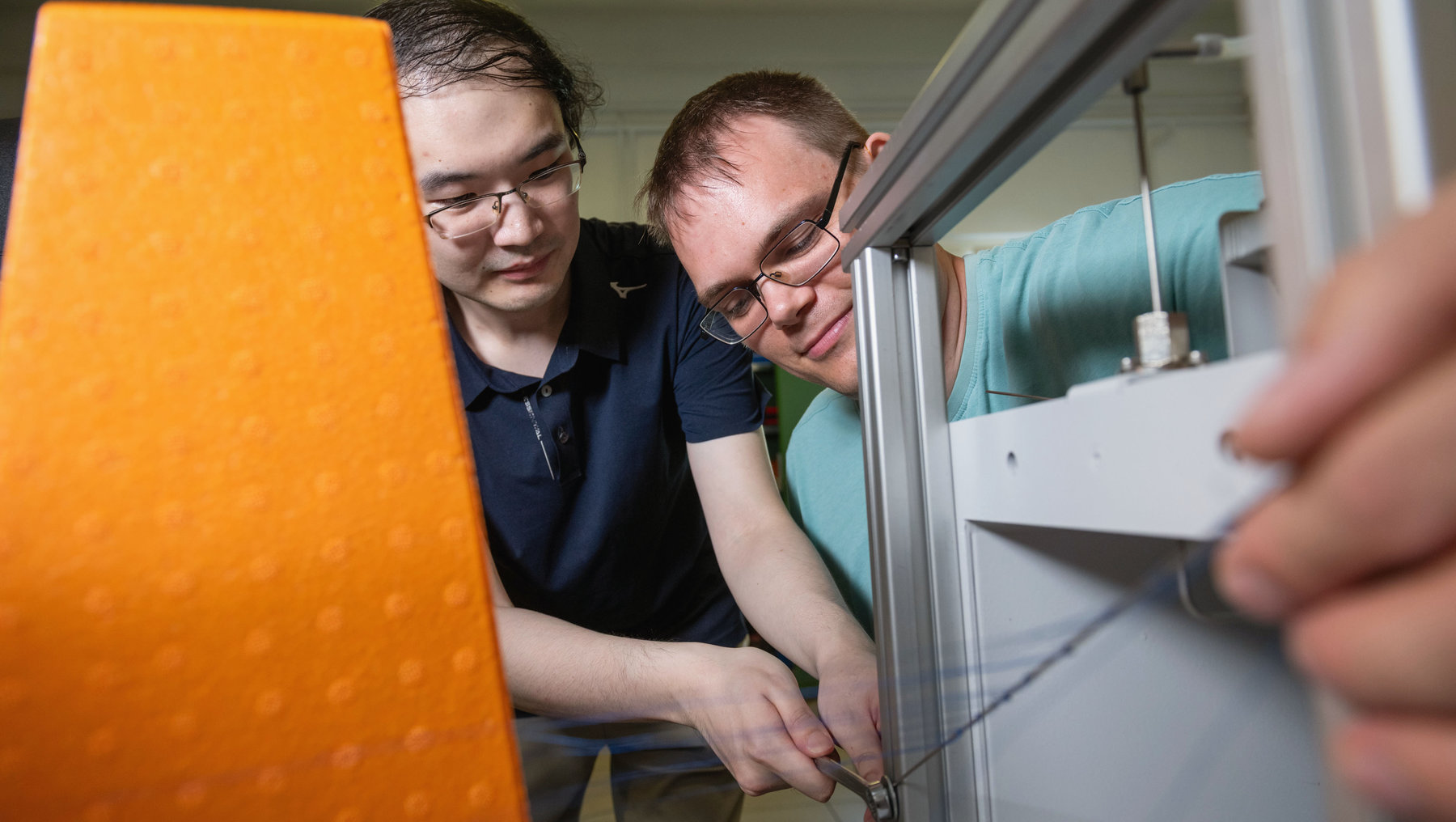
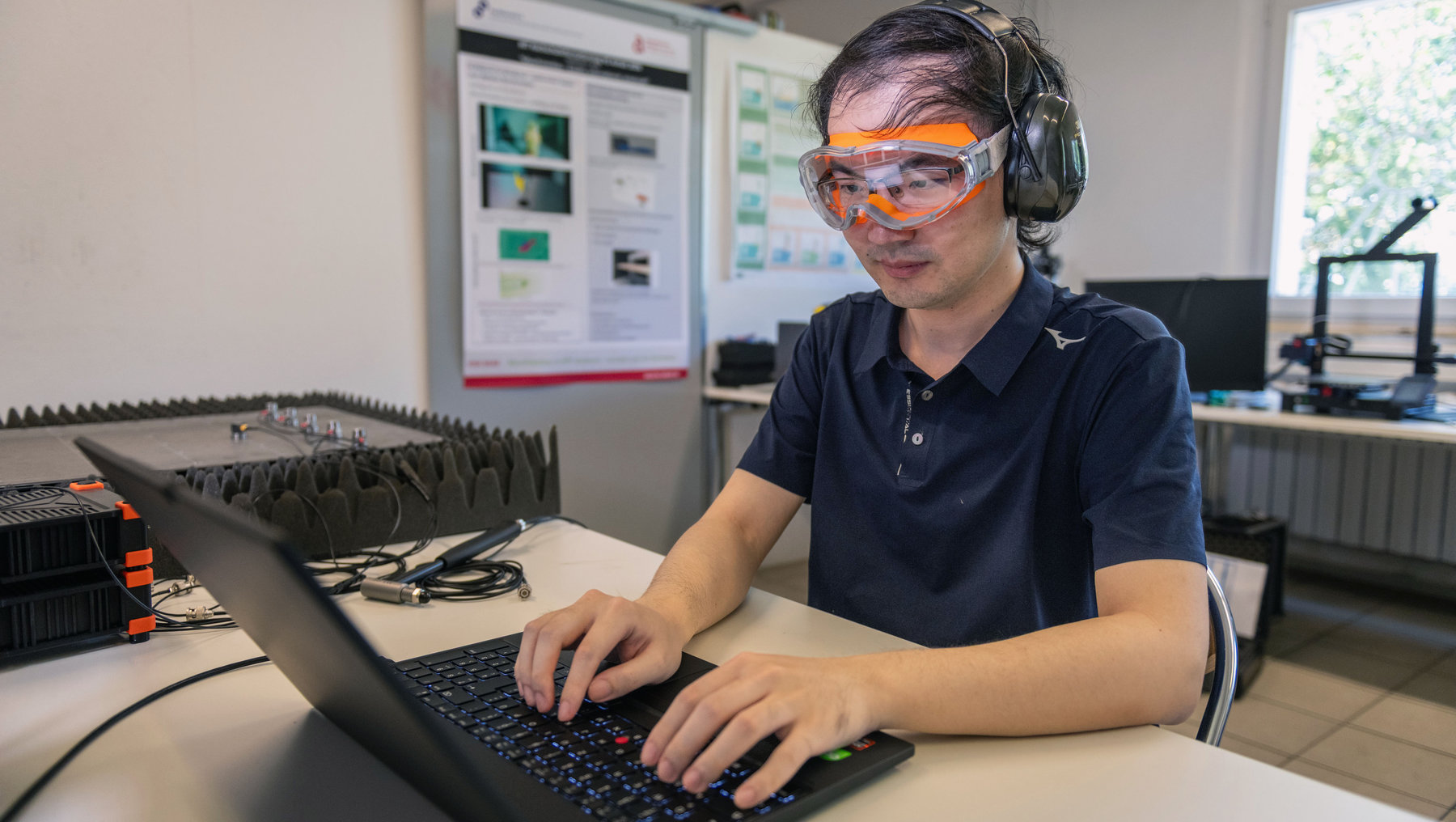
FP: My name is Fang Pengyu, I am 26 years old, and I am from China. I’m currently in my third semester of the Master’s program in Mechanical Engineering at Anhalt University of Applied Sciences and am working intensively on my master’s thesis. In my thesis, I’m focusing on excitation identification through modal analysis of structures, which involves conducting wind tunnel tests, among other things.
What initially motivated you to pursue your Master’s degree in Mechanical Engineering here in Saxony-Anhalt?
FP: Mechanical Engineering is a very strong and internationally recognized field of study and industry in Germany, which convinced me right from the start. I find the courses at Anhalt University of Applied Sciences interesting and practical, and the integrated preparatory program at the Studienkolleg helped me specifically improve my language skills, which were an important prerequisite for my studies.
Which modules or course content in the Master’s program did you find particularly good or helpful?
FP: I find all the modules in the Master’s program helpful in one way or another, as they cover different but complementary aspects of Mechanical Engineering. I especially like how theory and practical application are connected - that’s directly helping me with my thesis now.
What appeals to you academically about your thesis topic - why did you choose it?
FP: The content of my thesis - “Inverse Identification of Locally Acting Stochastic Excitation on a Beam Using Modal Analysis” - builds upon my Bachelor’s thesis, in which I had already examined the natural vibrations of excited systems. That’s why I want to delve deeper into the methods of modal analysis and gain a better understanding of them. I’m interested in aerodynamic problems, such as wing tests in wind tunnels, because they demonstrate how theoretical models are validated in practice.
My research interests lie both in the field of aviation with its specific challenges (e.g., wings, aeroelasticity) and in the physical engineering sciences as a whole. In the long term, I would like to conduct research in the field of aeroelasticity, ideally at DLR.
Can you tell us a little more about modal analysis and its applications?
FP: Modal analysis involves investigating how a structure (e.g., a wing or beam) responds to dynamic forces. This involves identifying the system’s natural vibrations - that is, the frequencies and modes of vibration at which the structure vibrates most strongly. An “excited structure” means that external forces (e.g., airflow, vibrations) set the structure in motion.
This is particularly important for wings: If the excitation frequency is close to a natural frequency, undesirable resonance can occur—and understanding this is essential for developing safe and efficient designs. For example, this limits an aircraft’s maximum speed.
In the field of aeroelasticity, one of the topics in this area, we are conducting innovative aircraft research in cooperation with DG Aviation in Bruchsal, IFF E&C in Leipzig, and the DLR Institute of Aeroelasticity in Göttingen.
How do you see your career prospects after graduation? Do you already have concrete plans to stay here in the region or to move elsewhere?
FP: I haven’t made a final decision yet, but I plan to apply for a doctorate program in Germany after completing my Master’s degree. I’d like to work at an institution with a strong research focus so I can further pursue my professional interests.
When you think about your future: What are your greatest hopes or wishes for your future life and career in Germany?
FP: My greatest wish is to continue learning and developing professionally. In the long term, I’d like to find a good position in research or industry where I can apply my knowledge and tackle new challenges at the same time.
Thank you very much for the interview! We wish you every success with your Master’s thesis!
Prof. Dr. Klaus Günzel is the advisor for Fang Pengyu’s Master’s thesis at the EMW Department. Prof. Günzel, what does an international university mean to you as a professor?
KG: For me, this means quite specifically: We educate professionals from all over the world - based on equal opportunity, academic freedom, and mutual respect. This is not only part of our identity but is also protected by the principle of university autonomy in the constitution.”
Why is it important that international students like Mr. Fang are also able to study and conduct research here?
KG: Among other things, it demonstrates that a good education and globally oriented research go hand in hand. Every person who can realize and develop their potential here ultimately strengthens our region - academically, culturally, and socially.
Interview from September 1, 2026
Jana Wiebach
