Anhalt University of Applied Sciences to Return to InterGeo 2026
The Department of Architecture, Facility Management, and Geoinformation Sciences will once again be represented in the campus area at Hall C5 / Booth H149.
Contact:
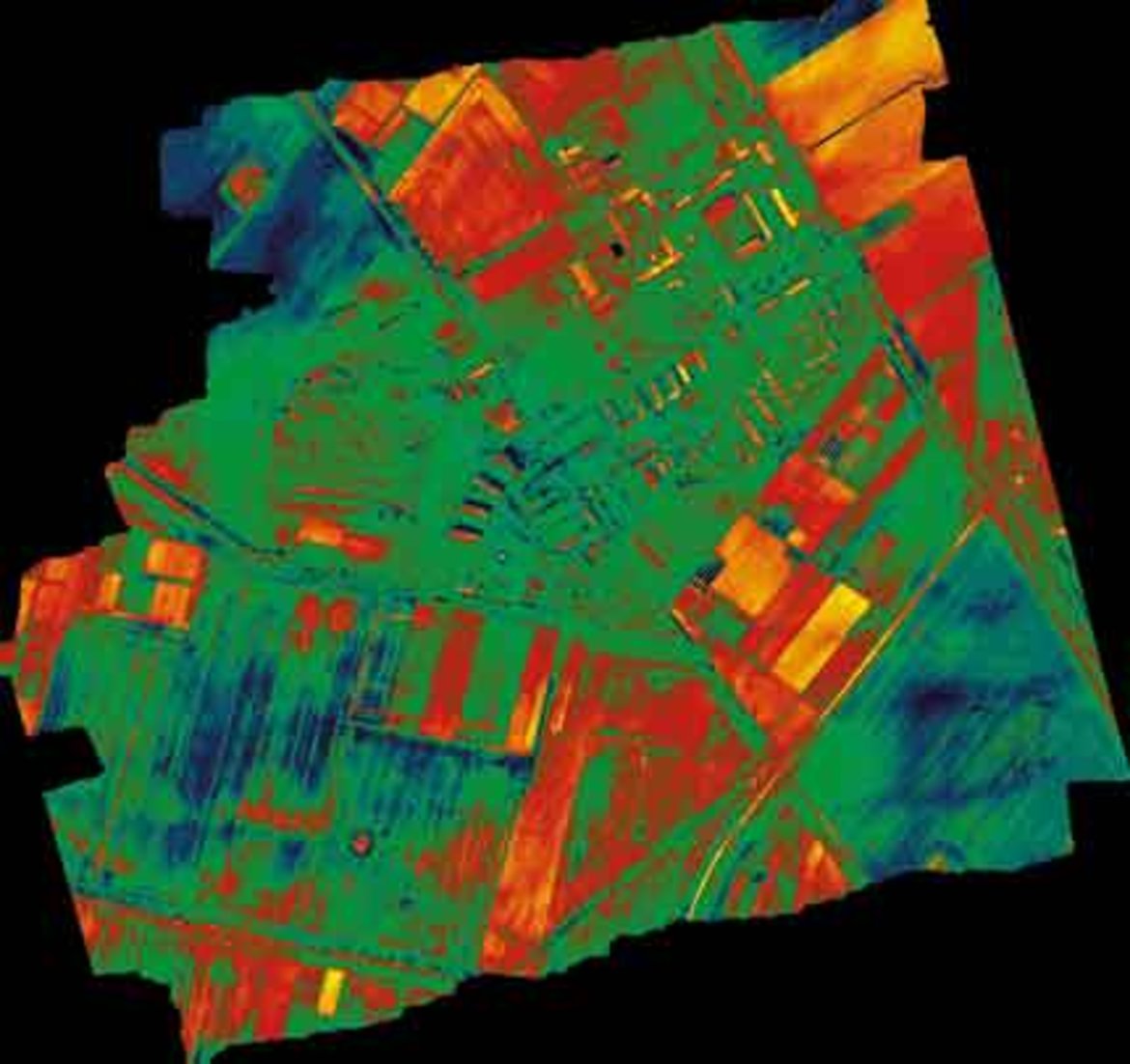 © Hochschule Anhalt / AG Prof. Dr. Marion Pause
3D Thermography for Building and Landscape Monitoring
The Need
The introduction of digital twins requires a new generation of data for application-specific 3D visualizations and analyses, e.g., as a basis for planning or for communication purposes.
Comprehensive thermal data (e.g., of an urban area) is currently provided in practice as 2D datasets collected during aerial survey campaigns. This method allows for the capture of significant information at ground level or from roof surfaces. Providing 3D thermal object information (e.g., including building facades) requires oblique imagery and complex flight planning. Given the measures for municipal energy and heating planning, as well as the development and monitoring of climate adaptation strategies for urban areas, spatially high-resolution thermal data provide an observation-based data foundation (e.g., also to supplement simulations).
Acquisition of 3D Thermal Data from Urban Areas with the AOS-Tx8
The AOS-Tx8 is a sensor system for aircraft-based acquisition of oblique imagery using four thermal and four RGB cameras. Data products include 3D thermal object models, e.g., of urban areas or landscapes. The sensor configuration enables efficient flight planning and data acquisition, as multiple viewing directions are captured simultaneously within a single image strip.
The AOS-Tx8 can be used in airplanes, gyrocopters, or helicopters equipped with stabilization platforms such as GSM 2000 / 3000 / 4000 with a minimum inner diameter of 390 mm. Common flight management systems
can be used to control the
AOS-Tx8.
Remote Sensing & Photogrammetry
Anhalt University of Applied Sciences has various sensors for providing aircraft-based remote sensing data. These include, in particular, imaging spectrometers (400–2500 nm, DFG INST 458/31-1) and an FTIR spectrometer (DFG INST 458/55-1) in the long-wave infrared (7.4–12.8 μm).
Contact:
