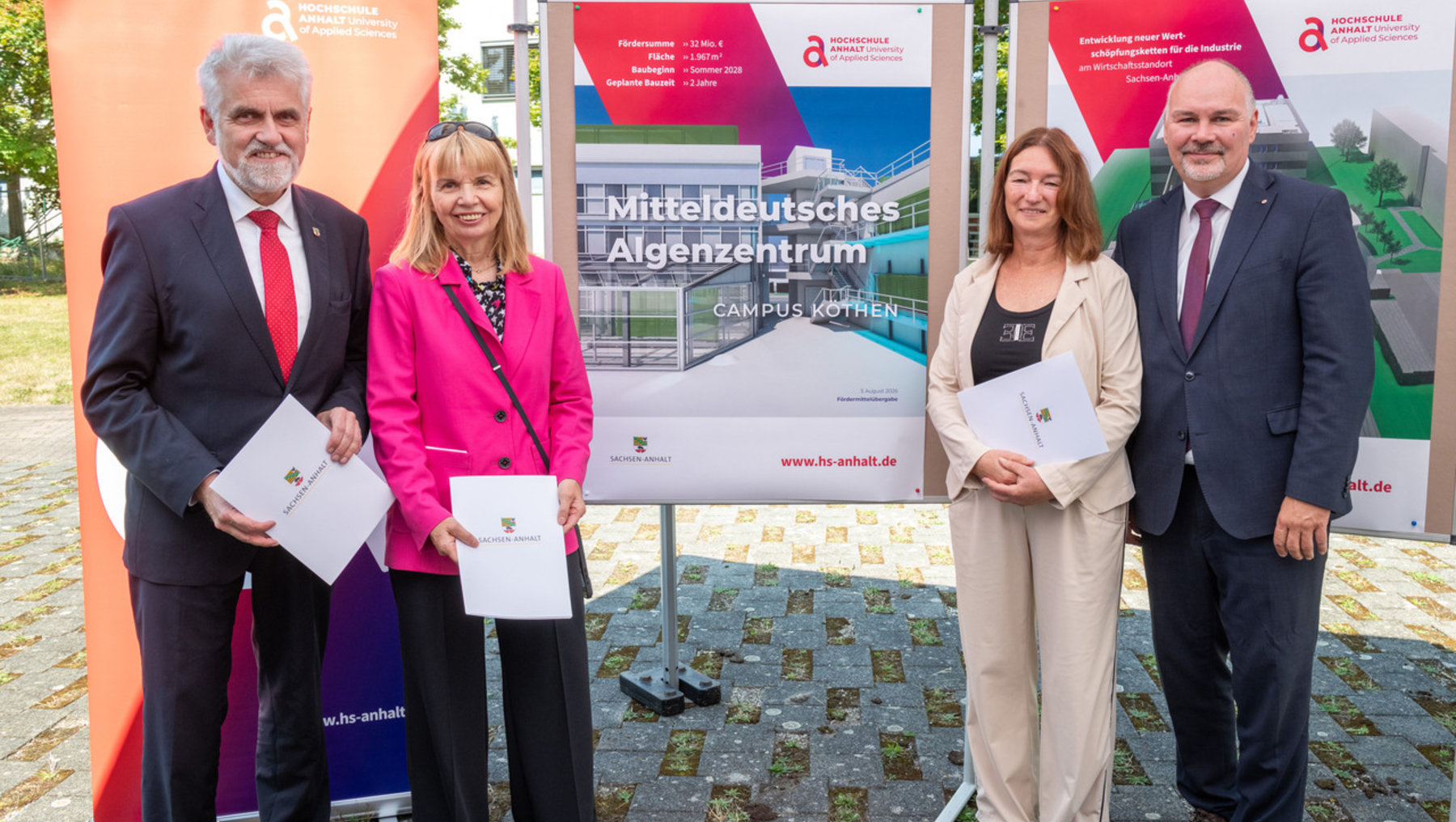
Can microalgae help replace fossil-based raw materials and provide sustainable products for the chemical, pharmaceutical, and food industries? Anhalt University of Applied Sciences has been conducting research on this question for many years and is among the most internationally renowned research groups in this field. The university is receiving additional support to expand its research: On August 3, 2026, Minister of Science Prof. Dr. Armin Willingmann awarded Anhalt University of Applied Sciences two grants and a funding commitment totaling approximately 39 million euros. The funds will bolster the expansion of algal biotechnology and strengthen Saxony-Anhalt as a research hub.
The funding will support three projects at Anhalt University of Applied Sciences’ Center of Excellence for Algal Biotechnology (CAB), led by Prof. Dr. Carola Griehl: the construction of the Central German Algae Center (MAZ) with approximately 32 million euros, financed by the Ministry of Science from the federal government’s “Infrastructure” special fund, as well as the research projects “FuI@Algenbiotechnologie” and “ProAlgenöl,” which are funded by the EU. “With this, we are making a targeted investment in Saxony-Anhalt in a future-oriented technology with great potential for climate protection, innovation, and sustainable growth,” emphasizes Minister Willingmann. “Anhalt University of Applied Sciences has been a top player in the field of algal biotechnology for years. Now we are creating the prerequisites so that this excellent research can find its way into commercial application even faster.”
Central German Algae Center to Be Built Starting in 2028
The Central German Algae Center will establish a state-of-the-art research infrastructure on the Campus Köthen. For the first time, the entire process chain of algae biotechnology—from the cultivation of microalgae to the extraction of valuable compounds and the development of new products—will be facilitated there. The MAZ is intended to bring research and industry closer together and open up new value chains for the agricultural, food, cosmetics, pharmaceutical, and chemical sectors. “In doing so, we are consistently expanding our leading international position in algal biotechnology,” says University President Prof. Dr. Jörg Bagdahn. “The MAZ will be a place where excellent research, technology transfer, and cooperation with companies work closely together. This will benefit our students as well as the business community and Saxony-Anhalt as a hub for innovation.” The center is expected to comprise 1,967 m² of research space. Construction is scheduled to begin in the summer of 2028, with the building set to open in the summer of 2030.
Funding for Innovative Research Projects in the Field of Algal Biotechnology
The MAZ will be complemented by two additional research projects. “FuI@Algenbiotechnologie: Research and Innovation in Algal Biotechnology” focuses on microalgae as a sustainable source of raw materials. “When people think of algae, many initially think of dietary supplements or toxic algal blooms in bodies of water. In fact, however, they can provide a wide variety of valuable raw materials—from oils and proteins to feedstocks for the chemical industry,” says Prof. Dr. Carola Griehl. “Our goal is to harness this potential economically and gradually replace fossil resources.”
With the project “ProAlgenöl: Process Development for the Production of Algal Oil Using the CO₂-Sequestering Green Alga Botryococcus braunii,” the research team is developing a particularly efficient process for this purpose. The CO₂-fixing green alga Botryococcus braunii produces petroleum-like, long-chain hydrocarbon oils that can be continuously harvested during growth using an in-situ “milking” process developed and patented at the university. This eliminates energy- and cost-intensive processing steps. The production of bio-based raw materials becomes more economical, bringing the technology closer to industrial application.
The Second New Research Building on the Campus Köthen
With the Central German Algae Center, the second major research building at Anhalt University of Applied Sciences will be constructed in the coming years alongside the Interdisciplinary Research Center for Sustainable Food Production (InFonaL). Together, these two projects strengthen the Campus Köthen as a hub for applied research in the Life Sciences and underscore Saxony-Anhalt’s growing importance for the bioeconomy.
