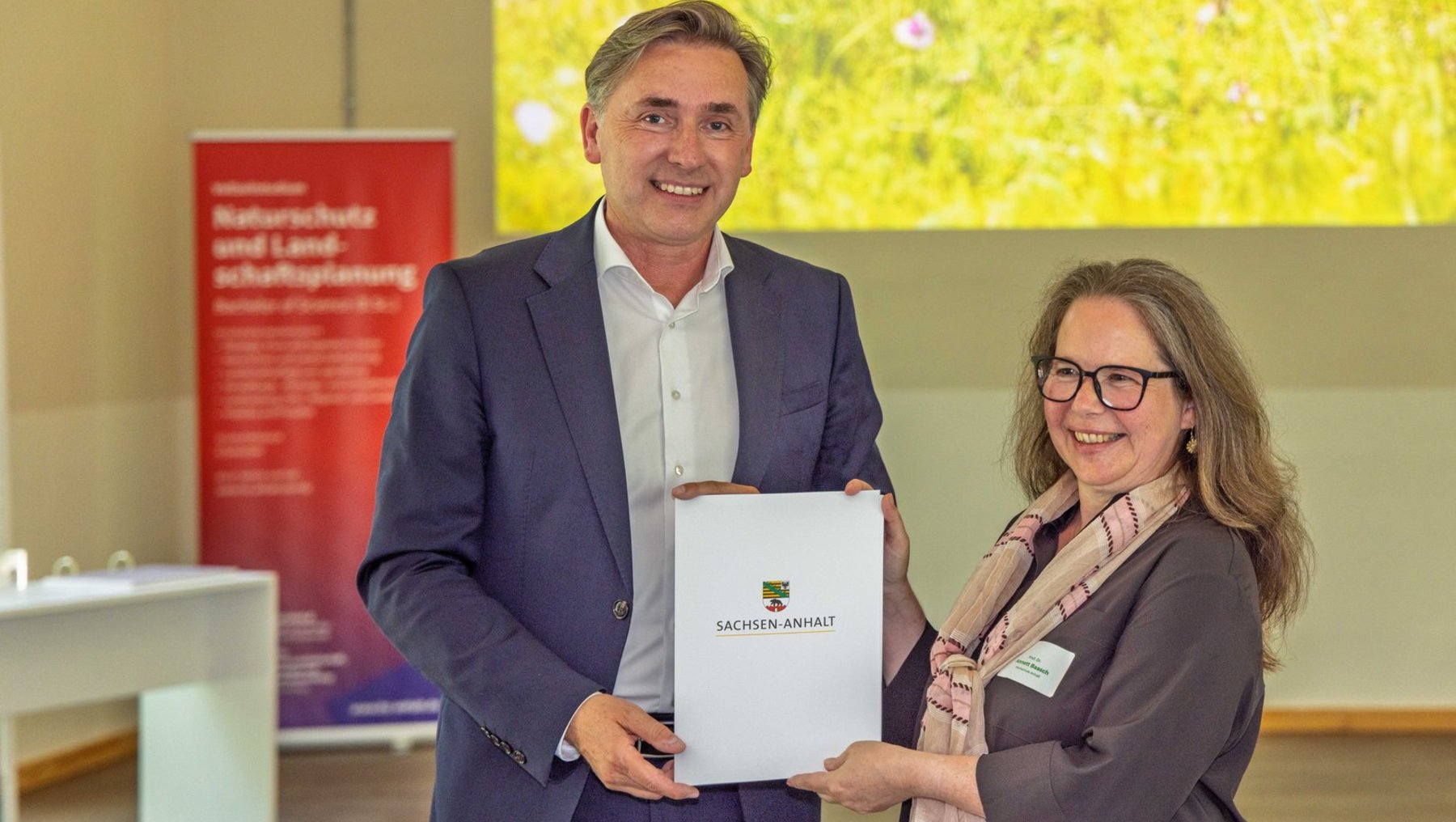
How can rare and endangered plant species, as well as valuable dry grassland habitats, be better protected and preserved in Saxony-Anhalt? Anhalt University of Applied Sciences is addressing this question with its new project, “ArtenWache: Protecting and Preserving Together – Monitoring Rare and Endangered Plant Species & Hands-On Conservation Activities to Preserve Valuable Dry Grasslands.” Today, State Secretary Thomas Wünsch from the Saxony-Anhalt Ministry of Science, Energy, Climate Protection, and Environment presented the grant notification for the project on the Campus Bernburg.
“With this project, we are sending a strong signal in support of biodiversity conservation in Saxony-Anhalt,” emphasized State Secretary Thomas Wünsch. The dry grassland habitats on which the project focuses are among the most species-rich, but also among the most endangered habitats in our state. They are home to numerous rare and endangered plant species, for whose conservation we bear a special responsibility—especially in times of advancing climate change here in our state.”
Through the “ArtenWache” project, Anhalt University of Applied Sciences aims to work together with citizens to implement concrete measures that protect and promote rare plant species as well as valuable dry grassland habitats. The focus is on so-called “ArtenWache” participatory activities. Planned activities include maintenance days for brush clearing and mowing, planting days to introduce young plants, and measures to allow grazing on selected areas.
In addition, project participants are developing and testing species-specific monitoring concepts for several selected indicator species of dry and open habitats. The goal is to record rare and endangered plant species even more systematically in the future, better assess their threat status, and derive effective conservation measures.
There is a great need for action: Current data from the FFH monitoring program indicate a poor conservation status for various dry grassland habitats. These include, among others, near-natural calcareous dry grasslands and sub-Pannonian steppe dry grasslands. Current threats include underutilization or complete abandonment of these areas. The consequences are nutrient enrichment, grass encroachment, and scrub encroachment, which further deteriorate the condition of the habitats and increase their fragmentation. At the same time, numerous plant species specialized to dry grasslands are coming under increasing pressure.
Professor Annett Baasch said: “Collaboration with the local community is particularly important to us. We want to exchange ideas and work together to develop conservation strategies for local areas.”
To mark the presentation of the grant award notification, Professor Lothar Koppers, Vice-President for Academic Affairs, Digitization and Continuing Education at Anhalt University of Applied Sciences, and Professor Elena Kashtanova, Dean of the Department of Agriculture, Ecotrophology and Landscape Development, welcomed the guests. Project Director Prof. Dr. Annett Baasch then presented the project and its planned activities.
The project will begin on July 1, 2026, and will receive approximately 650,000 euros in funding. It is funded as part of Germany’s strategic plan for implementing the European Union’s Common Agricultural Policy (CAP). Funding comes from the European Agricultural Fund for Rural Development (EAFRD) as well as from the state of Saxony-Anhalt through the “Biodiversity, Natura 2000 Network of Protected Areas” program.
Study Nature Conservation and Landscape Planning at Anhalt University of Applied Sciences
Those interested in the protection and development of nature and the landscape will find suitable degree programs at Anhalt University of Applied Sciences. The bachelor’s and master’s degree programs in Nature Conservation and Landscape Planning provide in-depth ecological knowledge and combine it with a strong practical component. Excursions, projects, and labs specifically prepare students for careers in nature conservation agencies, planning offices, associations, or research institutions.
Interested applicants can apply until July 15, 2026, to begin their studies in the 2026/27 winter semester.
For more information on the degree programs, visit: www.hs-anhalt.de/loel
