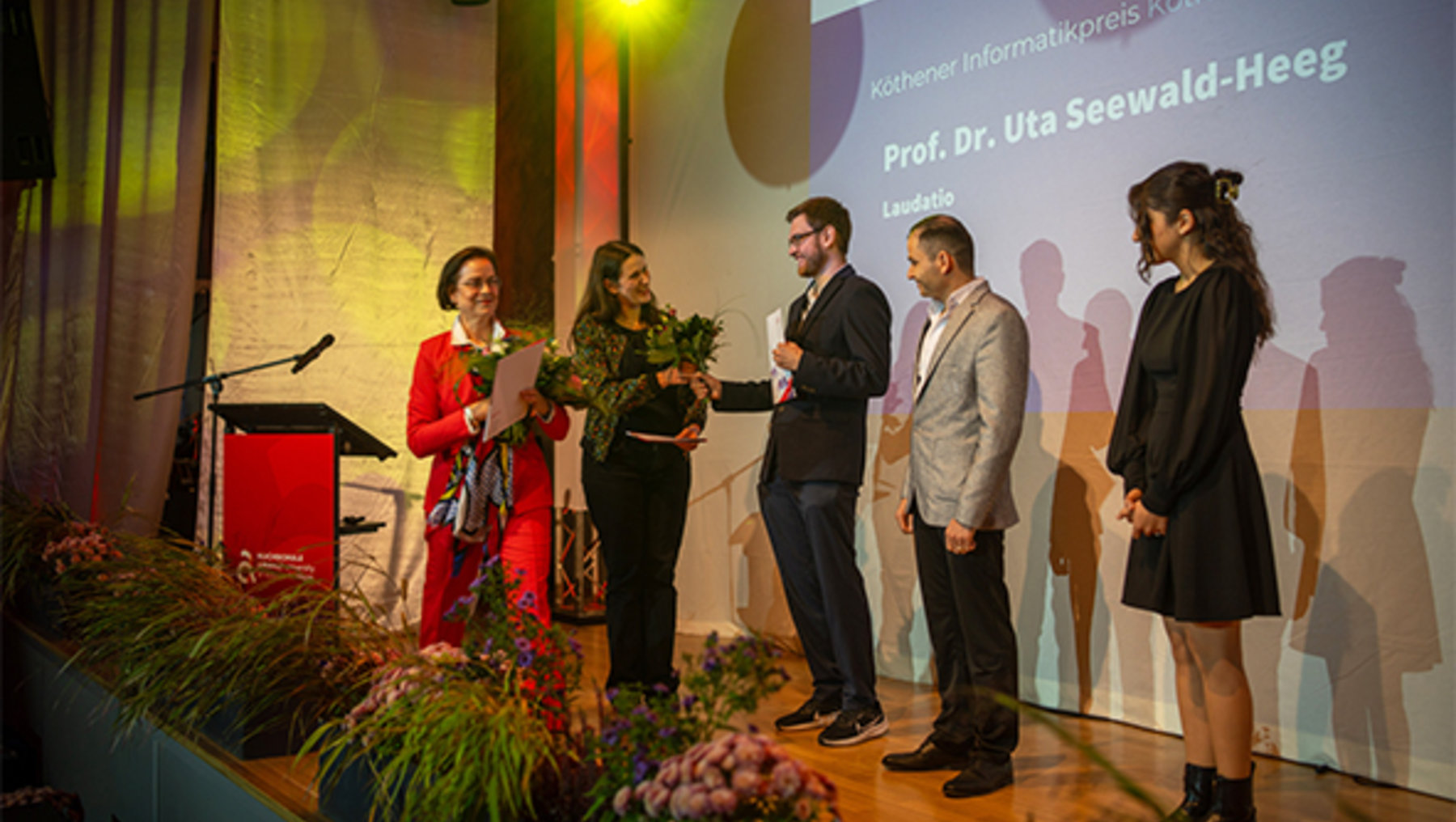
Maximilian Schuckert is one of three winners of the Köthen Computer Science Prize and was honored for the best Bachelor's thesis of the year. Alongside Maryam Akbari for the best Master's thesis and Hashem Sarwari for an outstanding thesis, he was honored at the matriculation ceremony and can thus be considered a role model for the new students. Our warmest congratulations!
Here Maximilian Schuckert reports on the news of his win and the significance of the prize.
Congratulations on winning the Köthen Computer Science Prize! Writing the best Bachelor's thesis of the year is something special. How happy was it for you?
I would like to thank you very much for all the congratulations I have received so far. The emotions I felt on the day I received the news are hard to put into words. I was very happy because it was also a big surprise for me.
To put it in chronological order: At the time I received the news, it had been about a year since I had handed in my Bachelor's thesis and the student part of my life had come to an end. A certain nostalgia for student life had already set in and so I had the opportunity to return for one more evening. It was also a nice occasion to open the Italian sparkling wine that I had brought back from Italy just a few weeks earlier.
Can you briefly outline the topic of your Bachelor's thesis and what inspired you to choose this topic?
Schuckert: My bachelor's thesis was about developing a tool that can compare different Excel files with data on rail vehicles. The tool should recognize data records that describe the same rail vehicle in order to prevent double counting of the same vehicle. Since rail vehicles do not have a unique identification by themselves and the individual data on rail vehicles is distributed across different, heterogeneous Excel files, it was not possible to compare the data records easily.
The choice of topic was less the result of inspiration than the next logical step in the general data integration of existing Excel files into a uniform database system, which had already been initiated in the lab before the bachelor thesis.
What hurdles did you face when writing your thesis and how did you overcome them? You don't write a Bachelor's thesis every day.
Schuckert: Probably the biggest hurdle for me was frequent writer's block. I knew what ideas I wanted to put on paper, but I found it difficult to find the right wording. The solution I found for myself was to divide the writing of a section into two parts. In the first part, I focused solely on writing the idea without paying attention to the wording. In the second part, I went back over the paragraph and edited it until I had a good formulation.
In addition, there was often the hurdle that I didn't always immediately understand a technical aspect through my own research. Regular communication with the mentors, both from the company and the university, helped here.
Looking back, what was it about your Applied Computer Science degree that helped you the most? What do you possibly benefit from now in your professional life?
Schuckert: Apart from the direct acquisition of knowledge, there are two things that have helped me the most during my studies and that are also crucial for my professional life. Firstly, the direct collaboration in practical projects with fellow students and the subsequent presentation of the results. Secondly, the tutoring job I did for 3.5 years for the programming and modeling module.
Through these experiences, I was able to effectively learn how to work well with other people, present my results to different target groups and actively support and educate people with problems. All of these experiences have already been helpful in my current job, allowing me to integrate well into the existing team and actively provide support to my team members.
Are there any professors or members of staff who have really inspired you?
Schuckert: There are a few professors who have been able to inspire me for certain topics. I would particularly like to highlight the professors with whom I also worked as a tutor for programming and modeling.
First of all, I would like to mention Prof. Dr. Andreas Both, with whom I discovered my enthusiasm for programming and was able to learn web technologies, which play a major role in my current job. I would also like to mention Prof. Dr. Anika Groß, who conveyed her specialist knowledge in an understandable way both in the individual database modules and as the first reviewer of my Bachelor's thesis and was always very helpful.
I would also like to mention Timo Hulsch from Railistics, who is and was a great help to me with his extensive specialist knowledge of rail vehicles.
Is there anything you wish you had known before or during your studies that you could pass on to our students?
Schuckert: As my studies went somewhat differently than planned due to the corona period, I can only give a few tips that are still relevant.
However, one special tip that is quite important to me is that some modules offer tutorials in addition to the usual lecture and internship structures. In these, students from higher semesters usually help newer students. The advantage is that general questions about the module can be asked there that are not only related to the current lecture or internship status.
When I started my studies, I wasn't aware of this option. However, when I was a programming tutor myself for around three years, I noticed time and again that the direct exchange between students always led to success.
What's next for you? Are you already fully immersed in professional life?
Schuckert: Basically, I picked up exactly where my Bachelor's thesis left off and am now employed full-time by the company Railistics. I use almost all the skills I acquired during my studies there and continue to work on the process that was started in the lab and continued in the Bachelor's thesis.
Apart from that, I'm thinking about doing a Master's degree in the future. However, I wanted to take a break from studying after my bachelor's degree because I wanted to continue working on the process and I needed a change after almost 20 years of school and student life.
The Köthen Computer Science Prize is awarded annually to the best Bachelor's and Master's thesis at the Department of Computer Science and Languages and is endowed with €500 for first place and €250 for further awards.
