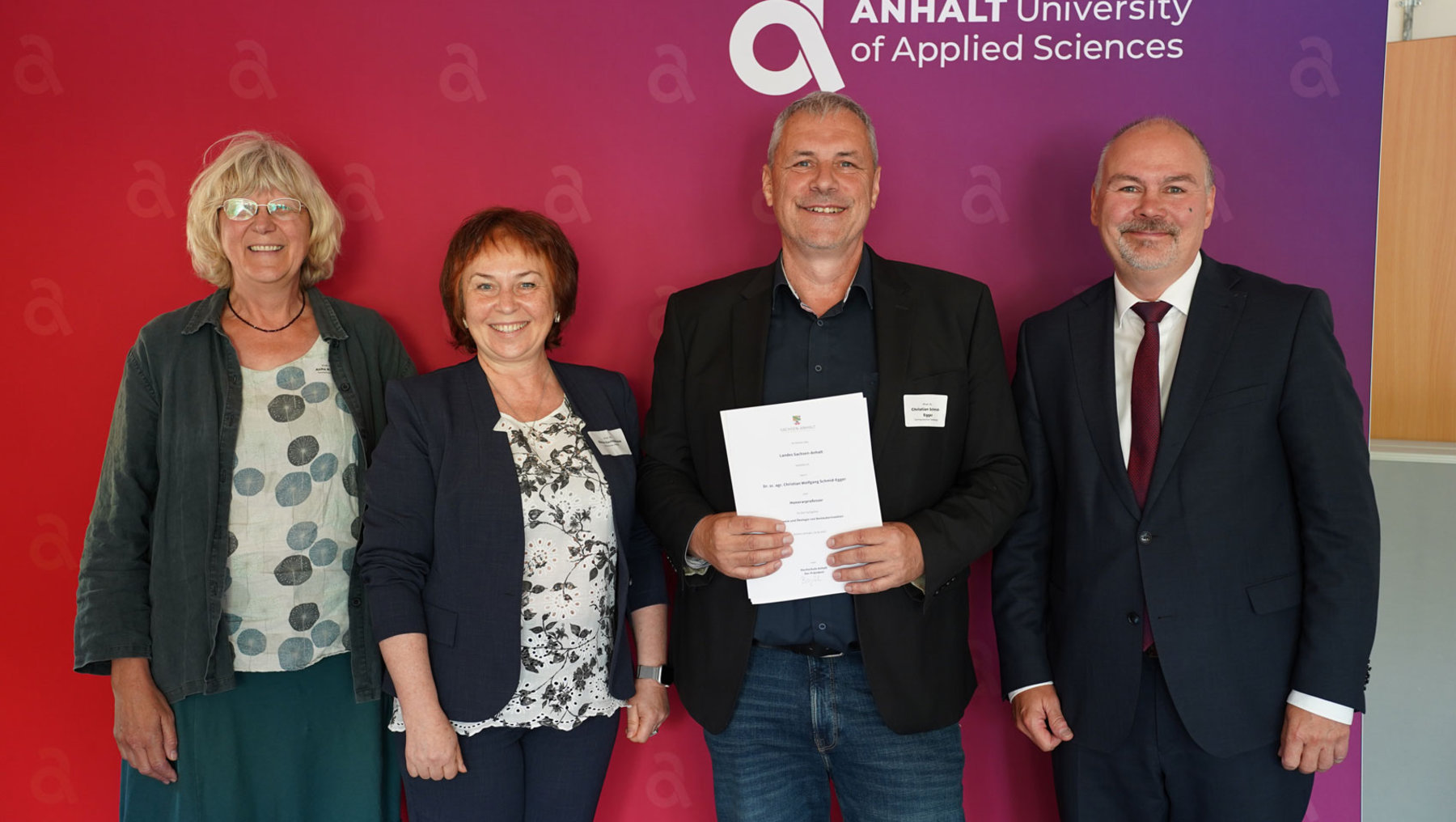
He knows the habitats of wild bees, knows how to describe new species - and how to arouse enthusiasm for the smallest players in our ecosystems: Dr. Christian Schmid-Egger was officially appointed Honorary Professor of Taxonomy and Ecology of Pollinator Insects at Anhalt University of Applied Sciences on 19 June 2025 as part of the Bernburg Innovation Days.
Schmid-Egger is an agricultural engineer, animal ecologist and specialist in wild bees and stinging insects. He studied agricultural sciences and completed his doctorate in landscape planning in 1994 - with a topic that was already unusually concrete at the time: the credits of habitats based on wild bees. For more than 30 years, he has worked as a freelance expert for animal ecology - whether in agricultural landscapes, environmental planning or urban ecology. At the same time, he completed a postgraduate degree in journalism - because for him, good communication is also part of science. He not only knows how to identify species - but also how to explain biodiversity. He has described over 150 new wasp and bee species to date, and has written numerous identification keys and specialist publications, as well as contributions to international excursions, conferences and genus revisions. His practical experience in the ecology and taxonomy of wild bees has earned him a reputation as an internationally renowned specialist in digger and trail wasps.
With his honorary professorship at Anhalt University of Applied Sciences, Schmid-Egger will be a regular lecturer in the future - particularly in the Nature Conservation and Landscape Planning, Landscape Architecture and Environmental Planning and Agriculture degree programs. There, he will contribute his expertise on pollinators in agricultural landscapes and cities, accompany identification exercises, provide insights into biotope assessments and teach methods for faunistic mapping.
