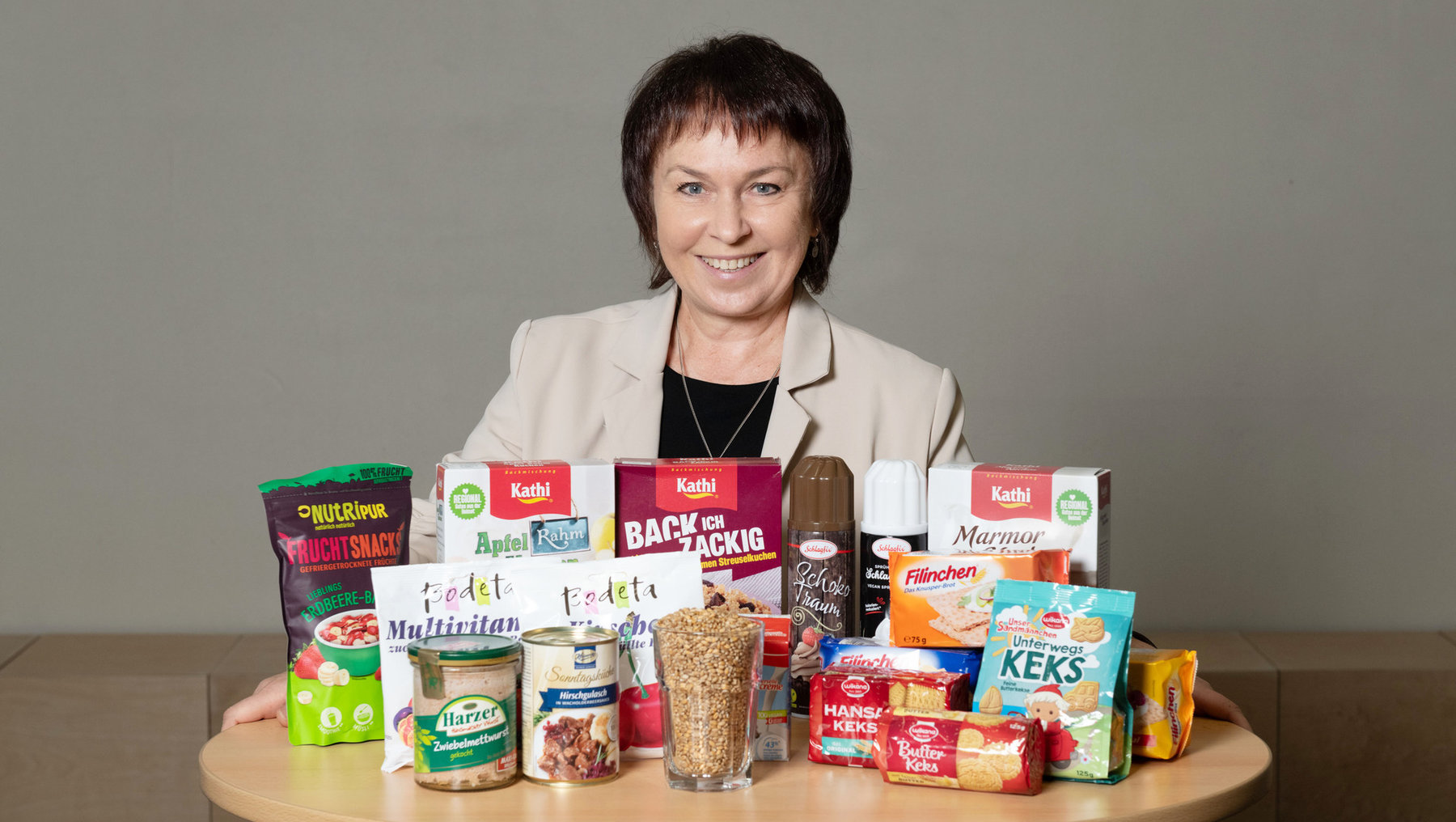
Prof. Dr. Elena Kashtanova has been teaching how food and Agriculture can use global markets at Anhalt University of Applied Sciences for 25 years. Her students develop export strategies for regional companies in "Global Team Projects" and try out international cooperation.
Campus between tradition and practice
Campus Bernburg is located in the middle of the agricultural landscape of Central Germany. Tractors occasionally drive along the circular path between functional buildings and teaching gardens. Elena Kashtanova works here as Professor of International Trade in Agribusiness and Dean of the Department of Agriculture, Ecotrophology and Landscape Development. Most people know her in this role: at the Green Week, for example, when she presents her department's projects. Her calendar is full of appointments, but this is only part of her work. "Making students fit for international markets - that was my mission right from the start," says the 56-year-old.
From Minsk to Bernburg
At the end of the 1990s, Anhalt University of Applied Sciences wanted to develop an international postgraduate course for specialists and managers into a Master's degree. Elena Kashtanova had the right experience for this: Studies in economics in Minsk, doctorate, consultancies for the World Bank and the UN. She had worked for Eastern European countries and internationally active companies. I therefore knew what was important for international business and wanted to convey this in a practical way," she says. In the early 1990s in Belarus, she had witnessed what happens when the Economics collapse: people leave, especially in rural areas, and only new international connections can help.
Learning in an international team
Her idea for the new Master's degree course in Food and Agribusiness: international student teams develop export and investment strategies for real companies. For the feasibility studies, students from Anhalt University of Applied Sciences work together with partners from the Netherlands, USA, Poland or the Czech Republic. The projects come from specialist networks or from students themselves. Even before coronavirus, the teams used online tools to exchange ideas. "A meeting on site is still a must," says Elena Kashtanova, because: "International business requires trust." How do I work together across cultures? What rules do I have to follow for my product? "Alongside market analyses, these are the most important questions," she emphasizes.
Regional companies as partners
In 2006 and 2010, the e-learning approach to international teaming won awards. Since the start of the degree program, over 250 have completed the Master's course to work in export departments of large companies such as CLAAS, BASF, KWS or in their own family business. Hundreds of projects have been completed. There is no concrete monitoring of the exports actually implemented - but there are well-known flagship projects. For example, the students carried out important preparatory work for the export business of Filinchen products from Weißenfelser Handels-Gesellschaft to China or quality wheat from the Börde region to Egypt. Around 50 projects are currently underway. One student is currently working on a Japan concept for Wikana Keks und Nahrungsmittel GmbH: market analysis, cultural characteristics, potential partners.
Flexibility as an economic factor
Companies from Saxony-Anhalt are involved in every round of projects. "Small companies in the food industry and agricultural companies often lack export departments," explains Elena Kashtanova. This affects most companies in the sector in Saxony-Anhalt. It is true that foreign sales (EUR 742.9 million in the first half of 2024) make up the smaller share compared to domestic business (EUR 3.03 billion in the first half of 2024). Nevertheless, the economist sees export strategies as an important factor for this sector of the economy, which has been one of the state's strongest in terms of turnover for years. "We have seen how quickly the global situation can change. Companies must then be able to react. If an agricultural company is thinking about exporting wheat to Norway, we can turn it into a project for students."
EU standards as an export commodity
German products are internationally regarded as reliable in terms of their quality, safety and, increasingly, sustainability. "Our future lies in exporting ethical and ecological standards to growing markets," says Elena Kashtanova, who visited Hong Kong and Vietnam in November with a delegation from the Chamber of Commerce and Industry to bring back topics for new projects. Many new ideas also come from the students themselves, such as an import project for fish from Indonesia, on which three students from Indonesia, the Philippines and Iran are working. One of the most important questions in their concept is how to comply with EU food standards.
Inspiration from partner universities
Elena Kashtanova's fascination with global markets now has many facets. She appreciates the pragmatic approaches she has seen from partner universities, or real business projects from Dutch partner companies for countries in the Global South: for setting up water treatment plants, insect breeding or the "Green House" - a small box for growing vegetables that was successfully exported to Ghana. "It met the need for fresh produce and the desire to earn some extra money. We can still learn a lot from startup ideas like this."
Information and contact
The Master's degree program in Food and Agribusiness (courses taught in English and German) currently has 58 students. A third of them come from international countries such as Ukraine, Iran and Indonesia, who spend four semesters on Campus Bernburg.
Prof. Dr. Elena Kashtanova's "Global Team Projects" involve students from various degree programs: in addition to "Food and Agribusiness", the module is also offered for the Bachelor's and Master's degree programs taught in English and German) as well as Ecotrophology.
More information can be found on the pages of the "Food and Agribusiness" degree program: https: //www.hs-anhalt.de/mfa
