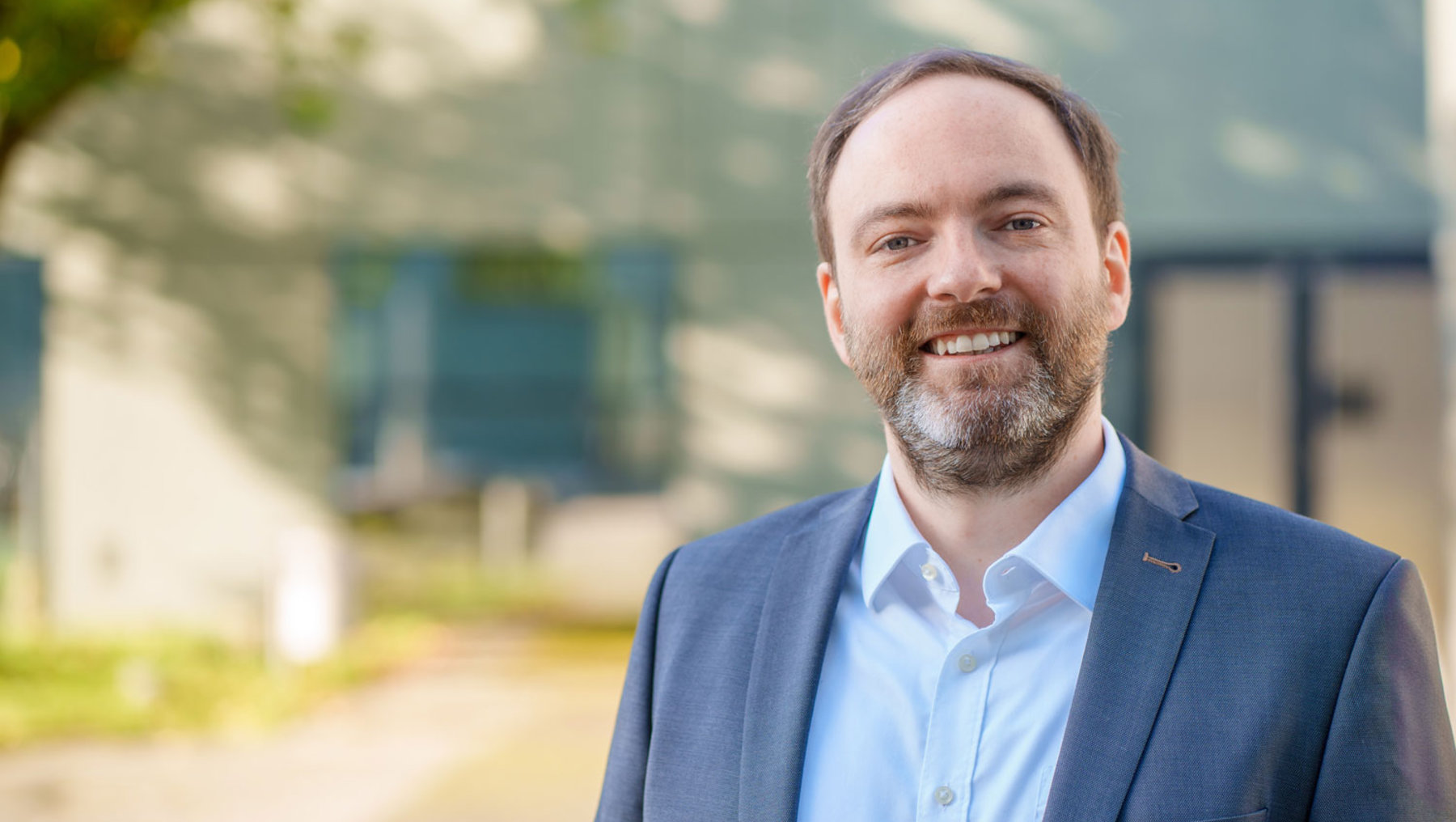
Despite technological advances and the advent of artificial intelligence in the surveying industry, Professor Dr. Christian Pröseler has to disappoint his students: "Lectures in mathematics will continue to be essential." Even in a world increasingly shaped by AI, mathematical fundamentals remain indispensable. In this interview, the new deputy professor for "Geodetic Evaluation Technology" at Anhalt University of Applied Sciences shares his first impressions of the campus, explains his practice-oriented teaching methods and talks about how he sees the future of the surveying industry in the age of artificial intelligence.
Professor Pröseler, you have been Professor of Geodetic Evaluation Technology since June 2024. How were your first few weeks in Campus Dessau, and what do you think of the campus and the students?
Overall, it's been good and I've really enjoyed the semester. I teach mathematics, and I know that this is not popular with all students. I was excited because there are always students who actively participate and others who see the subject more as a duty - that's completely normal.
I was particularly impressed by how good the students are at organizing themselves here. I didn't know that in this form from my time at university. They plan barbecues, support university events and are very committed. They even invited me and didn't let up until I was finally there. I really like this informal atmosphere. The smaller, personal setting here really makes a difference.
In addition to your professorship, you work at VermCad, a small software company that develops surveying software for the real estate cadastre. What experiences from your work at VermCad are incorporated into your classes?
I would like to expand on this question and ask what this job has given me and enabled me to do in terms of my current position at Anhalt University of Applied Sciences. The answer is pretty clear: almost everything. You have to know that I come from a mathematics background. There, I immersed myself in the purest and most application-oriented field I could find because I enjoyed it and also because the professor who taught it was an impressive person. It wasn't until I got a job at VermCad that I learned the practical side of math that is needed in surveying. I bring these practical insights and examples directly into my teaching. I can show students where problems occur in practice and why you sometimes need to take a step back to understand the problem properly.
VermCad has also taught me how important it is to communicate mathematics in an understandable way. In my early days, I found it difficult to communicate with users because I was thinking too mathematically. This experience has helped me to adapt my teaching to make it more tangible for the students. I try to convey theoretical content as clearly as possible, even if a lot of theory is necessary at the beginning.
You mentioned that you came to mathematics through an impressive professor. What was special about his teaching?
That's difficult to describe. This professor had an impressive charisma that immediately captivated me. His lessons weren't easy - on the contrary, the blackboard was often a mess and you really had to stay on the ball. But it was precisely this challenge and his personality that fascinated me. He taught exactly what I had always been interested in, and so he led me in the direction of algebra, a branch of mathematics that is quite remote from application.
Do you manage to inspire your students in a similar way?
That is a challenge. I try to take away the students' fear of mathematics by being open and approachable. I often ask if anything is still unclear and encourage students to ask questions - even after the lecture.
It's important to me that students don't see me as an unapproachable professor, but as someone who really wants to help them. I don't introduce myself as "Professor Dr. Pröseler", but simply as "Mr. Pröseler". It's about breaking down a certain barrier so that they have the confidence to approach me. Of course, I know that I can't take everyone with me, but I do my best to make access to mathematics as easy as possible.
Let's take a look inside your lecture hall. How do you teach complex topics in geodetic evaluation technology?
I start with very simple scenarios where the basic concepts are clear to everyone. Then I gradually work my way up to more complex cases to show how the challenges are compounded. This approach helps students to gradually understand the problems and internalize the necessary mathematical concepts.
An important point is that students need to understand not only the example but also the underlying theory. I try to create practical relevance by transferring the concepts to real software problems that I experience in my professional practice. This allows students to see how theory and practice intertwine. It's important to me that the students don't just apply the methods mechanically, but understand the why and how behind them.
Perhaps students will no longer need any math skills in the future. If artificial intelligence finds its way into the surveying industry - or how do you think AI and machine learning will change the industry?
Mathematics will change less as a result of AI than mathematics will shape AI. The underlying systems of AI are heavily based on mathematical concepts. The real change I see is more in how AI systems can be used in geodetic practice. While AI is able to mimic intuitive human decisions, the challenge remains that these systems often work like a black box - they deliver results without the process behind them being fully transparent.
So I have to disappoint the students: Math lectures will continue to be essential. It is simply important that the mathematical concepts are understood. Only then can the results of AI be correctly interpreted and, if necessary, adapted. If you don't understand what a system is doing in the background, it will be difficult to correct it if the results don't meet expectations. That's why I strongly advocate that mathematical training is not neglected in surveying studies.
Prof. Pröseler, thank you very much for the interview!
