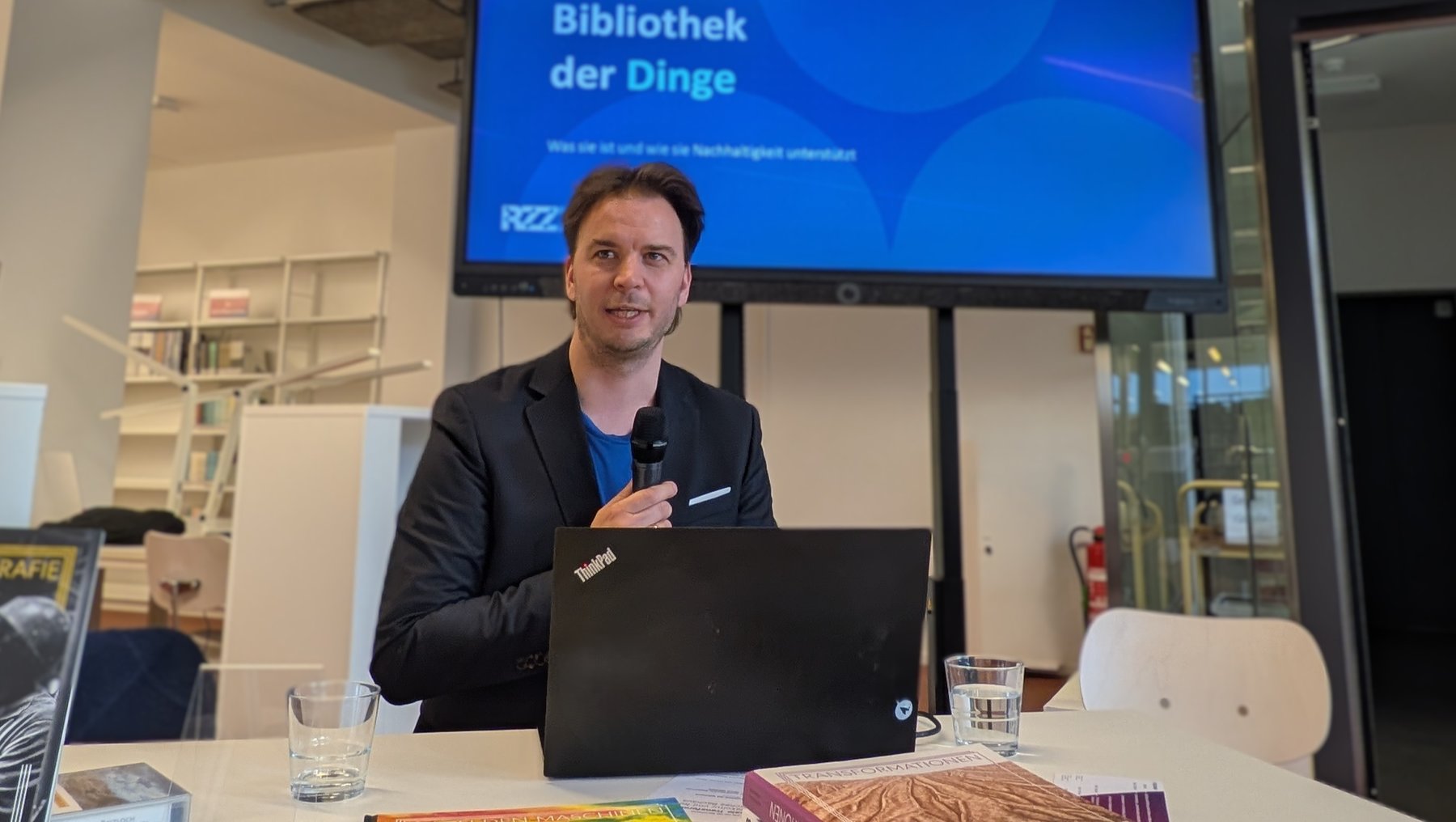
The Library of Things in Zeitz is set to lend out tools free of charge, 24 hours a day. Project manager Martin Wiesner presented the initiative on October 23 in Dessau. The occasion was Library Day, which Anhalt University of Applied Sciences hosted this year at the libraries at the Bauhaus. Theme: Regional Transformations. Industrial Culture and the New European Bauhaus. The audience raised questions that are frequently asked about such projects: Who takes care of the cabinet? Why isn’t an empty storefront with personalized advice offered? What happens in case of damage? Martin Wiesner explained the background and received support from the audience.
A "Library of Things" for Zeitz: Why not?
-
 © hochschule anhalt
Tag der Bibliotheken am 23. Oktober 2026 in Dessau: Martin Wiesner vom Reallabor ZEKIWA Zeitz stellt sein Projekt vor.
A lending cabinet at the ZEKIWA Zeitz Real-World Laboratory
The cabinet is being created as part of the Reallabor ZEKIWA Zeitz project. A “Reallabor” is a place where researchers and practitioners test new solutions in everyday life. The Library of Things is a subproject within this initiative (Work Package 3.1, Material Hub). The Real-World Lab aims to transform the historic ZEKIWA site into an urban neighborhood and is collaborating with various partners to achieve this: The consortium includes the City of Zeitz, Anhalt University of Applied Sciences, the Bauhaus Dessau Foundation, Burg Giebichenstein University of Art and Design Halle, Martin Luther University Halle-Wittenberg, and the Rathenau Forum. Anhalt University of Applied Sciences is leading key work packages.
In the early 1990s, the ZEKIWA company ceased industrial production of baby strollers in Zeitz—after about 150 years. Many jobs were lost, and the site largely became an industrial wasteland, though parts of it have since been restored.
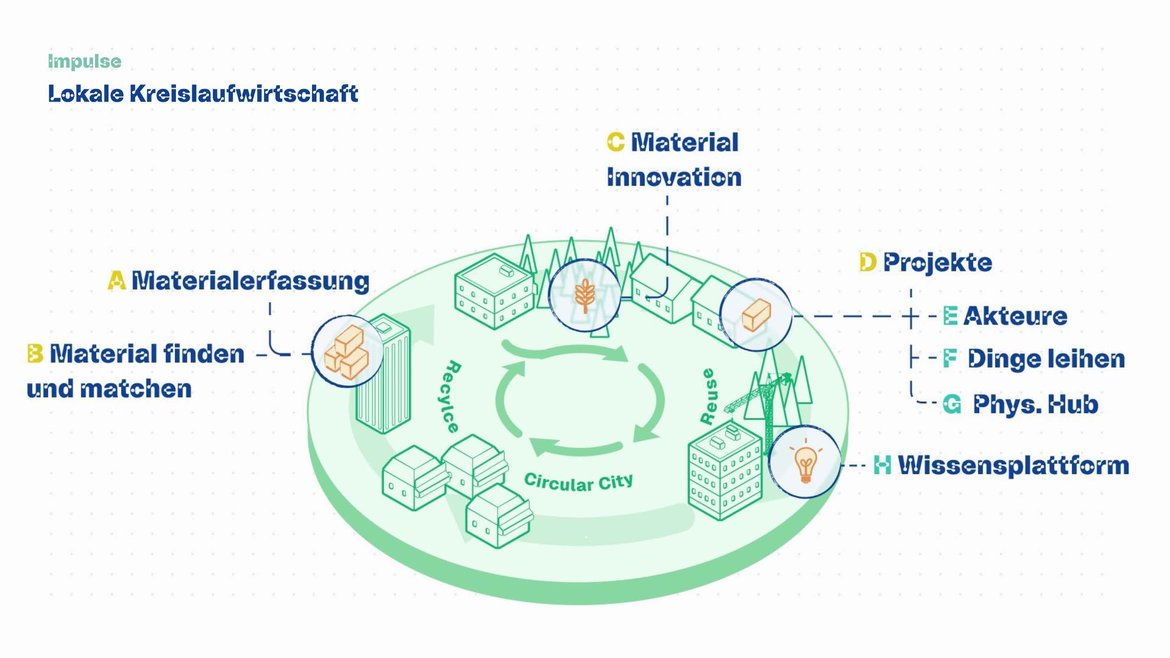
“The cabinet, as the centerpiece of our ‘Library of Things,’ is intended to encourage DIY projects and serve as a gateway to the Reallabor’s digital materials database,” says Martin Wiesner, explaining his subproject. There, users can access and share regional, secondary materials—that is, materials that have already been used once. It also provides information on sustainable building materials, project ideas, and instructions. Anyone who wishes can use the Zeitzer Zimmer as a building foundation—a project that combines open-source furniture plans with collaborative building and learning—another subproject of the ZEKIWA Zeitz Reallabor. The Library of Things complements this with the appropriate tools.
 © martin wiesner
Here's how the lending process is supposed to work
The tool-sharing cabinet functions as a shared tool storage area for the neighborhood. Anyone who wants to borrow a tool registers once—free of charge—reserves the tool, and picks it up from the cabinet within an hour. After use, the tool is returned, and the cabinet automatically registers the return. A smartphone app shows which tools are available.
Six items are planned for the launch: a cordless screwdriver, a cordless angle grinder (for cutting and grinding), a circular saw, a toolbox, a set of Japanese saws (hand saws that cut when pulled), and a hammer drill. The compartments come in different sizes; the smallest measures 30 by 45 by 12 centimeters. The team lists a hand truck, a sewing machine, and a projector, among other items, as potential additions. Demand will determine what’s needed.
When Borrowing Benefits the Environment
In developing the lending cabinet, the team relied on criteria established by the Federal Environment Agency (UBA). It lists three conditions for borrowing to reduce environmental impact: it replaces a purchase, the device has a long lifespan, and transportation distances remain short. “This was important to us because we operate according to the principles of the NEB,” explains Martin Wiesner, referring to the funding the real-world lab receives from the European Union and the state of Saxony-Anhalt through the New European Bauhaus (NEB) program. The goal is to jointly develop ideas that are sustainable and of high quality.
The Library of Things in Zeitz: Schedule and Outlook
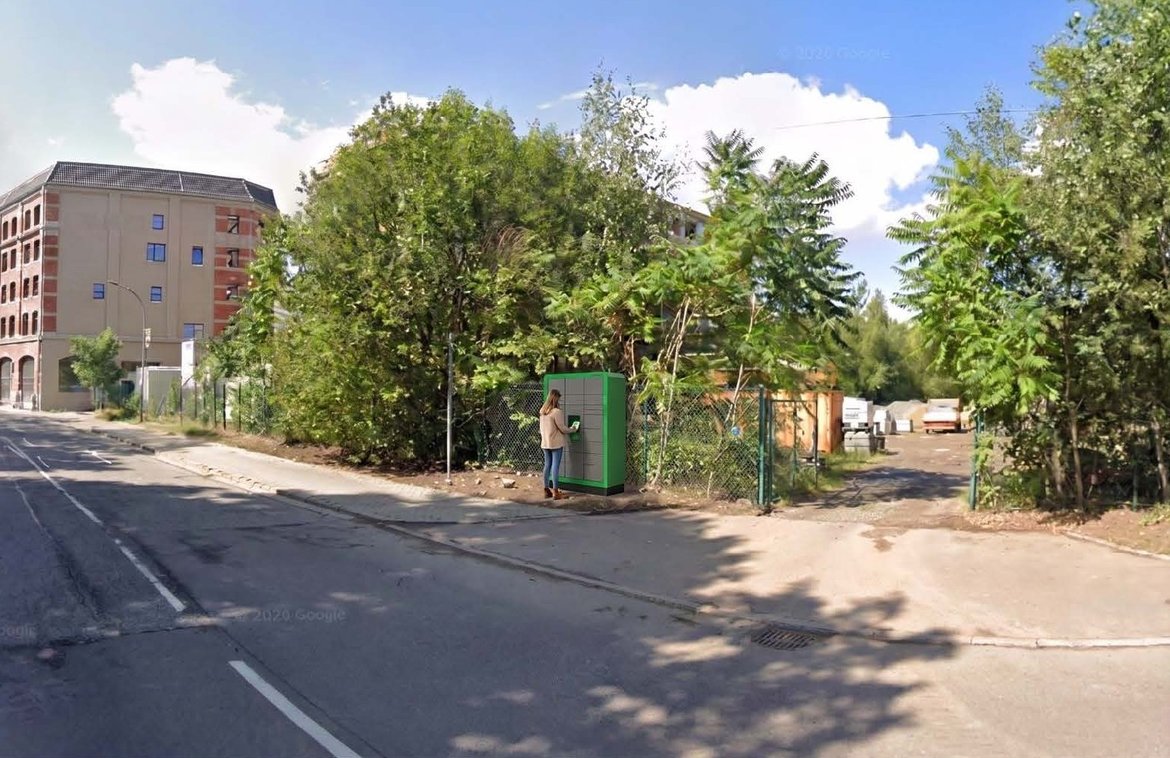
The coming weeks will show to what extent the idea of the lending cabinet is embraced and whether the “Library of Things” can be further developed: On November 10, the cabinet will be set up at the fence entrance on Geschwister-Scholl-Straße at the ZEKIWA site in Zeitz, followed by the opening in early December with an on-site furniture-making workshop in Zeitz.
“In the spirit of the New European Bauhaus, we are deliberately opting for an open concept in which both hardware and software can be further developed,” Martin Wiesner concludes, referring to the cabinet’s open-source software, which ensures that its functionality is transparent and adaptable for simpler applications.
 © martin wiesner, KI-unterstützt
Questions from the audience—answered by Martin Wiesner
Who will take care of the cabinet?
We—the Reallabor-Zekiwa-Zeitz team, later to be known as the Reallabor-Zekiwa-Zeitz Association—are happy to take care of this, and we’d also be happy to collaborate with partner organizations. Discussions regarding specific tasks are currently underway.
Why a cabinet with digital access rather than using vacant storefronts with in-person assistance?
Operating the cabinet is a solution that could be implemented using the project’s funds and will continue beyond the project’s end. Additionally, the loan service should be available around the clock, regardless of opening hours. Furthermore, the project cannot offer or promise any employment opportunities. The residents of Zeitz were involved through the joint development and design of the idea in various workshops. They are also involved in the implementation and management of the project.
(Editor’s note)
A comment from the audience with experience regarding similar projects: Repurposing vacant storefronts is often a workload. The spaces must be renovated, the previous use rarely aligns with the new one, and ownership and lease agreements must be clarified. This typically extends beyond the duration of such projects.
Are the tools handled with care?
We surveyed other projects on this topic, such as the Munich Tool Library and the Library of Things at the Stuttgart City Library. Damage occurred only in the rarest of cases there. We also expect that the joint decisions made with the residents of Zeitz regarding the lending cabinet will strengthen appreciation for the space and prevent vandalism.
Who is responsible for damage?
The project team will handle this, and later the association and the existing—and ever-growing—network in Zeitz. The procedures will be defined in more detail during the workshops in early December. The project plans to ensure that maintenance and training are organized in a binding manner.
Funding and Sources
The ZEKIWA Zeitz real-world laboratory will run from July 1, 2024, through December 31, 2027. It is funded by the European Union and the state of Saxony-Anhalt through the New European Bauhaus (JTF) program, grant number ZS/2024/07/188381. The Just Transition Fund (JTF) is an EU fund for regions undergoing structural change. Thanks to this funding, borrowing is free of charge. The planning details for the Library of Things were provided by the project’s initiators.
Contact: Visiting Professor Martin Wiesner, Anhalt University of Applied Sciences, Martin.Wiesner[at]hs-anhalt.de, Phone +49 (0) 3496 67 1748.
To the Anhalt University of Applied Sciences project page: https://www.hs-anhalt.de/projekte/projekt/neb-zekiwa-martin-wiesner.html
Visit the ZEKIWA Zeitz Real-World Lab project website: https://www.reallabor-zekiwa-zeitz.de/
UBA Publication: Gsell et al. (2015), “Use Instead of Owning: New Approaches for a Collaborative Economy”: https://www.umweltbundesamt.de/publikationen/nutzen-statt-besitzen-neue-ansaetze-fuer-eine
UBA Environmental Tips on Basic Strategies for Sustainable Consumption (2026): https://www.umweltbundesamt.de/umwelttipps-fuer-den-alltag/basisstrategien-fuer-einen-nachhaltigen-konsum-ein
Stuttgart City Library: https://stadtbibliothek-stuttgart.de/aDISWeb/app/opac?sp=SWI07000310
Munich Tool Library: https://erfindergarden.de/werkzeugbib/
Zeitzer Zimmer Project Page: https://zeitzer-zimmer.de/
More articles about Martin Wiesner on the Anhalt University of Applied Sciences Climate Blog:
What Are Chaff and Knotweed Doing in the Mechanical Engineering Lab?
Sustainable Design Today: For Aesthetics and Environmental Protection
