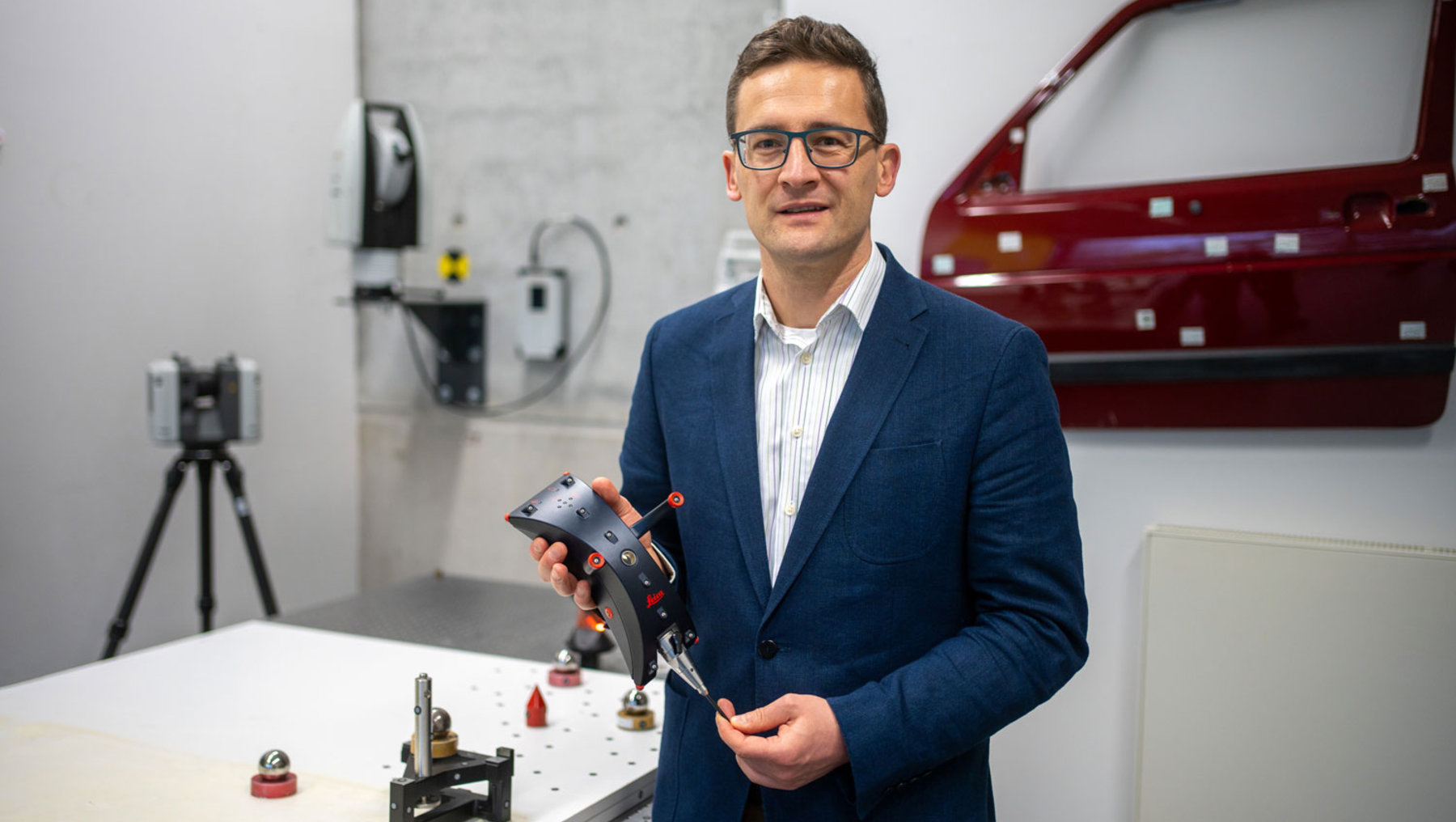
Prof. Dr. Jens Hartmann teaches students at Anhalt University of Applied Sciences the finer points of surveying - in a practical way. His specialty is the precise measurement and monitoring of buildings, a topic that is becoming increasingly important due to ageing infrastructure and current construction projects. Hartmann, who has held the professorship for Applied Geodesy since September 2023, focuses on a high practical component: "The students develop measurement concepts, carry out measurements independently, evaluate the results and interpret them critically." In the interview, the Degree Program Advisor explains what this work looks like using the example of the archway of the ruined bridge in Dessau's Georgengarten and what tasks await the students in order to ensure the long-term stability of this historical structure.
Professor Hartmann, what do precision and accuracy mean in surveying and how do the students practise this at Anhalt University of Applied Sciences?
Precision and accuracy do not necessarily mean the same thing. For example, precision describes the repeatability of measurements, while accuracy indicates how close the measured value is to the actual value. Accuracy is essential in everyday working life, as deviations can often have major consequences. At Anhalt University of Applied Sciences, it is therefore important to us that students learn to work carefully and plan measurements precisely right from the start.
How exactly do students practise these skills?
The high proportion of practical work here is a great advantage. As early as the first semester, students learn how to correctly place and operate measuring instruments such as total stations - usually on yellow tripods. The exact set-up and precise alignment on measuring points, which we call "centering" and "leveling", are crucial right from the start. We deepen these skills during the course of our studies, for example in the building monitoring project in Dessau-Roßlau. This is not just about collecting measurement data, but also about evaluating it and precisely understanding the possibilities of the technology used. In this way, students develop a particular care in dealing with measurements and acquire the skills to deal with measurement deviations. This approach makes our graduates stand out in their careers, as they learn to take responsibility for data quality.
Can you explain the project in Dessau-Roßlau in more detail?
The project has just started in cooperation with the city of Dessau-Roßlau and is a great opportunity for the students to work on a real structure. To do this, we go to the Georgengarten. There is an archway of the ruined bridge, which was recently secured. The students' task over the next few years is to regularly check how stable this structure remains and whether the reinforcement measures are working. The students are working from the ground up: First of all, they have to develop a measurement concept.
What is involved in such a measurement concept?
First, the students analyze the arch construction itself and the typical movements that are to be expected - such as the behavior during daily and temperature fluctuations. Then they look at where measuring points have been installed in order to record relevant measurement data. In this project, we use various measuring instruments, including tachymeters, which are set up at specific points. We will repeat the observations at certain intervals (temporal epochs). Over time, it will be exciting to see which movements (down to a few millimetres) we can detect and classify.
And how will the city and the students benefit from this project?
At the end, the students will produce a report, which we will also send to the city of Dessau-Roßlau. This will summarize the results and present recommendations. In the long term, this could show whether the stability of the arch construction remains guaranteed or whether further measures are necessary. The project is a win-win situation for everyone involved: the students work practically and learn how such projects are approached scientifically - and the city, which also carries out measurements here, benefits from additional data and new impetus for the preservation of the historic building.
Professor Hartmann, thank you very much for the interview.
