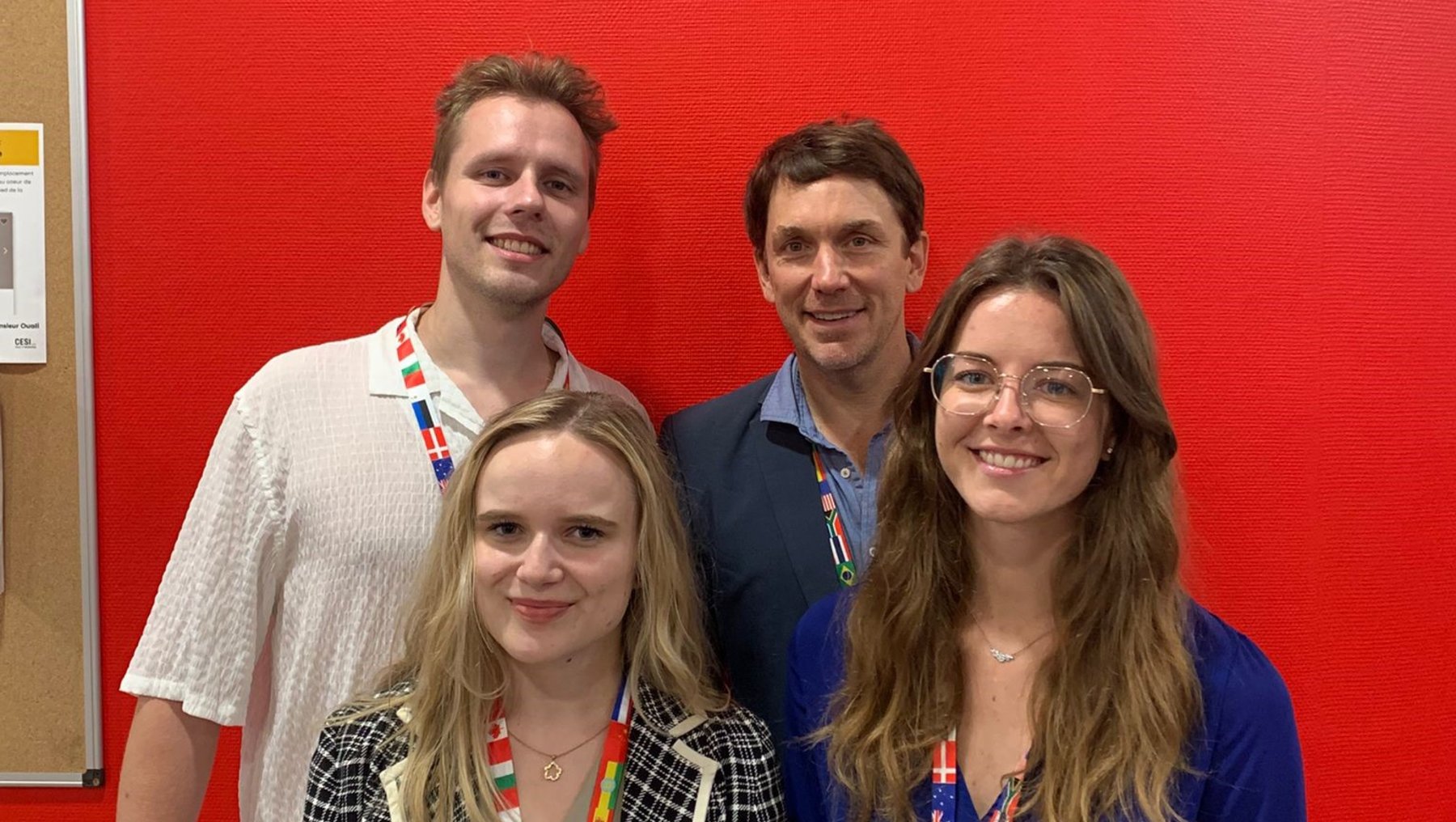
Anyone attending a lecture by Professor Dr. Daniel Michelis at Anhalt University of Applied Sciences will hardly find conventional textbooks, dry theories or pages of scripts that need to be memorized. Instead, the professor at Campus Bernburg takes students on a journey through a variety of projects that promote social engagement, support the development of networks and prepare students for professional life. He was awarded a teaching prize for this approach at an international conference in Paris. In this interview, he talks about his teaching style and how he wants to help students shape the world in a positive way.
Professor Michelis, congratulations! Who gave you the teaching award and what did you receive it for - and did you expect it?
The prize was awarded to me at the European Conference on Innovation and Entrepreneurship (ECIE), an international academic conference. I received it for a series of crowdfunding projects that I carried out over the past semesters in classes for the Online Communications master's degree program. I wasn't expecting that. As students are at the forefront of teaching, my idea was to present the crowdfunding approach with two students and show the jury how we create such projects. We then won the prize together. Working with students is a central part of my job. It was an exciting journey that took us all the way to the grand final of the competition.
How do you use crowdfunding in your teaching?
It's a class where students raise money for a good cause - in the past between 1,500 and 10,000 euros per project. The money goes directly to the selected partners, who always end up implementing the funded projects. My job is to teach the students how to create campaigns that motivate people to take action. How to establish a network from initial contacts that supports them in realizing their projects. So far, this has usually worked very well.
Do you have an example of this?
We'll be in the Fläming Nature Park next weekend. We are supporting the nature park in planting new trees on 1 ½ hectares. The students have raised 2,500 euros for the tree planting campaign. The suggestions for such projects usually come from the project partners or simply arise from within our own ranks. A few semesters ago, for example, a nature conservation student had the idea for a board game and wanted to market it with everything that goes with it. The students raised 10,000 euros together. Since then, the nature game Ecogon has been freely available to buy and further game variants have since been developed.
That sounds very good. Are the projects always so successful?
The projects don't always run smoothly, but it is precisely from setbacks that students learn to develop new solutions and react flexibly to obstacles. Initially, the students start in their personal networks. But they quickly realize that this does not get them to their goal. The motivation curve plummets. Gradually, they develop new, creative ideas for how they can make their project a success, what they need to do to achieve it, and this increases their motivation and commitment to achieve the goal.
What does the award trigger in you?
That you not only need new ideas, but also perseverance to motivate others. And it encourages me to continue on this path and make teaching an educational experience for students. For me, it is important to combine teaching and commitment.
How do you see teaching in 10 years' time?
I recently read that in 2030, all the work we do from home could be taken over by artificial intelligence. We need to prepare students for this development. However, we don't just have to teach them how to use AI, but also what AI can't do. For example, how we deal with each other in a trusting manner in order to achieve common goals. How they can rely on their individual strengths, build on them and grow personally. In the future, teaching must continue to impart knowledge, technologies and skills - but above all, what makes us human. Our thoughts, actions and deeds.
My teaching should continue to enable students to shape the world in a positive way.
Professor Michelis, thank you very much for the interview.
