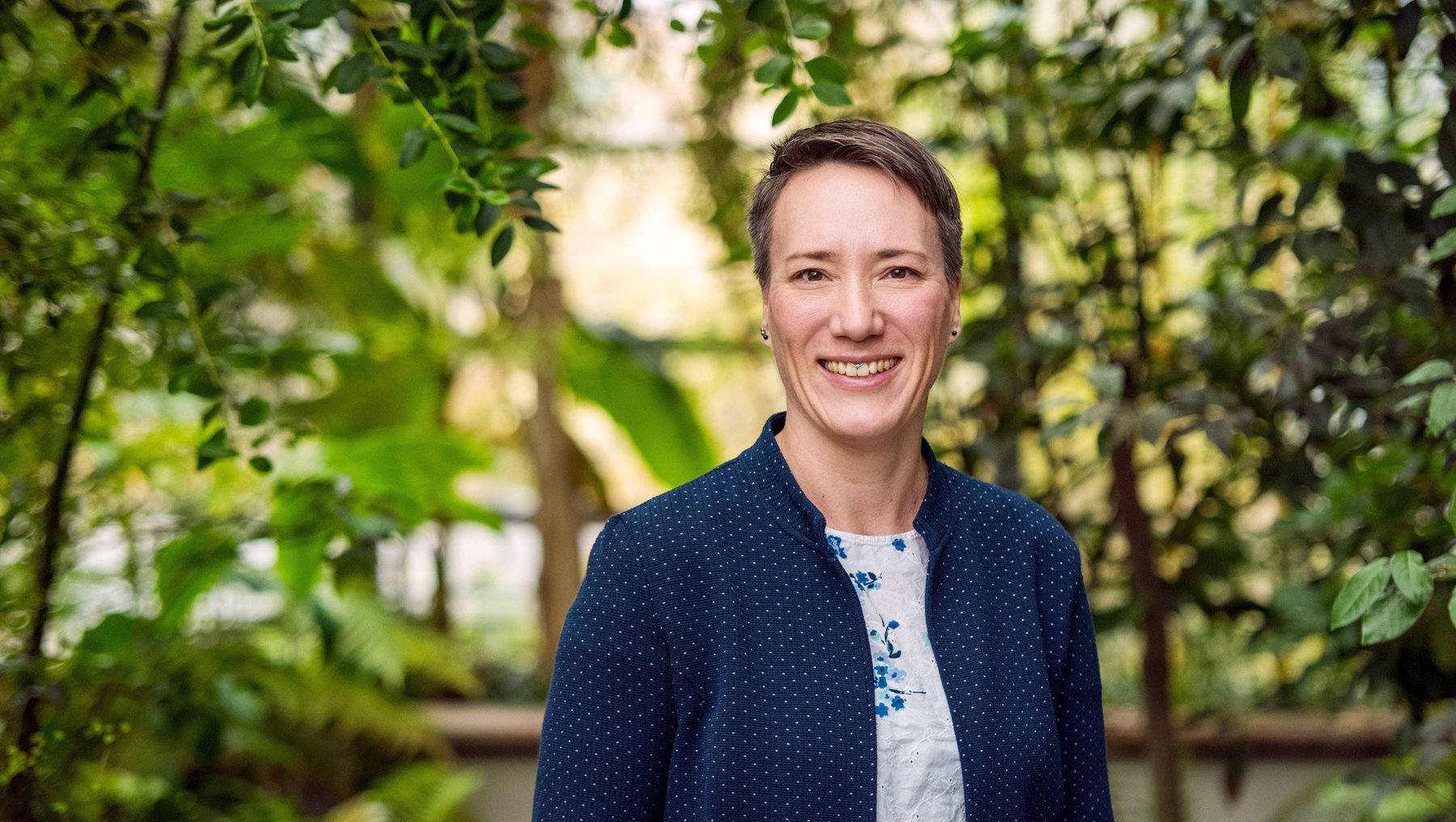
Dr. Monika Brückner-Gühmann has been Professor of Food Technology at Campus Bernburg since this semester. Whether plant-based cheese alternatives, sustainable product development or creative projects with real start-ups: her teaching combines theory and practice at eye level. In this interview, she talks about equality in science, self-confidence in her studies and how she wants to encourage her students to go their own way.
Dr. Brückner-Gühmann, you teach the basic modules in food processing. What can your students look forward to in their first semesters with you?
Exactly, at the moment I mainly teach basic courses in the Bachelor of Ecotrophology and the Master of Food and Agribusiness (courses taught in English and German). I try to make as many practical references as possible. I'm not just interested in conveying facts, but in promoting a real understanding of processes, interrelationships and real-life applications. I work a lot with practical examples and integrate practical courses in the laboratory. And I notice that the students really appreciate this. In the summer semester, we will focus more on product development. I'm particularly looking forward to that because we can work in small groups and get creative.
You worked at TU Berlin for a long time, most recently in a start-up. How does that shape your teaching?
I bring a lot from both worlds. At the TU Berlin, I worked for many years in teaching and research with a focus on plant-based alternatives, protein structuring and product development. In the start-up, it was all about bringing really new products onto the market, such as cheese alternatives based on proteins from fermentation. It was dynamic, very practical and entrepreneurial. I have a lot of questions from this time: What do start-ups actually need? What does industry expect from universities? What forms of collaboration work? Students benefit directly from this because, on the one hand, I have contacts in the industry and, on the other, I am passionate about applied research. This flows directly into my teaching.
Can we imagine the collaboration between the start-up world and the university as a mutual give and take?
Yes, that's exactly my aim, to develop this link. Berlin is not far away, so it's a good place to initiate cooperation. Industry representatives could come to Bernburg to see directly what we do here in our degree courses. Our facilities are excellent. And they could show the students what know-how and mindset is needed in practice. I would also like to work with the university's start-up center and see what can be implemented here locally. For example, a conference for Early career researchers or a conference where students and industry can exchange ideas would be conceivable. I would also find a kind of real-life laboratory with consumers particularly exciting - where the products we develop are tasted and discussed. For example, with the question: "Does this taste good?" or "Can this even be implemented at home?" I would therefore like to open this work up to the outside world: not only to industry, but also to society.
Are there any specific topics or projects that students can get involved in?
Yes, definitely. My main interest lies in the development of sustainable, plant-based foods. These can be classic milk substitute products, but also new concepts based on regional raw materials. I am particularly interested in climate-resilient plants, i.e. varieties that are good at coping with changing growing conditions and how they can be processed sensibly. The Bernburg site offers ideal conditions for this, so cooperation with Agriculture is a good idea. Our laboratories are very good: from the sensory laboratory to the Biotechnikum (BT - Building 29 - Bernburg), we have everything we need to implement creative, practical projects.
What is important to you when it comes to projects and theses?
It is important to me that the students not only work with me, but also develop and implement their own ideas. I give them ideas and suggest topics, but they should learn to work independently. After all, this is a key skill that they will need later on in industry. At the same time, I support them closely: with clear milestones, regular feedback and open discussions. I see myself as a kind of sparring partner in these processes, helping to move projects forward and reflect on them together.
What would you like to pass on to your students in addition to their specialist knowledge?
I want them to develop self-confidence. That they discover their strengths and learn to go their own way. Specialist knowledge is important, no question. But it is just as important to be able to deal with uncertainty, make decisions and take responsibility for your own actions. I myself had professors who showed me exactly that. If I can be a similar role model for my students, that would be a great compliment for me.
You are also committed to promoting Early career researchers. Why is that important to you?
I have two children and know from my own experience how challenging it is to combine a family and an academic career. For women in particular, this is often still a hurdle that is associated with many doubts. That's why I want to show that both are possible. I also see it as my responsibility to actively contribute to improving the framework conditions: through targeted programs, mentoring or simply by openly sharing experiences. I want to encourage young people to go their own way and show them that they don't have to choose between academia and family, but can do both if they want to.
Thank you very much for the interview.
