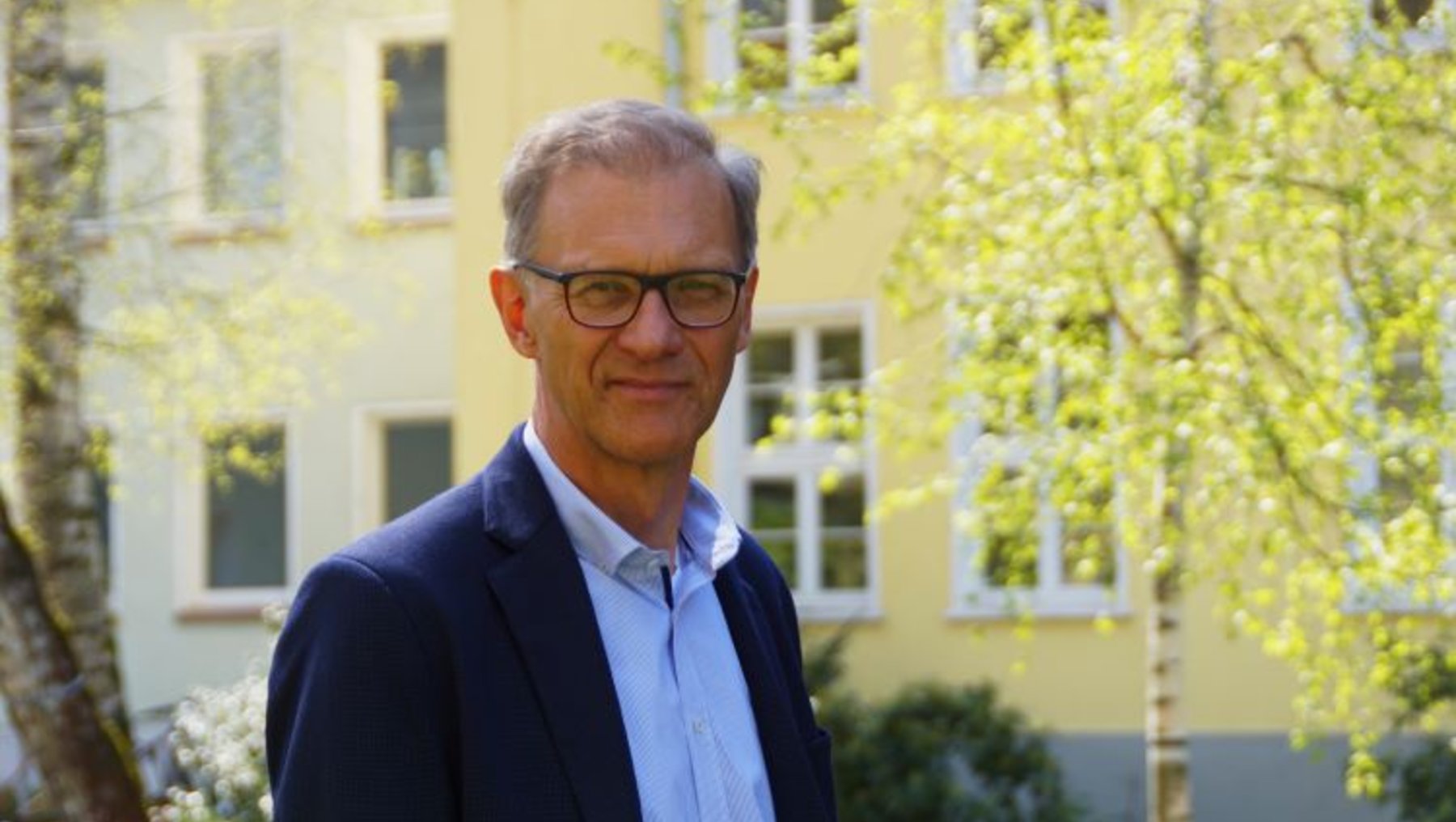
Professor Dr. Uwe Reuter helped set up the career-integrated Naturopathy program, sought Accreditation and is responsible for its supervision and further development. In 2022, he was appointed Honorary Professor of Naturopathy at Anhalt University of Applied Sciences due to his expertise. We spoke to the Zwickau native about his passion for Naturopathy, asked him how he got into it and what therapies Naturopathy can encompass. He also introduces us to his research in the field of pain therapy, explains the career-integrated program in Naturopathy and tells us what Dr. Wald can and cannot do.
Professor Uwe Reuter, you have been appointed Honorary Professor of Naturopathy in 2022. In your medical career, you have already completed numerous further training courses and specializations. You are a specialist in orthopaedics, have specialized in homeopathy and naturopathy as well as in special pain therapy and acupuncture. What fascinates you about your specialty?
For me, the human being is a work of art that I want to perceive in its uniqueness. People are very strong in their self-regulation, metabolism and self-healing and you can actually achieve a lot with just a few things. Naturopathy has a lot to do with plants and plant tinctures.
How did you first come into contact with Naturopathy?
I was a nurse in Dresden and came into contact with Professor Manfred von Ardenne, who was giving lectures on oxygen therapy at the time. Oxygen is something we definitely need - and Professor von Ardenne had started with oxygen therapies. That was my first contact with Naturopathy. During my medical studies, I then came into contact with various traditional methods - for example acupuncture or reflex therapies, manual therapy or osteopathy - through fellow students from Asia. I am now also a recognized pain therapist and also use Naturopathy.
Naturopathy - how long has it been around?
The first written mention of naturopathy can be found on 4,000-year-old papyrus scrolls on which the ancient Egyptians wrote plant tinctures. Naturopathy is therefore at least that old, perhaps even older. It is also interesting to note that the doctors had to wait three days before they were even allowed to treat.
Why was that?
We know that a cold lasts seven days with treatment and a week without treatment. So we already knew back then that the body is able to regulate itself in the first three days. If it didn't get any better then, they administered their plant tinctures and remedies to support the body.
What therapies does Naturopathy include?
In his day, Pastor Kneipp described Naturopathy as having five main pillars. These include hydrotherapy, i.e. treatment with cold and warm water, nutrition Therapy and fasting. Another crucial point is exercise therapy, physiotherapy and sport. Relaxation therapy and psychotherapy are also included. In a broader sense, you can also include traditional Chinese medicine, acupuncture and neural therapy, i.e. the use of local anesthetics. This is one of my areas of research. I co-developed the so-called procaine base therapy, a pain therapy in which we are currently researching and developing a procaine cluster (as procaine bicarbonate) that can also be used as a capsule or ointment, which is not possible with the original procaine.
How does procaine base therapy work?
Procaine is a local anesthetic that was previously used for minor operations. Procaine is an extract from the agave plant - today it is produced synthetically. It has been found that procaine in particular causes a kind of "reset" of the cells. Like a computer, it causes a kind of reboot. You can imagine a similar effect on nerve cells when this active ingredient is used as an infusion. This has a clear effect that can stimulate self-healing and has a very good effect. The base component is also added because we know that the procaine then has a longer effect. Procaine base therapy (procaine bicarbonate) can be used as an infusion or in capsule form, as an inhalation or as an ointment. Its use in pain therapy shows good results.
What does the career-integrated program in Naturopathy involve?
The degree program is based on an integrative approach. Naturopathy is part of medicine, it can reduce side effects, strengthen self-healing powers and improve living conditions. This is an important approach that we also teach our students.
We also address the limitations of Naturopathy in our courses and ensure that students recognize when standard medicine should be used. We try to incorporate evidence-based medicine. Evidence-based means, on the one hand, the practical experience of the doctors, but also external paper through studies. And we have patient prevalence - in other words, the question of what patients themselves want. Various studies in recent years have shown that 70 percent of patients want Naturopathy as part of their treatment. This combination and integration is desired and we also include this in the degree program.
What does the practical implementation look like and what happens after graduation?
In practice, we practise the course content of communication, patient communication and pleasant environmental factors. There are also various labs in standard medicine and Naturopathy to ensure practical implementation.
After completing the course, graduates can work as a Naturopathy assistant in a practice or clinic, or set up their own practice after passing the alternative practitioner examination.
Who can apply for the career-integrated program?
The degree program is open to anyone who has completed vocational training in the medical field, as well as laboratory assistants, physiotherapists and midwives who wish to enter the field of Naturopathy.
You helped set up the degree program in 2019 and were an important pillar for the knowledge to be imparted and the Accreditation. What did this process look like and when did the idea for the degree program come about?
We have a holistic approach in Bernburg, from plant cultivation to Ecotrophology, i.e. nutritional sciences, through to application in nature conservation. So it was a logical conclusion to include Naturopathy. In 2019, after various preliminary discussions, we applied for Accreditation of the degree program, which was confirmed in March 2023.
Naturopathy, holistic diagnostics, but also course development and auditing are part of your professorship, is that right?
Exactly, in addition to these content-related topics, I am also responsible for the further development of the degree program. From 2024, there will be a module on preventive medicine. The next steps are to develop this further, perhaps even in the direction of a Master's or modular course.
What do you have planned in terms of research?
One project would be to investigate the effects of biodiversity on human relaxation. They say that your blood pressure drops just by seeing something green - no, seriously, studies have shown that Dr. Wald contributes a lot to relaxation. There's just one thing Dr. Wald can't do - he doesn't make house calls.
What discovery, invention or insight would you like to see in the next ten years?
Something really simple: that people become aware of the importance of life. To treat themselves and the environment with love. Nature conservation is very close to my heart, because a healthy environment also has a healthy effect on people. The idea of prevention plays a major role in Naturopathy.
Do you have a motto that you would like to pass on to your students?
I would like to quote Hermann Hesse: "Happiness is love, nothing else. He who can love is happy. And he who believes he will never err, errs."
Professor Reuter, thank you very much for this interesting interview.
