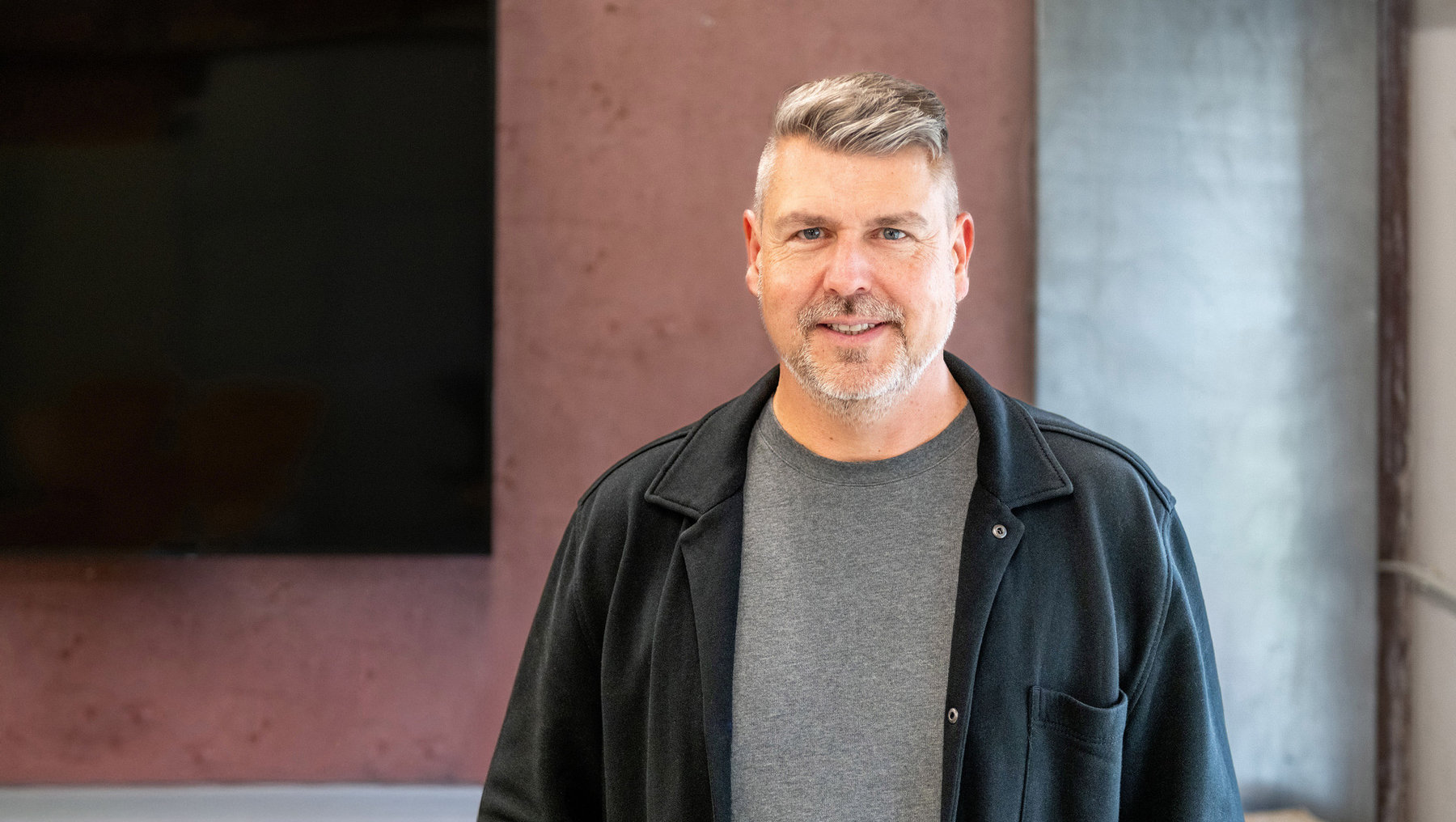
"Even the supposedly "ugliest" house becomes interesting if you spend three months looking at it intensively," says Prof. Gunnar Schulz-Lehnfeld, the new Professor of Monument Preservation Management and Building in Existing Contexts at the Campus Dessau of Anhalt University of Applied Sciences. He talks about the appreciation of existing buildings and why good planning always begins with careful observation. He also explains what is important to him as director of the international Master's program "Architectural and Cultural Heritage (all courses taught in English)".
Mr. Schulz-Lehnfeld, how would you describe your own background - are you more of a researcher, practitioner or mediator?
I originally come from an Architecture and Design background, but I worked in building research for many years. At the same time, I have always worked in practice: in architectural offices, in Monument Preservation Management and in renovation projects. This combination shapes my perspective. I know how important it is to ask the right questions early on, preferably directly on the building. After all, many problems only arise when the existing structure is not fully understood.
What does this "close look" mean in concrete terms?
We often lose knowledge about buildings more quickly than we realize. After just a few years, we sometimes no longer know exactly which materials were used or how a structure is actually built. It then becomes difficult, for example, to make an energetic credits or to plan conversions in a solid way. Suddenly things come up that nobody asked about before and it becomes expensive or complicated. For me, building research means deciphering the layers of a building, recognizing and understanding construction phases and changes before intervening. This is the basis for every decision.
Are you mainly concerned with very old houses?
No, not at all. I've worked on Romanesque churches, but also on half-timbered buildings, for example in Goslar, and on buildings from the post-war period. The decisive factor is not the age, but the approach. Any more recent building can be just as important in terms of cultural history or exciting in terms of design. All planning should begin with an understanding of the existing building.
What role do sustainability and recycling play in your field?
A very big one. Many pre-industrial construction methods are surprisingly sustainable in terms of their material logic: they are reversible, repairable and consist of clearly separable building materials. With industrialization came more and more mixed and composite materials, adhesives, foams; materials that can no longer be separated without destruction. This makes refurbishment and recycling difficult. That's why my approach is to think reversibly, i.e. to build in such a way that interventions can be reversed. Existing buildings should not automatically be replaced, but rather further developed.
The expansion of renewable energies - such as photovoltaics - is often controversial in listed buildings. How do you see it?
A lot has happened here. In federal states such as Lower Saxony, renewable energies are now given priority without compromising the historical substance.
Reversible installation and sensitive integration are crucial. In this way, climate protection can be reconciled with monument protection. I think that's a very positive development.
What classes are you currently taking on?
I teach the lecture "Fundamentals in Architecture Theory and Heritage Conservation" in the international Master's program Architectural and Cultural Heritage (all courses taught in English). The students come from very different disciplines - Architecture, Civil Engineering, Art History - and from many different countries. This diversity is a great enrichment, but also presents us with challenges. We have to teach the basics, but at the same time talk about our own thinking: about Eurocentric perspectives, about other building cultures, about the question of what actually counts as "heritage".
Can you give us an example of a current project?
Yes, we are currently working on an ensemble in Mosigkau, a former Economics and estate building. The first step is a thorough inventory: analysis of the building phases, material analysis, documentation. In the next step, the students develop design concepts and utilization concepts based on these results. The project shows very well how closely research, analysis and design concepts are linked. One semester is actually too short for this, but it is a start and we want to continue in the long term.
The Master's program has an international focus. What role does language of instruction play in this?
I would like to see both sides moving forward. Of course, international students should learn German in order to find their way in everyday life and in practice. But we instructors should also offer our courses in English so that knowledge remains accessible and barriers are broken down.
In the end, it's about getting into conversation with each other, and that often works surprisingly well with just a few words on both sides.
What would you like to pass on to your students?
Curiosity and accuracy. I want them to learn to really understand a building, to observe it, draw it, document it and ask questions. If you take a serious look at a building over a long period of time, you discover connections that you didn't see at the beginning.
I often say that even the supposedly "ugliest" building becomes interesting if you spend three months looking at it intensively. This kind of examination leads to appreciation, and it is the basis for working responsibly with existing buildings.
Thank you very much for the interview, Prof. Schulz-Lehnfeld!
