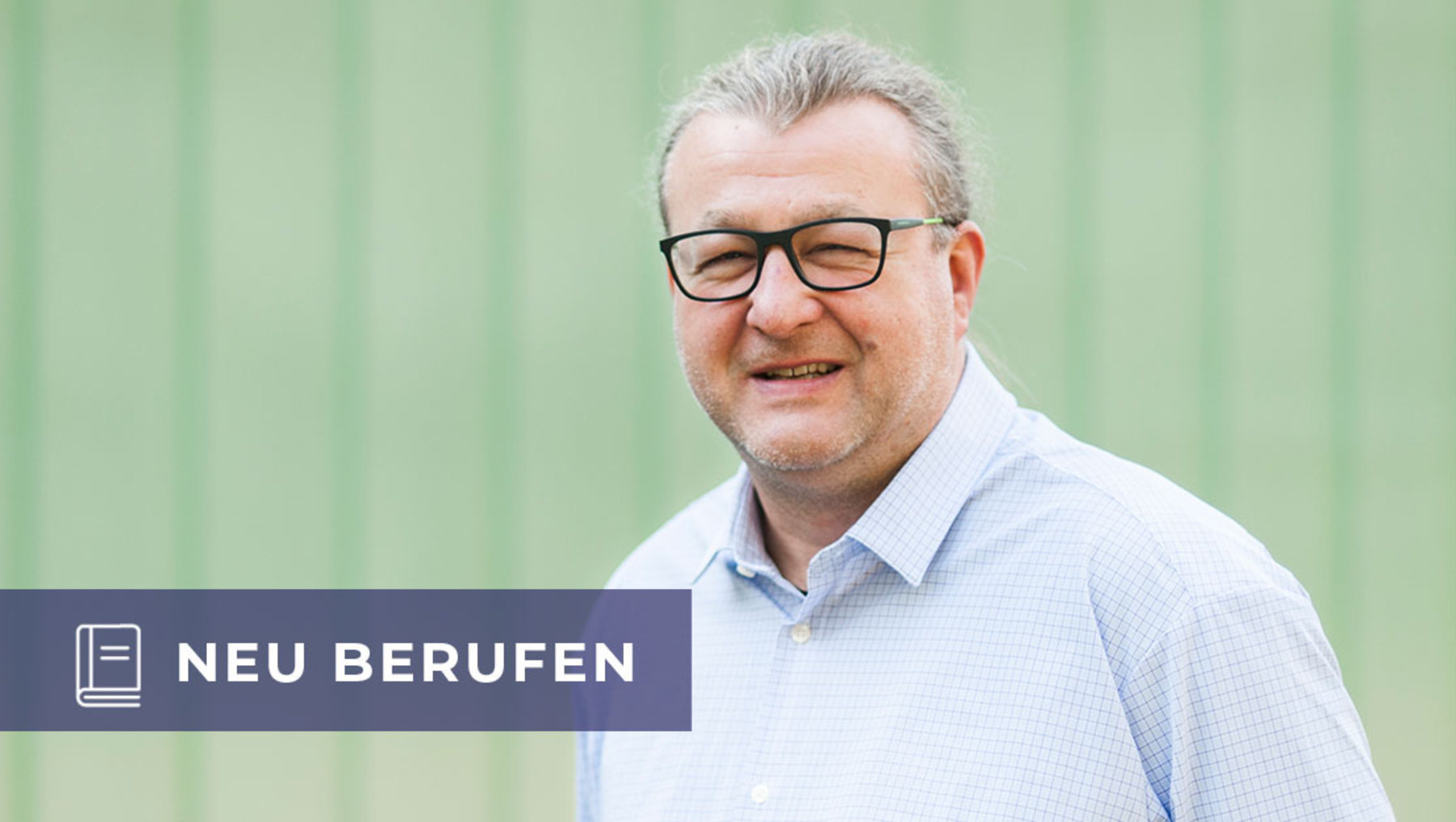
It takes the "bigger picture" to recognize problems and find holistic solutions, explains the newly appointed Professor of Microbiology at Anhalt University of Applied Sciences, Professor Tim Reuter. He is returning to his place of study, Bernburg, for the Department of Agriculture, Ecotrophology and Landscape Development. In his teaching, Professor Reuter draws on his wealth of experience from 18 years as a food safety scientist with the Canadian government.
Prof. Reuter, before we talk about your new tasks at Anhalt University of Applied Sciences, let's take a look back. After leaving school, you decided to do an apprenticeship in the butcher's trade. Did your parents or grandparents have a business?
No, I didn't really know what I wanted to do back then and thought I'd try butchery.
After five years, you then enrolled in Ecotrophology in Bernburg. How did that come about?
That's relatively easy to explain. It was the year of reunification, 1989. Suddenly everything had changed and completely new options had opened up. It was a very moving time. An entire world view had changed and people were right in the middle of it.
Was the change from working in a trade to the lecture hall a big adjustment?
Yes, definitely. When you haven't used your brain for so long and then have a pen in your hand again, a lot of things are new and exciting.
But it worked and perhaps your CV will also motivate today's apprentices who are thinking about going to university.
Possibly. In hindsight, I saw my path as an advantage. I had to learn less in anatomy and physiology than many of my fellow students, I had so many practical "incisions", I knew it all very good from the trade.
You became interested in your current field, microbiology, during your studies.
That came from my thesis supervisor at the time, Prof. Wolfram Schnäckel, and the subject of raw sausage. There was a great deal of interaction between Food Technology and food microbiology, which I found very fascinating.
Now you have returned to Bernburg after more than 20 years. What was your first impression and what are your plans for your time at Anhalt University of Applied Sciences? The university campus in Strenzfeld has retained its familiar flair, or rather it has become even more attractive thanks to many landscape architectural changes. A lot has happened in microbiology in recent years. I would like to add molecular biology to the teaching in my field.
How would you like to organize your teaching?
I try to make the lectures exciting and practice-oriented. Not just book knowledge, but to incorporate my own experiences into the subject matter. I want to get students interested in the subject of microbiology and hygiene and help them to think analytically. My expectations of the students are that they listen, "think together" and participate. In addition to technical content, I believe that teaching soft skills such as oral presentation, giving feedback and the visual presentation of content is also a vital part of the course.
Your own experience, which you incorporate into your teaching, also includes 18 years of experience abroad in Canada, where you first accepted an invitation from the Canadian government to work at the Agriculture and Agri-Food Canada research center in Lethbridge, Alberta. This was later followed by a position in Alberta's Agriculture and Food Sectors at the Alberta Ministry of Agriculture. How did this invitation come about?
They had read my work that I had published as a doctoral student on the subject of genetic engineering. Genetic engineering was a very big topic in the 1990s, I had written publications on molecular biology and nutritional physiology and I was asked if I would like to come to Canada to work at their institute.
... and then you said "yes"...
No, I said no at first (laughs)! What am I supposed to do in Canada, I thought (and where in the world is Lethbridge?). I was working at the University of Veterinary Medicine in Hanover at the time. It wasn't until quite a while later that I decided to leave. And that's when I left.
What were your areas of responsibility?
I was a scientist and primarily researched the topic of food safety - from Agriculture to the plate. One concept that we pursued not only in Canada is called One Health. This is an approach that aims to improve the health of the environment, animals and people. Here, many disciplines, not just scientific ones, think and work together - we try to gain a better understanding of the interactions between the individual disciplines, such as human and veterinary medicine. I also try to convey this concept to the students in Bernburg. It is important to me that the students see the connection between the individual sub-disciplines and recognize how the individual pieces of the puzzle then merge to form a picture. When looking for a solution, I like to advise them to first zoom out 10,000 meters and look at the "Bigger Picture".
Can you give us an insight into your field of research? What excites you most about your scientific specialty?
I wouldn't call it a specialty, but the complex and evolutionary development of pathogenic microorganisms and especially bacteria that can make people ill fascinates me a lot. My medium-term plan is to build up the molecular biology department in Bernburg and then continue to investigate the spectrum of effects of these pathogenic microorganisms.
Do you have a motto that you would like to pass on to the students?
The quote "Imagination is more important than knowledge, because knowledge is limited" by Albert Einstein.
Thank you very much for the interview.
