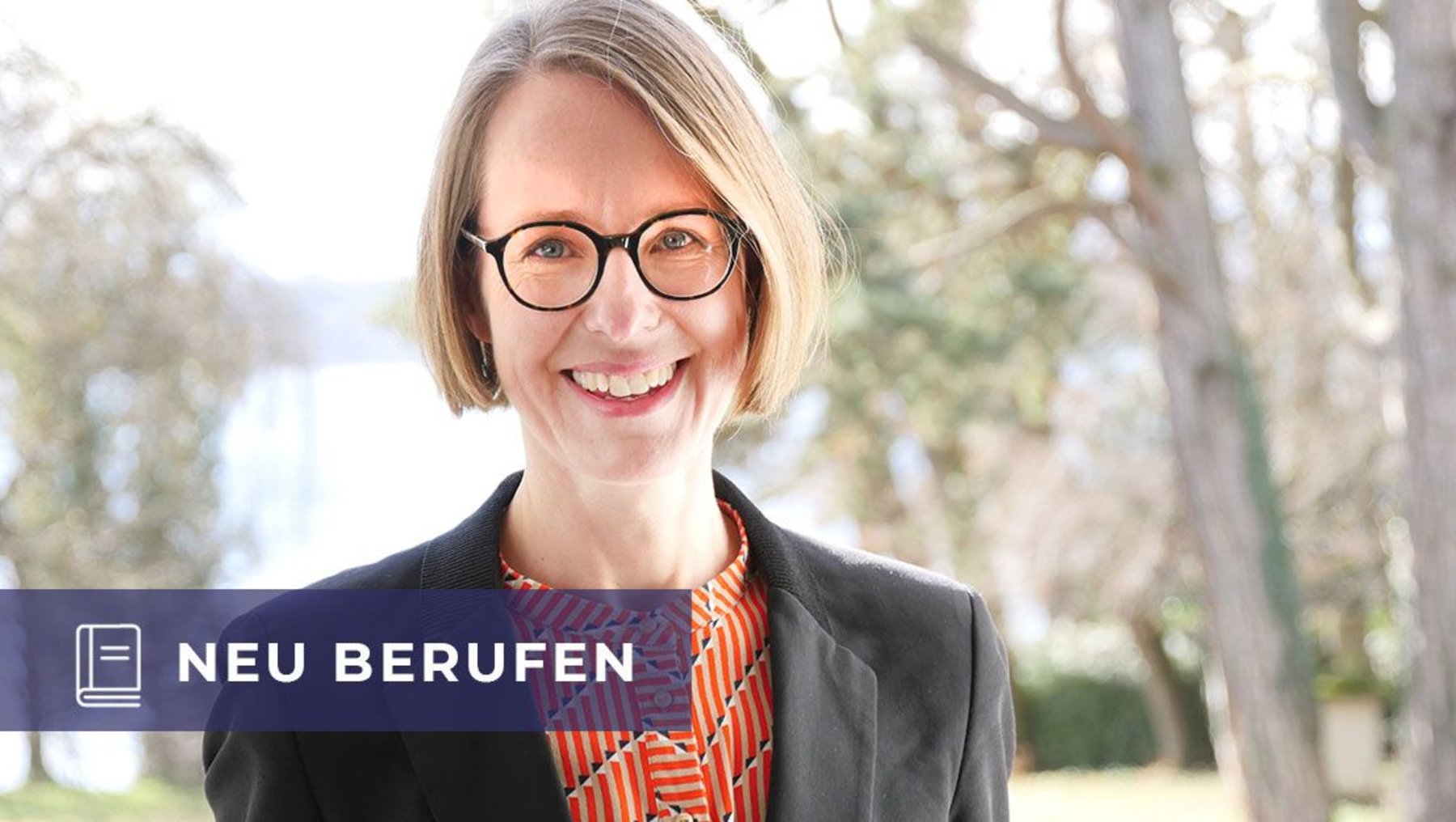
With the start of the summer semester, Anhalt University of Applied Sciences welcomes Dipl.-Ing. Nadja Häupl as a new professor in the Department of Architecture, Facility Management and Geoinformation for the field of urban design. The practicing, lecturing and researching architect works in the field of sustainable urban and rural development. In this interview, she gives an insight into how she will involve students in her work.
Professor Häupl, welcome to Anhalt University of Applied Sciences. After studying Architecture at TU Dresden and on a scholarship at the University of Oregon (USA), you initially stayed in Dresden as a research assistant at the Chair of Public Buildings .
What career path did you take afterwards?
I then worked as a project manager at Weinmiller Architekten BDA in Berlin. In 2007, I moved to the urban planning department of the Faculty of Architecture at the Technical University of Munich, where I joined the Chair of Sustainable Urban and Rural Development in 2010. There I designed and supervised seminar and lecture series as well as design studios as real laboratories. I also managed third-party funded projects and third-party funded research and expert reports, which took me to regions in Switzerland, northern Italy, Austria and Germany. Most recently, I held teaching positions at the OTH Regensburg and the Carinthia University of Applied Sciences.
What were other important professional milestones for you?
Parallel to teaching and research, as a freelance architect I realized several building group projects in Leipzig and Dresden as a sustainable form of neighbourhood development. In 2017, I founded www.ortegestalten.de with Stefanie Seeholzer to transfer the experience and findings of collaborative building together with those of sustainable urban development from the university to municipal practice - and vice versa.
You have now been appointed Professor of Urban Design in the Department of Architecture, Facility Management and Geoinformation. What will be your responsibilities?
I will be leading lectures, practical courses and seminars in both the Bachelor's degree program in Architecture and the international master's degree program DIA. One of my main tasks will be teaching in design studios, which is the core of the Architecture course.
What goals are you pursuing here?
As a practicing, lecturing and researching architect, I am active in the sustainable development of urban and rural areas. I would now like to contribute and deepen this profile at the Anhalt University of Applied Sciences in Dessau, alongside the Bauhaus and the Federal Environment Agency. In the spirit of these institutions, I would like to work with them to send impulses into and beyond the region.
What challenges might there be?
First of all, despite the coronavirus contact restrictions, we need to network locally: with my colleagues in the Department in Dessau and the Department of Agriculture, Ecotrophology and Landscape Development in Bernburg, with the Bauhaus Dessau Foundation Academy, the Federal Environment Agency and various ministries in Magdeburg, the Federal Foundation for Baukultur in Potsdam and with urban planning offices. The idea of a "European Bauhaus" gives new impetus to these institutions to develop and live such a regional network.
What research projects are you currently working on to enrich the university?
For the time being, I will enrich the university through my network from my most recent professional practice, namely my work for the Evangelical Lutheran Church in Bavaria. This will give rise to topics for my first urban planning real-world labs in the upcoming summer semester: the Protestant Academy on Lake Starnberg in Tutzing and the preacher's seminary on Lake Wöhrder in Nuremberg. In both cases, the focus is on redensification potential for a non-profit organization in a challenging urban context.
How can students benefit from this?
Students can benefit from these case study-based design laboratories with cities and municipalities in Saxony-Anhalt, Germany and Europe through projects and theses. They practise an interdisciplinary approach and take responsibility for their own designs. Conversely, towns or districts can benefit from cooperation with Anhalt University of Applied Sciences. Real-world laboratories of this kind mean a considerable workload for us lecturers in the preparation, supervision and subsequent evaluation of the results for the cities and municipalities, the case study-based research and the university's public relations work. But this exchange is definitely worth the workload.
The summer semester is starting in online mode. What challenges do you face?
Teaching urban planning without seeing and analyzing spaces as part of excursions, without meeting people in these spaces, without collaborative work in the studio and on the large model of the surroundings - that's actually hardly possible. The technical possibilities compensate for a lot, but in my opinion they can't replace working in the real three-dimensional world.
Apart from your job, do you have a hobby to compensate?
Reading, traveling, eating, going to concerts, walking through the city, hiking through the countryside - all these pleasures are not a compensation, but a stimulus for me as an architect. That's why I love my profession!
Prof. Häupl, thank you very much for the interview.
