Doing a doctorate in design? This is rather rare, but is becoming increasingly important - and attractive. Prof. Dr. Michael Hohl talks about the reasons for this in an interview. He is an expert in design theory and research at Anhalt University of Applied Sciences. At the still young Doctoral Center Architecture and Design Research, he supervises various scientific works, which were also presented at this year's national colloquium "Design promoviert" on Campus Dessau.
"The design process is often a research process"
-
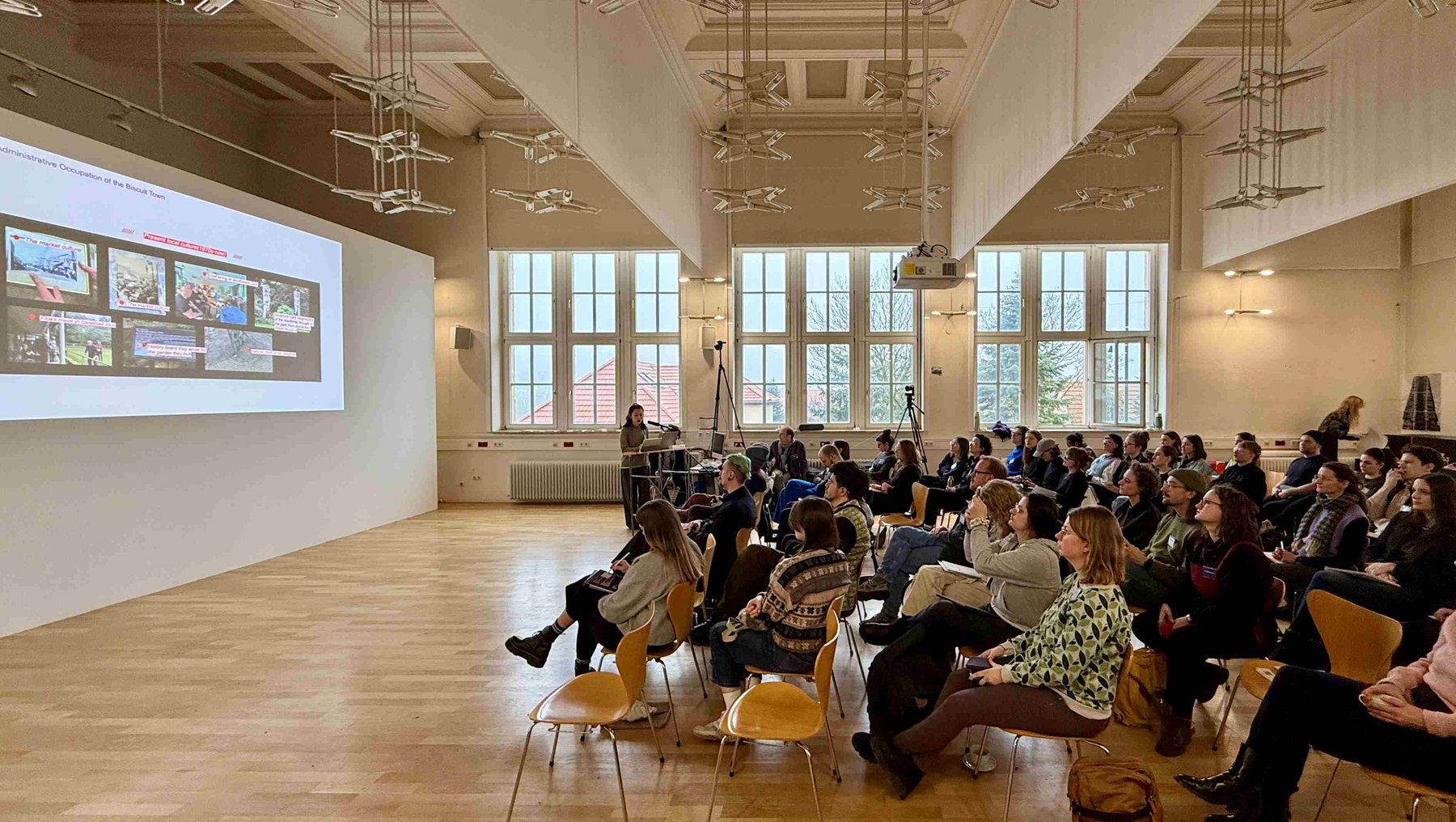 © hs anhalt | Arne Berger
The colloquium "Design promoviert" at the beginning of 2025 on the Campus Dessau of Anhalt University of Applied Sciences. The focus was also on doctoral projects at Anhalt University of Applied Sciences.

The world around us and also the products have become more technological, more complex and more complicated. Much more knowledge and skills are required to bring a product to market.
Prof. Hohl, how does scientific work in design work?
What scientific work in design can look like is still somewhat unclear in this country and is currently in the process of developing. The German Society for Design Theory and Research (DGTF), for example, was only founded in 2003. It was possible to do a modern doctorate in Jena from 1807. Academic work and research in design is therefore still relatively new in Germany compared to doctorates in other subject areas and has only started to gain momentum since the Bologna reform. Subsequently, doctoral centers for design were founded at German universities, although some already had the right to award doctorates. The right to award doctorates alone is not sufficient, it takes a concrete location, time and good will, a critical mass of researchers, framework conditions and structures to build a research culture. Design is a little late to the game here. In addition, design, like the other practice-oriented disciplines, finds it somewhat difficult to implement the scientific claim and canon of knowledge. As a rule, few of the lecturers have a doctorate and most of them come from the field of design and art. Design cannot be learned from books, but only by doing. The Bauhaus, for example, did not yet have a library.
What reasons do you see for the fact that doctorates have played less of a role in design to date?
New knowledge and excellence are only exceptionally demonstrated here in the form of academic publications, but in other forms: In prizes, honors and awards, for example jury invitations in competitions and calls for proposals, for example from the Bauhaus Museum Dessau, in invitations to host exhibitions and panel discussions. Their own work appears in the publications of others, in interviews and reports in the media. For example, two doctoral students in the field of design, whose research I helped to supervise, were invited to present their design research to international guests from the fields of economics and politics at the World Economic Forum WEF in Davos. New knowledge with social, cultural and Economics relevance, but more likely to be found in a documentary on ARTE TV than in a scientific publication. The Vorort e.V. project here in Dessau, which has over 30 members from the university, can be classified in a similar way. Vorort e.V. has won various prizes for urban development and has been recognized by the Federal Ministry of Housing, Urban Development and Building as a special example of good practice. Innovative design work with direct social relevance takes place here. It could also be a very good location for a doctoral position.
In the natural and cultural sciences, the aim is to understand the world as it is. Design is about improving something through new design concepts and changing the world as a result.
How does scientific work differ from research in the natural and cultural sciences? What research directions are there in design?
In the natural and cultural sciences, the aim is to understand the world as it is. Design is about improving something through new design concepts and changing the world as a result. Just like the car, blue jeans or the internet have changed the world. In design, simply put, a distinction can be made between three different types of research. The first is "research about": this can be historically oriented and analyzes specific examples of Architecture, Art and Design. For example, the history of innovation in the weaving class at the Bauhaus. Then there is "research for": this can be, for example, new technical material developments, processes or surface treatments - such research results then flow into innovative products. Finally, there is "research by": here, design methods are used to generate new knowledge. Practice, theory, testing, observation, etc. can alternate in an iterative learning and design process. This representation of the types of research is now roughly simplified; often all three are used alternately. The final step is often artifacts (prototypes, models, work) that are exhibited and in which the knowledge is implicitly contained. This can be a new technique, a new process, a model or something similar. In scientific research, however, the process must be documented and made explicit in an analytical, critical and thorough dissertation. The new theory, materials, methods and models that have been developed through practice can then be found here.
Why is research important for design?
The world around us and the products that surround us have become more technological, more complex and more complicated in recent years. Nowadays, much more knowledge and skills are required to bring a product to market than 30 years ago. The design process is often a research process, where it only becomes clear in the process what problem is to be solved and what solution is appropriate. In recent years, for example, I have supervised pioneering design research work based on new findings in neuroscience and neuroplasticity. One designer used this knowledge, for example, to specifically strengthen the sense of balance. Today, such products are often developed by interdisciplinary teams and tested and refined together with users during the development process. Aspects of the social sciences, psychology or neuroscience can often come into play here, alongside knowledge of materials and production. Design is therefore not limited to the superficial aesthetics and function of products, but often considers them as a system and as a cycle: Where do the materials come from? Under what conditions are they put together? What happens to it when we throw it away? How does it affect users and the environment? These are all topics that have gained in importance in recent years and show how important scientific work and research in design have become.
-
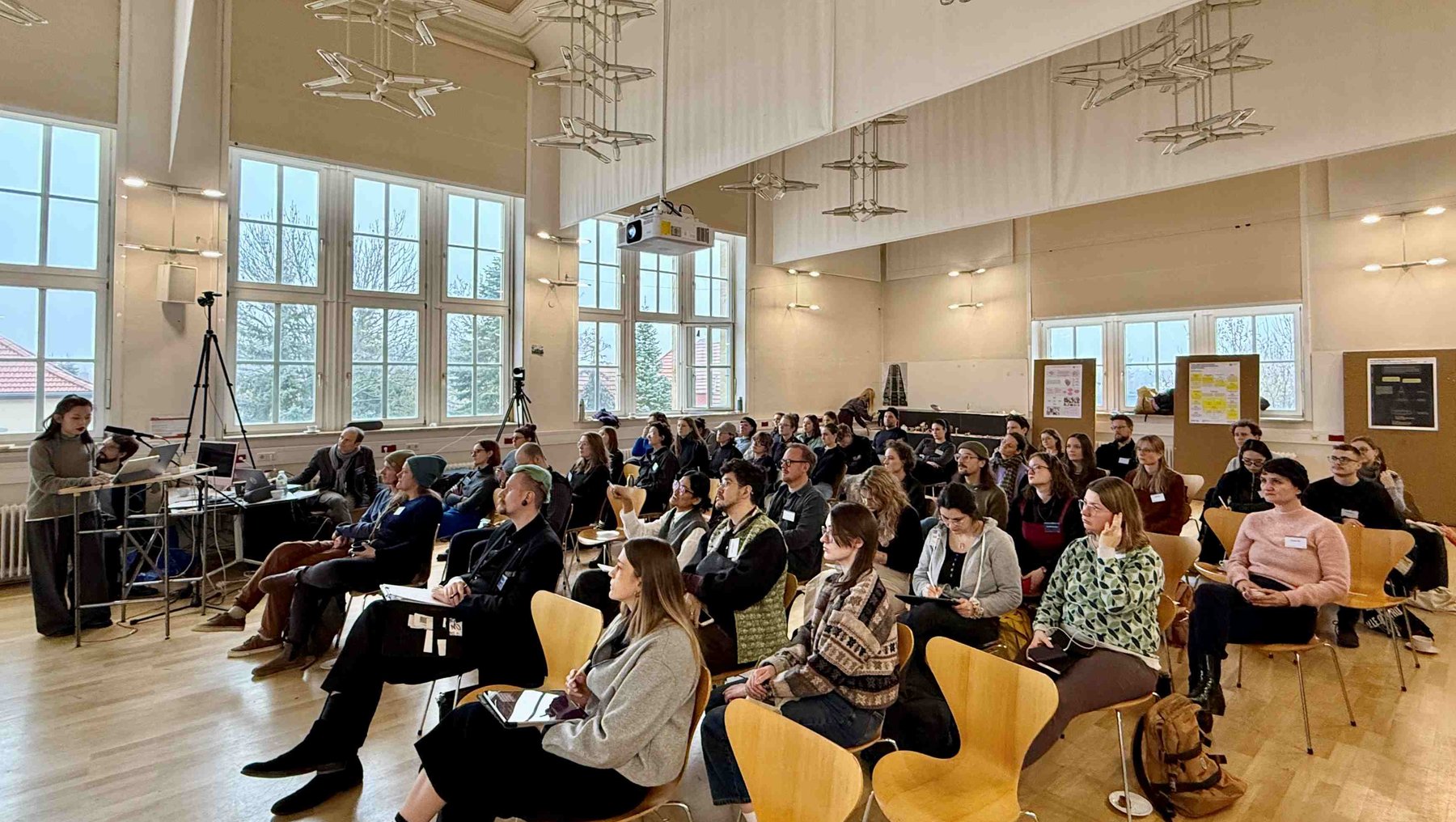 © hs anhalt | Arne Berger
The Lyceum on the Campus Dessau of Anhalt University of Applied Sciences offered sufficient space for the design doctoral students from all over Germany - for lectures and exchange. -

You have been involved in design research for several years now. What is particularly important to you personally?
Responsibility for the next generation is particularly important to me - helping to build and support a positive, open research culture of integrity in the departments and at the doctoral center. Research and academic work do not take place in a vacuum, but have a decisive social component. Research thrives on a lively exchange of experiences, on criticism and questioning, on good communication when sharing new findings, methods, methodologies and experiences. From scientific integrity, honesty, thoroughness, honesty and critical discourse.
Which doctoral projects were presented by Anhalt University of Applied Sciences at the colloquium on January 18 and are these groundbreaking for the Doctoral Center Architecture and Design Research?
The range of projects at the doctoral center is very broad and includes all three types of design research described above. On the one hand, there are more technical projects in the field of AI, where a clearly limited, technical task is implemented within a larger project for the doctoral project. There is a project on Architecture and how certain architectural patterns, such as on-site servants, have become established in modern architecture. Furthermore, there are projects that look at teaching in design, including how virtual reality can be incorporated into teaching, and also a research paper that critically explores how ADHD can be influenced by the use of design methods. This is just a brief, simple insight into the complex issues.
What challenges does a designer who wants to do a doctorate face?
For me, there are two main issues. I think the biggest challenge is to realize that you don't necessarily have to take on a "big" research topic, but that "small" problems can often be particularly difficult to answer. This can also include observations from your own practice. This is where it can be particularly interesting to produce new findings.
The other challenge I see is that funding needs to be clarified. Doctoral research in design is a great burden and challenge. At the beginning, I showed that each case is unique in its own way and that it is rarely possible to fall back on "tried and tested" methods and methodologies. Real design research therefore has many aspects of a journey into the unknown, on which one should be able to concentrate fully in order to complete it successfully. Unresolved funding stands in the way of this.
Responsibility for young talent is particularly important to me - to help build and support a positive, open and honest research culture in the Departments and at the Doctoral Center.
To what extent can the doctoral center founded in 2021 contribute to the promotion of design research?
Here, too, I see a lively exchange and an active research culture as a particularly important element. It's less about academizing design and more about tackling complex challenges in a more critical and reflective way - without unnecessarily scientifying design. Determinism, logic and technical rationality have their place primarily in other scientific fields. I realized this myself in the course of my own doctorate, when I was stuck, and later observed it again and again with the doctoral students I supervised. In design, as in the natural sciences, outstanding research is usually linked to good observation, intuition, curiosity and openness, new questions, chance, assumptions, spontaneous findings and surprises. This is also presented and discussed at the doctoral center, and the knowledge and findings are brought back to the departments. In this way, the doctoral center radiates into teaching and the research culture.
You are currently working on a new edition of your book on doctoral studies. How will it differ from the first edition?
The text will be completely revised and will contain four additional chapters. One on research culture and the social dimension of research, one on supervising doctoral studies, then one on doubt and certainty in research and finally an annotated list of further literature. It is due to be published in October 2025.
Doing a doctorate in design at Anhalt University of Applied Sciences:
More information on theory and practice, teaching and research by Prof. Dr. Michael Hohl can be found on his personal page: https://www.hs-anhalt.de/hochschule-anhalt/service/personenverzeichnis/person/prof-dr-michael-hohl.html
If you would like to find out more about the Doctoral Center Architecture and Design Research, you can find out more here: https: //www.hs-anhalt.de/forschen/promovieren/promotionszentren/architektur-und-designforschung.html
The "Design promoviert" colloquium is an initiative of the German Society for Design Theory and Research (DGTF). Twice a year, interested parties have the opportunity to exchange ideas about doing a doctorate in design. The colloquium on 18 January 2025 on the Campus Dessau of Anhalt University of Applied Sciences was organized by Prof. Dr. Michale Hohl. The program is still available here: https://design-promoviert.dgtf.de/wp/wp-content/uploads/2025/01/31-DP-Programm.pdf
New dates will be published on the DGTF homepage: https://design-promoviert.dgtf.de/
