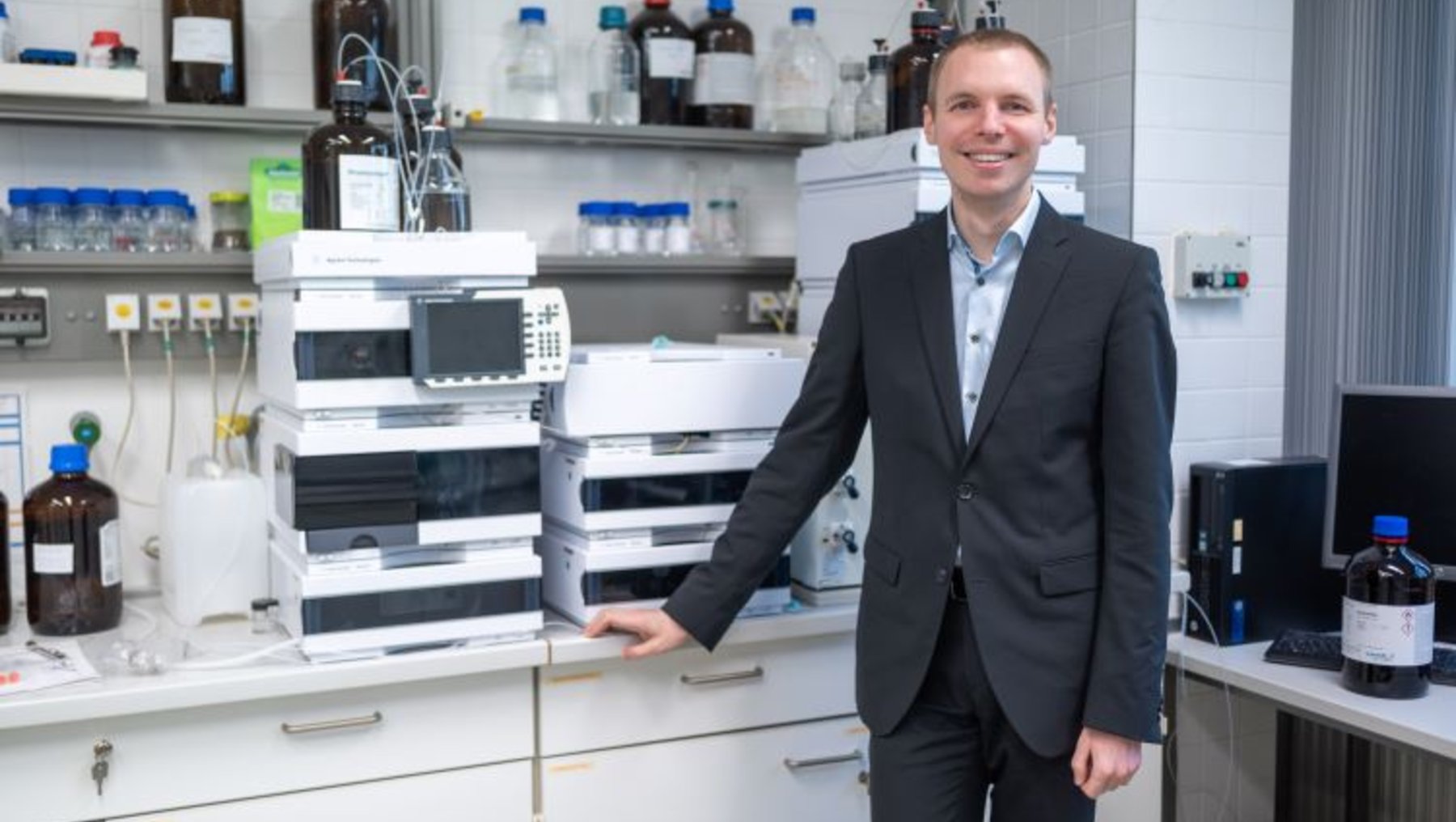
At just 31 years old, Dr. Christoph Wiedmer is taking over the professorship for Food Science at Anhalt University of Applied Sciences. In this interview, the native of Nuremberg explains what students can learn from curious cases such as the repurposing of food supplements as "garden gnome food" and why an interdisciplinary perspective is fundamental for budding ecotrophologists.
Professor Wiedmer, welcome to Anhalt University of Applied Sciences. According to my research, the youngest female professor in Germany is 26 years old. At 31, you are also a very young professor. That is quite an achievement. Can you tell us something about your motivation to pursue an academic career?
It really just developed that way. I was already involved in training food chemists for the second state examination during my previous employment at the Bavarian State Office for Health and Food Safety. I gave lectures there and thus gained an insight into teaching. I also took on a teaching assignment for food law at the Technical University of Munich in the field of nutritional sciences. This made me realize that teaching is something I really enjoy. So it was a logical step for me to then put my academic motivation into practice as part of a university professorship. When the professorship for food teaching was advertised at Anhalt University of Applied Sciences, I saw a great match between my skills and the requirements of the position. I simply had to apply and am delighted that it worked out.
What subjects will you be teaching in the future?
My teaching focus is mainly on sensory analysis, food law, as well as product knowledge and food toxicology.
How do you plan to pass on your specialist knowledge and your enthusiasm for teaching food to students?
The special thing about food science is that it is incredibly relevant to everyday life. We all have to eat every day and this fact provides an excellent opportunity to link theoretical concepts directly to practical examples. For example, I could spend hours per semester explaining the legal definition of food in theory, which is undoubtedly important. But I can also look at why this is relevant in practice, for example when a manufacturer suddenly repurposes a food supplement as "garden gnome food". There was actually such a case a few years ago. Is it then still a food or not?
Wait - a food supplement as garden gnome food?
Exactly! However, the entrepreneur didn't get very far with it - the competent administrative court put a stop to the whole thing. But these are real-life cases that make it clear why a sound understanding of food law is so important. It makes it clear that food does not necessarily have to be intended for human consumption, but that it is sufficient if it can reasonably be assumed that it will be consumed by humans. Food supplements remain food for humans, not for garden gnomes.
What is your field of research?
My field of research covers two main areas. On the one hand, I deal with human sensory science, i.e. the evaluation of the properties of food through the human senses such as taste, appearance and smell. To ensure that no subjective individual opinions are recorded here, I work with sensory panels, i.e. groups of people who evaluate the products. We then calculate objective mean values from these credits. I also combine the results of the sensory analyses with chemical analysis: For example, if a food has an off-flavor, I can use sensory analysis to determine the fault, but not necessarily the cause. However, if I also analytically detect and identify the odorous substances contained in the food, I understand the cause of the off-flavor and can use this knowledge to develop strategies to prevent it from occurring.
And with the results you can develop products that are liked by everyone on average, or is there a different goal?
That always depends on the specific question. My main aim is not only to assess how the products taste, but also to understand which specific substances are responsible for the taste. With this knowledge, you can then take different directions.
For example, manufacturing processes can be optimized so that desired flavouring substances are formed to a greater extent, but strategies can also be sought for products with off-flavours in order to avoid the development of off-flavours. The latter is also relevant in the development of meat substitutes, for example, which should not taste like their plant-based ingredients, but rather like the traditional meat dishes they imitate. Even if you want to replace certain ingredients in an existing product with other, healthier ones, for example to reduce the sugar content, I can investigate how changes in the ingredients of a product affect its sensory properties.
How can students get involved in your research area? Are there opportunities to involve them?
We offer labs in sensory analysis in both the Bachelor's and Master's degree programs in Ecotrophology. This involves becoming part of a sensory panel and getting to know the world of sensory analysis. The great thing about sensory analysis is that it can be experienced directly - almost everyone can smell and taste. The practical experience not only helps you get to know your own senses better, but also develops a better understanding of sensory analysis.
In your opinion, what is a particularly important skill that students should take away from their studies for their professional future?
When we talk about the field of Ecotrophology or food in general, it is particularly important to always think outside the box and never forget to look left and right. After all, there are many factors that influence the safety and marketability of food. For example, it is important that a food is microbiologically safe. At the same time, however, it must not contain any chemical substances that are harmful to health and must be properly labeled. Advertising must also be legally compliant. This means that advertising must not falsely claim that the food can cure cancer, for example, as this is prohibited by law. In other words, I have to take many, many things into account. With an interdisciplinary degree course like the one offered here at Anhalt University of Applied Sciences, you have very good prerequisites.
Professor Wiedmer, thank you very much for talking to us.
