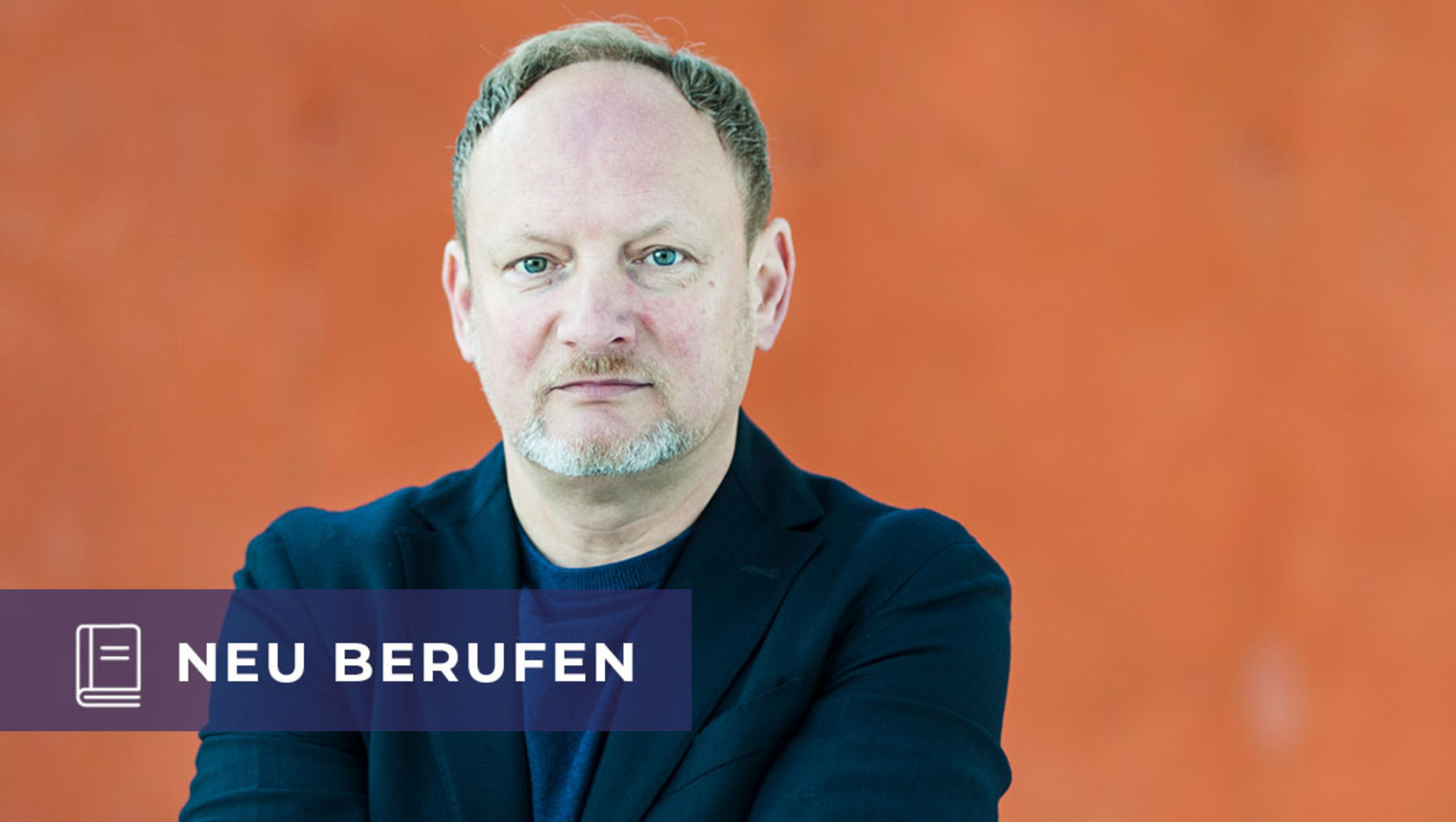
Professor Stange, before we talk about your new role, let's take a brief look back. You studied Architecture at the Anhalt University of Applied Sciences in Dessau. How did you come to specialize in your field?
When I was studying architecture, I quickly realized that I wasn't going to be a great designer. But it was easy for me to grasp and work on complex contexts holistically. There have to be architects who can lead projects and bring them to the finish line. I found myself in this ability. That's why I didn't apply to a competition office after graduating, but to a generalist, a consultant in Munich.
Where did you go after your studies?
I went to Obermeyer Planen und Beraten in Munich - an internationally operating planning company with a focus on complex general planning in almost all areas of application. Right after graduating, I was lucky enough to go to Dubai with Obermeyer to develop exciting projects from scratch, from the desert, so to speak. That was my first stop after graduating, which in retrospect put me on the right track.
What professional stations followed?
I then went to Zurich to work for Christophe Carpente Architects, where I planned and realized exciting projects in Asia and Russia. This also allowed me to develop my language and intercultural skills. However, I quickly looked for a new challenge and found it at the Royal Group in Abu Dhabi. There I had the opportunity to develop and implement very large projects in the Middle East, North Africa and South America on the client's side for the first time. It was a very exciting task, but after six years abroad I wanted to return to Germany. I then took over the management of the Architecture and Project Management department at Dorsch Consult in Dresden. After four years at Dorsch Consult, I became head of the general planning division at Arcadis Deuschland GmbH in my home town of Halle. During this time, I completed my doctorate while working and gained an interest in research and teaching.
You have now been Professor of Construction and Project Management and Project Control in Dessau since August 2022. You have already been deputy professor in this area since October 2021 and bring a lot of international experience to the university.
Yes, for example, I have the idea of planning an excursion to the Middle East with the newly accredited master's degree program in Project Development. It's a very good place to see how project development can take place and how it affects us and our habits. However, as is so often the case in life, there are positive and less positive examples.
You're back at Anhalt University of Applied Sciences, it's more or less a home game for you. What has changed, what was your first impression when you came back to Dessau?
I have a home advantage because I studied here myself, but I still noticed two things. Firstly, the quality of life here on campus, which is just as pleasant as it was when I was a student here. You feel right at home here, it's a great campus, probably also due to the great legacy of the Bauhaus. On the other hand, I've noticed that the instructors are extremely friendly with the students and with each other. Now, as a colleague, I'm really looking forward to working in this friendly and appreciative environment.
What areas of overlap are there between your previous career path and the new challenges in teaching?
I see the biggest overlap in the transfer of my tried and tested knowledge in the field of construction and project management, supported of course by the theoretical foundations that have been introduced. The biggest challenge is probably to show students the weaknesses that still exist in the construction value chain and at the same time convey technological and methodological solutions. For example, the application of BIM throughout the entire real estate life cycle or the establishment of innovative project management models, such as integrated project management in the form of project alliances.
What does the application of BIM mean?
BIM means creating a digital building information model during the planning process that contains all the geometric and alphanumeric information required for the construction, use and utilization of the building. This is also referred to as a "digital twin". Unfortunately, in practice it is used almost exclusively in planning, for example to detect collisions in planning at an early stage. BIM could develop its greatest potential in the construction and use phase. Of course, only if it contains the necessary information.
What information is contained in a BIM?
Information can be attached to each component. Such as maintenance cycles, warranty periods, material properties, prices, manufacturers, information on fire protection components or the window and floor surfaces to be cleaned, which are important for facility management. But also the delivery and installation times for components in order to simulate various scenarios for the construction process, which are important for selecting the optimum construction method. The information required for this is stored in this "digital twin". Probably the biggest advantage is that you can first simulate different scenarios in theory and then decide on the most suitable solution in practice.
Is that also part of your teaching?
Exactly. I try to teach how the BIM model can be used after planning and, above all, in the context of construction and project management. This great, innovative tool - which has been around for over 20 years - has unfortunately not yet been fully implemented in practice.
I would like to address this problem in both teaching and research.
Your field of research also deals with the BIM model. What is the appeal of this?
I want to rethink the current processes in the construction value chain - we all still have unpleasant memories of the inglorious chaos projects such as the Elbphilharmonie Hamburg, Stuttgart 21 or Berlin Airport. It doesn't have to stay that way, or better, it can't stay that way! My focus is on the question of how sustainable our current processes in the construction value chain actually are and how the BIM method in conjunction with new, innovative forms of project management can remedy this. The appeal lies in the unfortunately still untapped potential of this model-based, collaborative cooperation with the help of BIM and the necessary - but not yet completed - cultural change in planning and construction.
What discovery, invention or insight would you like to see in the next ten years - is cultural change with the help of BIM a part of this?
Absolutely, yes. For the construction and Real Estate industry, I would like to see the development of a project management model that enables more efficient and largely conflict-free planning and construction.
Do you have a motto that you would like to pass on to students?
My motto is always: less is more! Look for the simplest and most effective solution and avoid detours.
