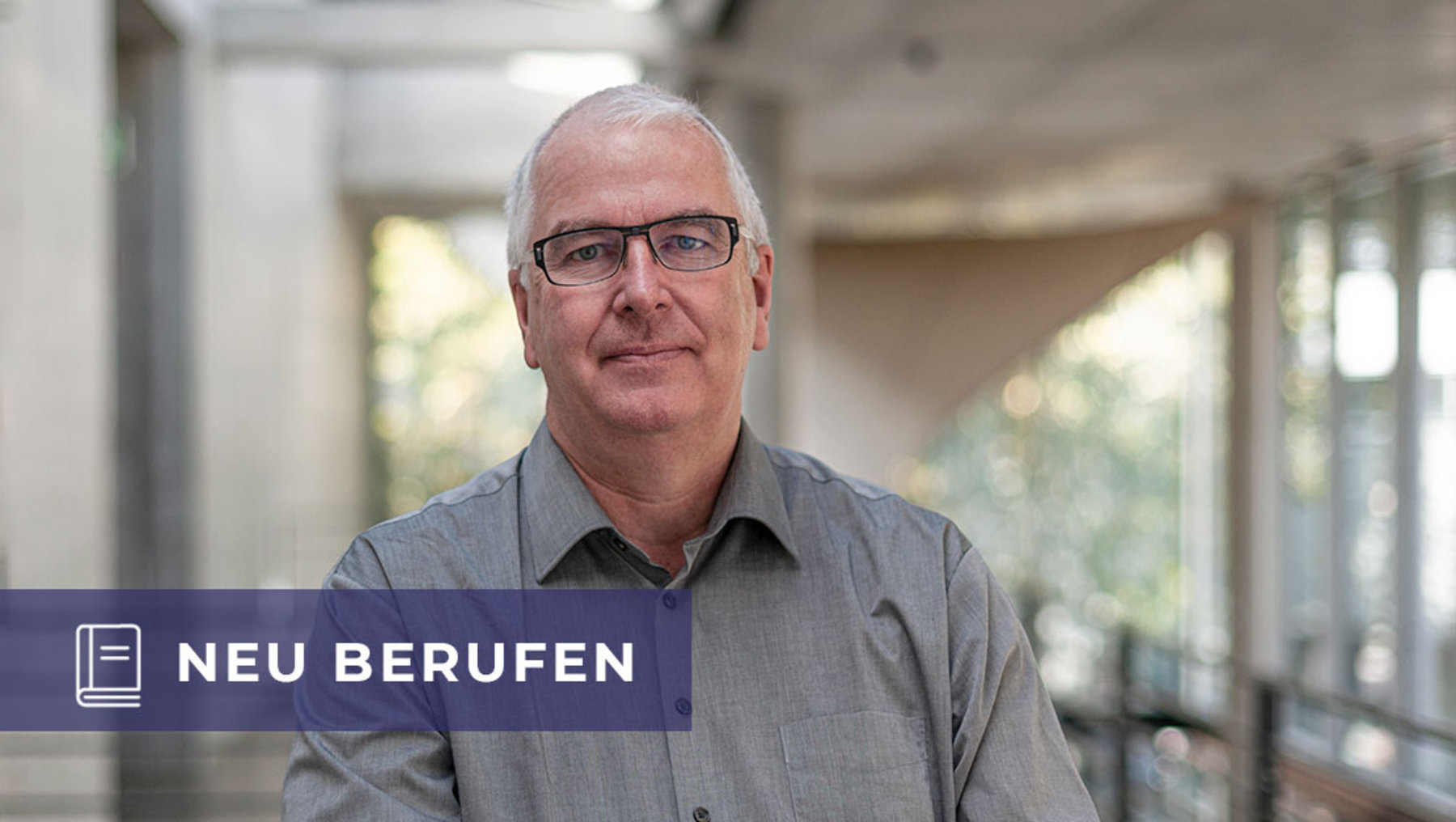
Professor Westermann has been appointed to the Dessau site at Anhalt University of Applied Sciences for the winter semester 2021. In this interview, we look back and forward with him - because Professor Westermann is certain that his graduates will face a number of challenges in the future: "We are currently preparing for a completely new approach to construction. We have to be climate-neutral by 2050: Architecture and technology can only do that together," explains the engineer.
Professor Westermann, you have been working as a freelance engineer since 1994. You have been appointed Professor of Building Technology in Dessau for the 2021 winter semester. Before we talk about your new role, let's take a brief look back. How did you come to specialize in your field?
Prof. Westermann: Firstly, through my family background: I have two architects in the family. After a school lab in a planning office, I became fascinated by construction technology and have remained so to this day. From 1984, I studied building services engineering at the TU Dresden. This fulfilled my desire to tackle energy-related problems with a scientific approach. In the GDR, the TU was the only institution to offer this technical course at university level. After graduating, the appeal of practical work was great. An academic career was out of the question back then. Now, more than 30 years after graduating, I look forward to passing on my fascination with this subject area to students.
In addition to building technology and BIM, you also give lectures on renewable energy and energy efficiency. What does sustainable architecture mean to you? Architecture that can be used for generations and experienced as a space. In particular, my focus is on energy efficiency and climate neutrality in the construction and use of buildings, as well as building with sustainable materials and materials with a low ecological footprint.
As Vice President of the Saxony-Anhalt Chamber of Engineers, you can develop the future of the profession in the state through the various committees. What is your task?
Developing the profession further means, among other things, promoting the professional title of engineer. Since the Bologna reform, a degree course is usually completed with a Bachelor's or Master's degree. The Chamber of Engineers can award the title of engineer depending on the focus of training in the STEM field. To ensure that the combination of subjects and weighting of credits in the curriculum of a degree program can open up this possibility, I am holding consultative discussions with the universities in the state.the Chamber of Engineers' promotion of young talent is not only aimed at students. For example, we try to introduce our commitment in schools through school competitions, and the Chamber of Engineers is also a point of contact when it comes to the recognition of foreign engineering degrees. In addition, we provide information on self-employment, organize contact exchanges and arrange succession planning.
You have been a professor in the Department of Architecture since the winter semester. What subjects do you teach?
I will be teaching the field of building technology in the Department's various degree programs. This includes the subjects of building climatology, technical building services and renewable energy, environment and sustainability.
What goals are you pursuing?
One of my most important goals is to make students more aware of the integrative planning approach.
Can you explain that in more detail?
Yes, of course. When we want to build a house, numerous trades are involved, each of which specializes in a particular field. These have to be coordinated and integrated into the construction planning as early as possible. Increasing complexity can be observed in the area of building technology in particular. Questions regarding heating, ventilation and air-conditioning technology, lighting and the use of renewable energies need to be answered. These factors can have a direct influence on the Architecture of a building and vice versa. It therefore makes sense to bring specialists together at an early stage in the planning process.
It must also be said that we are currently preparing for a completely new approach to construction. We have to be climate-neutral by 2050: This is not only possible through the interaction of Architecture and technical expansion. Added to this are the needs of users in modern living and working environments. Many people are not yet thinking that far ahead in practice, but that is what I am strongly pushing for: to solve these tasks together. I want my students and graduates to broaden their horizons in this direction. Later on in their careers, they should understand and promote building planning as a joint effort of many trades.
So you think that this increased cooperation is needed, especially with regard to climate neutrality?
Exactly, but we also need to think about climate adaptation! We will have new weather conditions. We need buildings that are designed to cope with heavy rainfall events and changing climatic conditions, for example.
If students recognize this need, then you want to provide them with digital tools to enable better planning processes. How can these be used?
Students can use the tools to visualize the processes, but also to carry out integrative simulation and calculation processes. This then goes as far as BIM (building information modeling) and the "digital twin", even before the project is implemented. The connection between the various degree programs at the university is particularly noticeable here.
What discovery, invention or insight would you like to see in the next ten years?
Advances in nuclear physics, such as nuclear fusion, would be great, but a stronger focus on Biotechnologies in all areas would also be good for our environment. Substituting fossil fuels and materials is one of the most important goals of our time.
Do you have a motto that you would like to give students to take with them on their journey through life?
We have the knowledge to make changes and it is increasing every day. We just have to learn to apply it creatively.
Professor Westermann, thank you very much for the interview.
