Legumes such as the grain pea play hardly any role in German Agriculture. Yet they could be the solution to some pressing problems in central Germany. This article on Anhalt University of Applied Sciences’ Climate Blog explains why.
Regional Bioeconomy: Why the Grain Pea Is a Good Idea for Central Germany
-
 © Adobe | I.H
Agriculture in Central Germany is under pressure: In particular, the intensive use of land in recent years, tight crop rotations, persistent drought, and heavy rainfall are taking a toll on the fields. Switching to new crops sounds promising, but it is complex and jeopardizes farms’ regular income: There is a lack of varieties and plant protection products, experience is limited, and a reliable market for the crops is virtually nonexistent. The DIP:DiPisum research project takes a holistic approach to these problems, focusing on innovative ideas and methods for pea breeding, pea cultivation, and pea utilization. Funded by the Federal Ministry of Education and Research, nine partners from academia and Economics aim to advance a sustainable pea economy in Central Germany. They are capitalizing on the characteristics of the white-flowering pea with its yellow pods and the locational advantages of Central Germany. Our infographic explains the details. We then put the facts into context in an expert interview with Prof. Dr. Annette Deubel.
The grain pea:
 © HS Anhalt
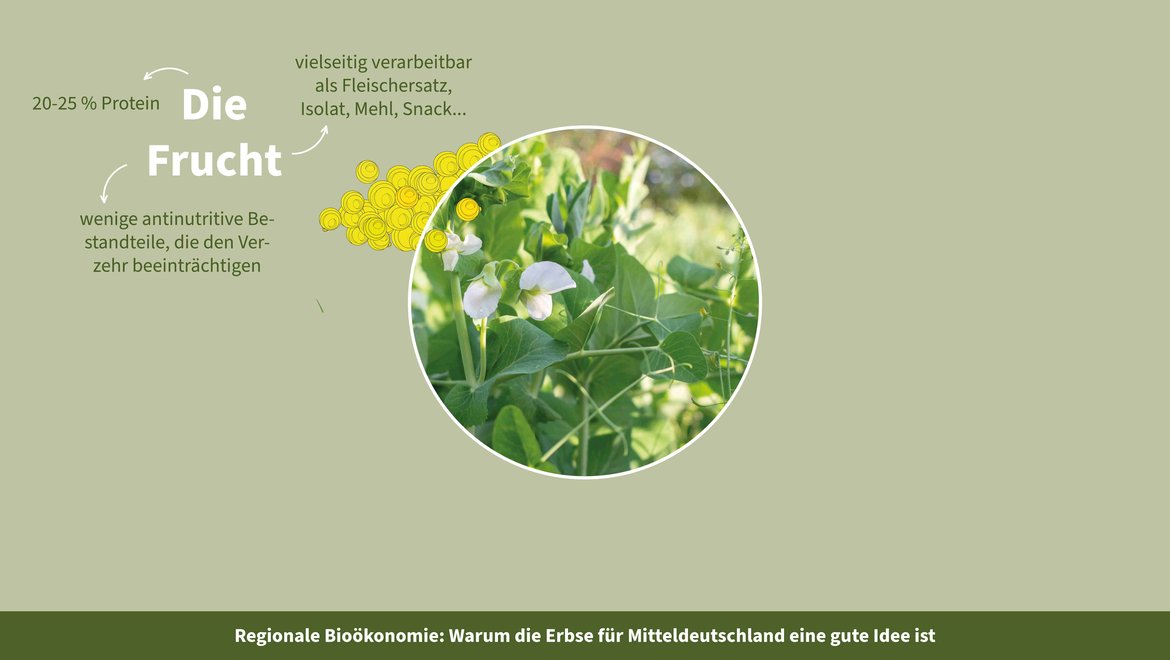
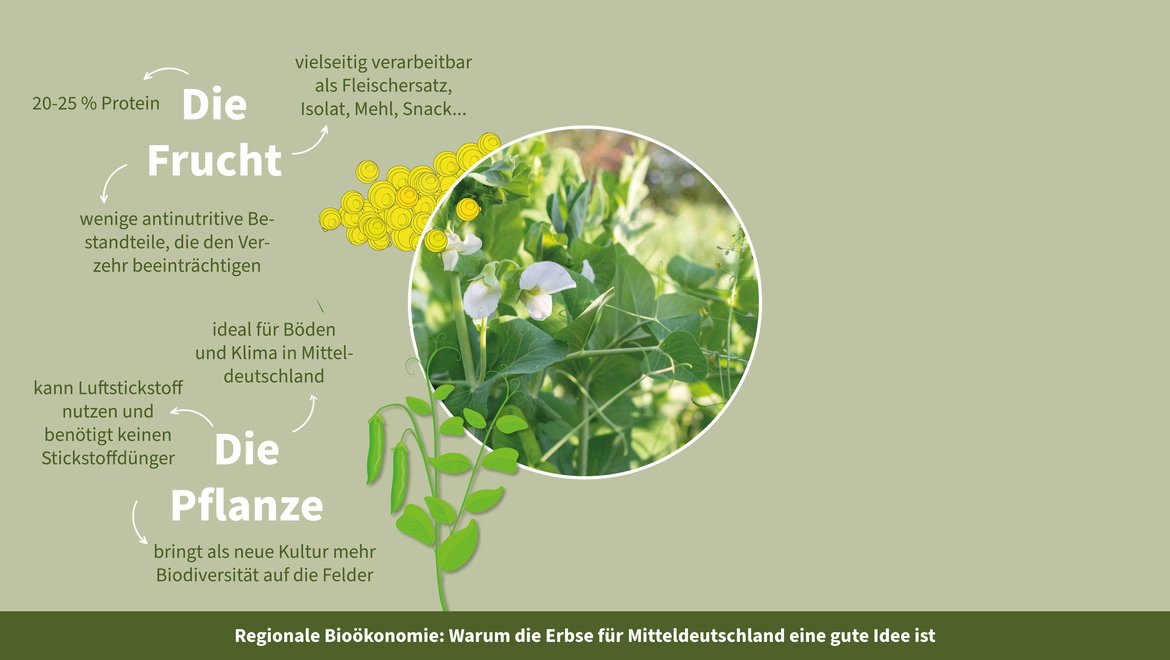
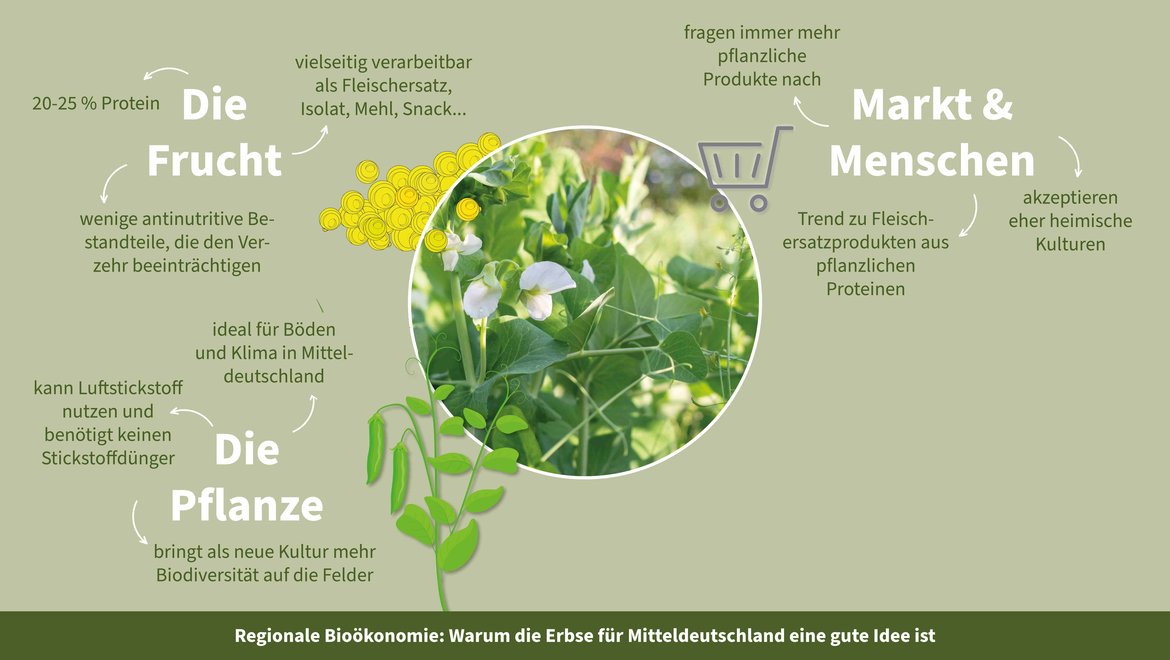
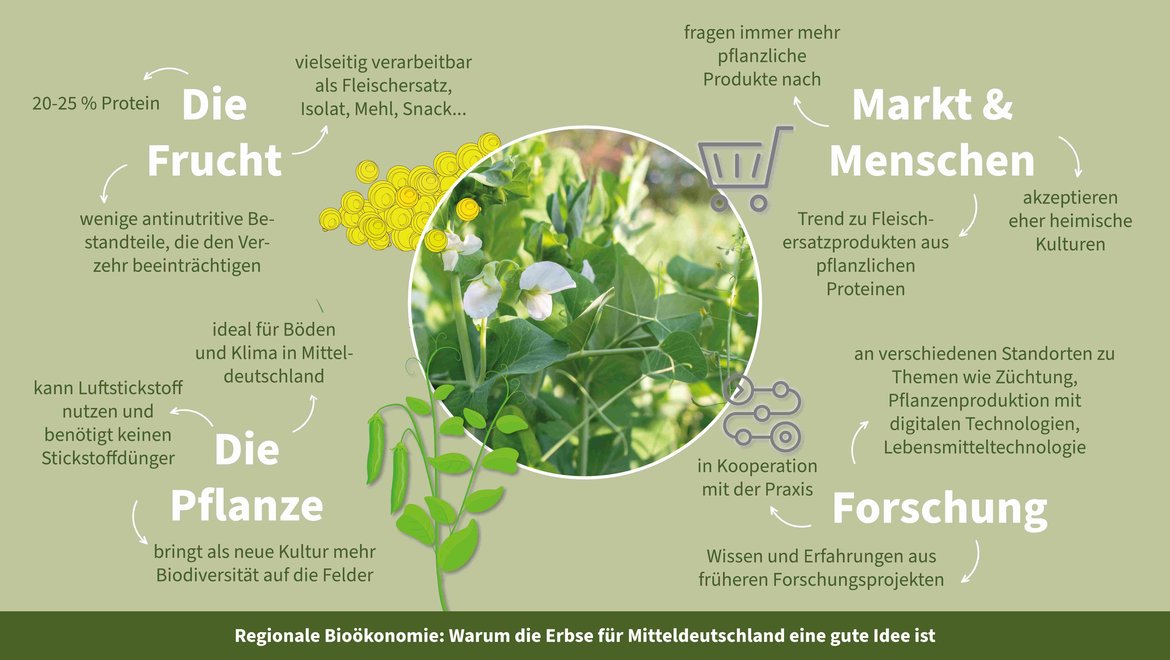
Benefits of the fruit: The yellow fruits of the white-flowering pea plant contain 20 to 25 percent protein, making them a valuable source of protein. When dried, they can be used to make a wide variety of products: as meat substitutes, in the form of isolates (highly concentrated protein extracts for food production), flours, or snacks. Among legumes, yellow peas have the fewest antinutritional components—that is, substances that impair consumption or enjoyment. Soy, for example, must be heated before it can be used in the human diet. This makes the pea the simpler alternative.
 © HS Anhalt
Benefits of the Crop: With its fertile soil and temperate climate, central Germany is ideal for growing the grain pea. Compared to other crops, it copes relatively well with drought. At the same time, it provides its own fertilization, as legumes like the grain pea are among the plants that fix nitrogen from the air and release it into the soil. This reduces CO₂ emissions, since the production of mineral fertilizer requires a lot of energy, often through the use of fossil fuels. That is why the pea is also so interesting as part of a crop rotation—that is, the alternation of different crops in the same field—with other grain varieties. It would also bring more biodiversity to the fields. Theoretically, other legumes are also suitable for this purpose. However, soybeans are less resistant to adverse weather conditions than garden peas, and field beans require more water than is available in the arid regions of central Germany.
 © HS Anhalt
The Benefits of Fruits and Plants, the Needs of the Market and People: Plant-based proteins are all the rage—as substitutes for animal proteins found in meat and dairy. Experts anticipate a growing market. Pea protein isolates—highly concentrated protein extracts—are already a key ingredient in products such as burger patties and dairy alternatives. While soybeans are currently the go-to source for plant-based proteins, However, as a locally grown crop, the garden pea has an image advantage: it stands for regionality and sustainability, which are increasingly in demand among consumers.
 © HS Anhalt
Benefits of fruits and plants, market and consumer needs, research potential: resilient and suitable varieties, efficient cultivation, processing, and products: To establish a regional pea economy—that is, the local cultivation, processing, and marketing of peas—many research questions still need to be addressed. This effort draws on expertise from both theory and practice—ranging from basic research on new varieties to the development of marketable products. In the DIP.DiPisum project, nine partners from academia and industry are collaborating to develop innovative solutions. These include the Leibniz Institute of Plant Genetics and Crop Plant Research (IPK), the Julius Kühn Institute, Martin Luther University Halle-Wittenberg, and the Fraunhofer Center for Chemical-Biotechnological Processes. Companies such as KWS Saat SE, SGS Institut Fresenius, and Planteneers GmbH are also contributing their expertise. Anhalt University of Applied Sciences is contributing its many years of experience in plant production using digital technologies as well as Food Technology.
"Legumes can be a valuable addition to other areas of Agriculture."
Interview with Prof. Dr. Annette Deubel, Director of the DIP:DiPisum project at Anhalt University of Applied Sciences
Prof. Deubel, with the DIP:DiPisum project in Central Germany, are we moving from a wheat-based to a pea-based economy?
It’s not about replacing other sectors of agriculture. Legumes can usefully complement other sectors of agriculture with the goal of securing the regional protein supply through innovative approaches. To that end, we want to increase the proportion of land used to grow grain peas to 10 percent, if possible. Currently, that figure stands at two percent in Central Germany.
The goal is not to replace other sectors of agriculture. Legumes can effectively complement other sectors of agriculture to ensure a regional supply of protein.
Prof. Dr. Annette Deubel
You have been conducting research in the field of crop production for a long time and also oversee the field trials for grain peas. What are those?
We are currently comparing ten summer and five winter pea varieties on our field trial plots in terms of development, disease incidence, and yields. In addition, there is a large-scale trial on tillage practices that we have modified; in this trial, we are using grain peas instead of canola in the crop rotation alongside various cereal varieties. The focus here is on how the soil should be worked, particularly with regard to weed control. This is essential for farmers, as they have only limited chemical options for treating legumes.
In your view, what are the other challenges to establishing peas as a crop?
Major challenges include significant yield fluctuations, susceptibility to soil-borne diseases, and pest infestations. To induce such conditions, we’ve established a monoculture plot where fungal diseases and pests spread more readily. We then make soil from this plot available to breeders to help them develop new varieties. I believe this will be the key to solving many of these problems.
Why are there currently so few new varieties of grain peas and hardly any plant protection products?
These are typical problems for minor crops. For manufacturers, the development costs aren’t worth the effort, which is why research projects like DIP:DiPisum are so important—also to continue learning from real-world experience. Using a platform and surveys, we want to identify weaknesses in cultivation—that is, what Agriculture needs from breeding, cultivation research, processing, and marketing.
How will Anhalt University of Applied Sciences contribute to these research questions—aside from plant production?
An important aspect is the use of digital technologies for efficient and safe cultivation with the help of sensors, drones, and artificial intelligence. Various research groups will be working on the issue of processing, as there is very little experience in this area. Currently, most yellow peas end up in animal feed with little processing. But to develop a predictable product for human consumption, I need to know the composition of individual varieties, how they behave under specific conditions, and how they can be processed into an isolate, flour, or meat substitute. This will also be done in close coordination with breeders to, for example, rule out any adverse effects on flavor from the outset.
You’ve also been working with farmers for many years. How open are they to new crops?
There is definitely interest. Between 2015 and 2017, legumes were a very attractive way to meet “greening” requirements for agricultural subsidies, and by no means have all farms stopped growing them since then. I think that if the conditions are right, Agriculture is also willing to try new things. With the DIP:DiPisum project, we can make a significant contribution to this.
Research at Anhalt University of Applied Sciences: Agriculture and Food Technology
Applied research that bridges theory and practice has a long tradition at Anhalt University of Applied Sciences. For example, researchers in the field of Agriculture benefit from a long-standing partnership with organizations such as the German Agricultural Society (DLG) and the State Institute for Agriculture and Horticulture at the Campus Bernburg-Strenzfeld—a partnership strengthened by numerous projects addressing current challenges and exploring new solutions. To this end, they make use of, among other resources, the 55-hectare field trial area in and around Bernburg.
The Food and Nutrition Research Group led by Prof. Wolfram Schnäckel on the Campus Bernburg-Strenzfeld now comprises more than 60 research projects and 70 partner institutions. The research questions cover a wide range of topics and have consistently adapted to current developments: What do consumers expect? How can new or higher-quality products be developed and marketed? How can technologies be adapted or newly developed—for example, with the help of 3D printing?
One of the most recent research topics at the Bernburg-Strenzfeld campus is remote sensing for Agriculture. The team led by Prof. Uwe Knauer is investigating how crop production can be made more efficient and sustainable with the help of image data. To this end, it uses drones, sensors, and artificial intelligence—for example, an innovative hyperspectral camera for thermal infrared imaging.
The research groups at Anhalt University of Applied Sciences involved in the DIP:DiPisum project are part of the Department of Agriculture, Ecotrophology and Landscape Development. Learn more on the department’s website: https://www.hs-anhalt.de/hochschule-anhalt/loel/uebersicht.html
Redaktion
Many thanks to Prof. Dr. Annette Deubel: She reviewed the infographics and provided further insight through the interview.
Further details and contact information can be found at the end of the article.
Cover image: I.H/stock.adobe.com
Graphics from stock.adobe.com: MVshop (pea pod and plant); dstarky (market & people); Iconic Space (research)
An article on the current state of legume research at Anhalt University of Applied Sciences was published in June 2026 on the university’s KlimaBlog: https://www.hs-anhalt.de/hochschule-anhalt/aktuelles/neuigkeit-1/regionale-eiweissversorgung-was-erbsen-und-soja-aus-sachsen-anhalt-leisten-koennten.html
Back to the KlimaBlog homepage
