What does an email spam filter actually have in common with an analysis of creditworthiness? How do the recommender systems of large online stores work? And what risk do strongly fluctuating commodity prices pose to my company's success?
These are just three of countless examples from the Business Analytics specialization. The central skill taught in this specialization is:
"Learn how the data generated in a company can be translated into information that can then be used in a targeted manner for the company's success."
 © Peter Grösche
Why study Business Analytics?
Interested in human resources? Or is logistics your thing? Or do you rather enjoy marketing and pricing? Nowadays, all areas of Business Studies face the same challenge: the data generated must be subjected to a sound analysis in order to be able to derive business decisions from it.
Put together your individual portfolio of Business Studies subjects, acquire methodological expertise and learn one or two programming languages with which you can implement the data analysis operationally.
FAQ
Whether at management consultancies, in banking and insurance, in the telecommunications sector, at manufacturing companies, and ... and ... and. Wherever data is generated, there is a need for specialists who are able to analyze this treasure trove of data. With increasing networking and digitization in the future, the amount of data will continue to increase, and consequently the need for trained staff. The answer to this question can only be a counter-question: Where will the skills not be needed in the future?
Yes and no. Of course, the computer does the actual calculations. However, in order to be able to understand the content of the data analysis and the statistical methods used for it, a certain degree of access to abstract representations is necessary. After all, you need to know what the results mean. The prerequisites here are therefore not so much school mathematics skills, but rather the ability to abstract.
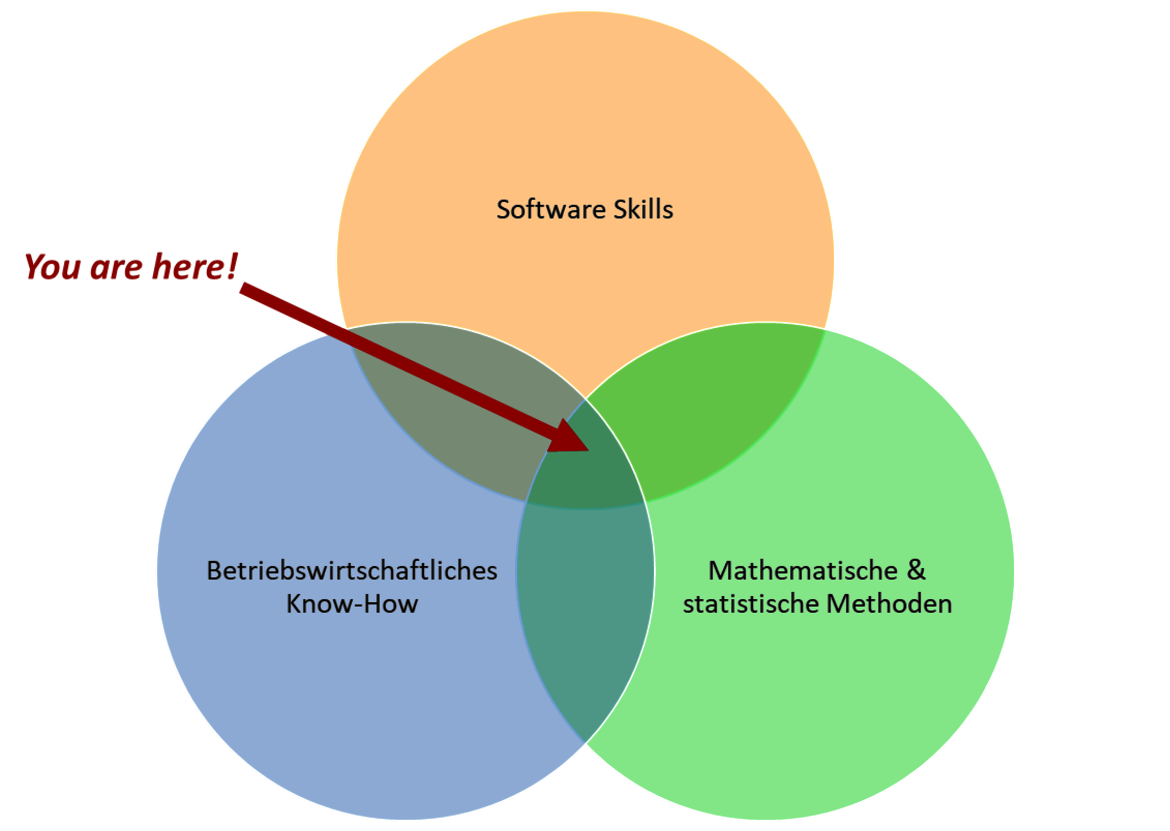
As can be seen from the diagram above, the major is made up of three modules. You put together the Business Studies module largely according to your own ideas from a large number of compulsory elective courses. The study regulations set a certain framework here, e.g. economics and law subjects must also be taken.
At the beginning of your studies, you should take one or two introductory courses in programming. Here you will learn how to deal with software architecture, which will accompany you throughout the rest of the program sequence. After the first year of study, you will be ready to build up your analytical skills. To do this, you can choose from a range of elective courses specific to your area of specialization.
Study content in the focus area
Computer-intensive methods are used for problems with high computational requirements. The aim of this module is to apply these methods to specific problems and data sets using the statistical software R. Areas of application include many areas of Industry 4.0, such as smart manufacturing, predictive maintenance, supply chain management and optimized energy management, as well as traditional areas such as market research and marketing.
In this module, students learn about a range of multivariate statistical methods and typical applications. They will be able to determine an applicable method for a quantitative question, carry out the analysis and interpret the results.
Students learn to translate an economic question into an econometric model and to test their statements empirically. Hypothesis formation, evaluation and interpretation of the estimation results are presented using suitable examples. The class is accompanied by a computer exercise in which students apply the lecture content directly with statistical software using data sets
Students learn to mathematically map production processes with the help of graphs and to analyze the processes mathematically. Various algorithms and methods are presented that allow the process sequences to be analyzed more precisely and, if necessary, weak points in the processes to be uncovered in order to optimize them in a next step.
In this module, students should acquire knowledge of the Python programming language.
Scientific examination of Business Studies problems in management.
Students receive an introduction to the topics of data protection and data security in the company.
In this module, students should gain specialist skills in the application and development of digital data processing in organizations.
The lecture teaches the management of corporate risks through risk identification, risk analysis, risk quantification, risk aggregation, risk assessment, risk evaluation, risk communication and final risk management.
Interactive learning and class dealing with methods related to the focus on business analytics.
Students receive a comprehensive overview of the content and tasks of the cross-sectional functions HR Risk Management and HR Analytics as well as the processes and instruments of the HR Controlling and HR Risk Management processes. The skills taught are aimed at starting a career in the HR function of companies of different sizes and industries or in management careers in different operational functional areas.
In this module, you will learn to understand the market and customers using digital tools. We look at the digital path, which tools can be used here, how do they work and how do they function?
In the project, students work independently in groups on a comprehensive task.

Anhalt University of Applied Sciences enabled me to have a personal exchange with the instructors and to transfer the knowledge I had learned directly into the projects with the practice partners.
Andreas Sichmund, former student at the Department of Economics
Degree programs with top scores
Germany's largest university ranking (CHE) attests the Department of Economics top marks in the categories of contact with professional practice, international orientation and Degree Program Coordinator.
The Anhalt State University of Applied Sciences offers you:
- low tuition fees
- Very high recognition for the degrees
- Accredited degree programs
Attractive student life
A unique campus with university and residential buildings. The magnificent old town with the castle directly on the Saale. And green spaces full of perennial gardens and plants everywhere. Campus Bernburg-Strenzfeld shines with quality of study and quality of life.
Read moreWhether on the numerous sports facilities, in the gym, in the fitness studio or in the sauna, whether alone or in a team, whether Zumba, yoga or floorball, there is a wide range of sports activities to discover everywhere on campus. With us, everyone can study fit and healthy!
Read moreAnhalt University's career service offers free workshops, training courses, lectures and advice to help you prepare for your career start. In addition, there are beneficial cooperations with important partners within and outside the university.
Read more