Beekeeping Event Series
Are you interested in beekeeping and looking to learn more?
You can find the current semester program on this topic and all the dates here.
Goals of the Lehrimkerei (Building 29a - Bernburg)
At the Lehrimkerei (Building 29a - Bernburg), students learn how to keep bees and how to successfully manage a bee colony throughout the season. Students from various degree programs (particularly Nature Conservation and Landscape Planning, Agriculture, and Ecotrophology) work together in an internship group and learn to value each other’s expertise. Each student manages their own bee colony during a semester that runs from April through July, covering the most important stages of the bee year. Successful beekeeping practices by the students are rewarded by the bees with good colony development, sufficient brood, and abundant, high-quality honey. Beekeeping mistakes made by the students lead to weak or diseased colonies, as well as losses due to swarming and low honey yields. Students thus experience firsthand the successes or failures of their actions and are motivated to care for their colony reliably. The weekly lab is accompanied by a lecture that is also open to visiting students. The honey harvested from the Lehrimkerei (Building 29a - Bernburg) is sold as “Campus Honey” in the Bernburg cafeteria. At the Saxony-Anhalt Beekeepers’ Association honey competition, Campus Honey has won gold or silver medals on several occasions.
Space for students to participate in the practical courses with the beehives at Anhalt University of Applied Sciences is limited. There are 20 spots available each year.
During the practical courses, please make sure to wear
- sturdy clothing in light colors; no floral patterns
- long sleeves
- long pants made of thick fabric (preferably good jeans that aren’t tight-fitting)
- sturdy shoes, long socks
- no woolen clothing
- No perfume, no aftershave, no fruity shampoo.
- For the first two practical courses, bring a sleeping pad, an old blanket, or a jacket so you can lie on the grass.
- Do not bring any open beverages.
- If you have one, please also bring a camera with a macro function.
Note for visiting students: Practical training can be arranged through a mentor from the local beekeepers’ association (Imkerverein Bernburg und Umgebung e.V., Imkerverband Sachsen-Anhalt).
examination
- Course Assessment (Caring for a bee colony from April through July, 80% attendance in lectures, extracting honey, 6 reports)
- and presentation (20 min)
Credit Recognition
- As an required elective module worth 5 credits for students in the Bachelor’s degree program in Ecotrophology and Agriculture
- As an additional module for students in other degree programs
An exam is offered to auditors. Students who have attended 80% of the lectures are eligible to take the exam.
A certificate is issued upon successful completion of the exam, which, in conjunction with practical training under the guidance of a mentor from the beekeepers’ association, grants access to funding for beekeepers in the state of Saxony-Anhalt.
An internship can be completed at the Anhalt University of Applied Sciences’ Lehrimkerei (Building 29a - Bernburg) from March through August. The internship can be combined with a bachelor’s thesis in the field of beekeeping. Please contact Prof. Dr. Dasbach.
- German Beekeepers' Association e.V.
- Apidologie (Journal of Apicultural Sciences)
—current issue freely accessible
—volumes up to 2011 freely accessible - Saxony-Anhalt Beekeepers’ Association
- Bernburg and Surrounding Area Beekeepers’ Association
- The Honey Makers
- State Institute for Apiculture Hohen Neuendorf e.V.
- Institute for Apiculture, Celle
- Siedentopf, Jan; Steinel, Margot; Lichtenberg-Kraag, Birgit: Analyzing Honey Yourself. In: German Bee Journal (2016) 2, pp. 15–16
- Steinel, Margot; Bernsdorf, Sophie; Albertsen, Sandra:
What Customers Want.
In: German Bee Journal (2013) 9, pp. 12–13 - Subscription to the “Bienen@Imkerei” newsletter from the bee research institutes in Mayen, Münster, Veitshöchheim, Kirchhain, Hohenheim, and Hohen-Neuendorf
Literature on honey analysis:
- Guidelines for Honey Testing from the German Beekeepers’ Association
- Special Issue of *Apidologie* 2004
- Harmonized Methods of the International Honey Commission
- 2013 Interlaboratory Comparison Study for Honey
How does the annual honey harvest progress? The beehive scale provides you with a wealth of useful information about the development of a bee colony at Anhalt University of Applied Sciences. (On Apple devices, the scale can be saved as a link on the home screen.)
continueExperiments have been conducted at the Anhalt University of Applied Sciences’ Lehrimkerei (Building 29a - Bernburg) since 2018. Their goal: to understand how various factors interact in the production of creamy honeys.
Download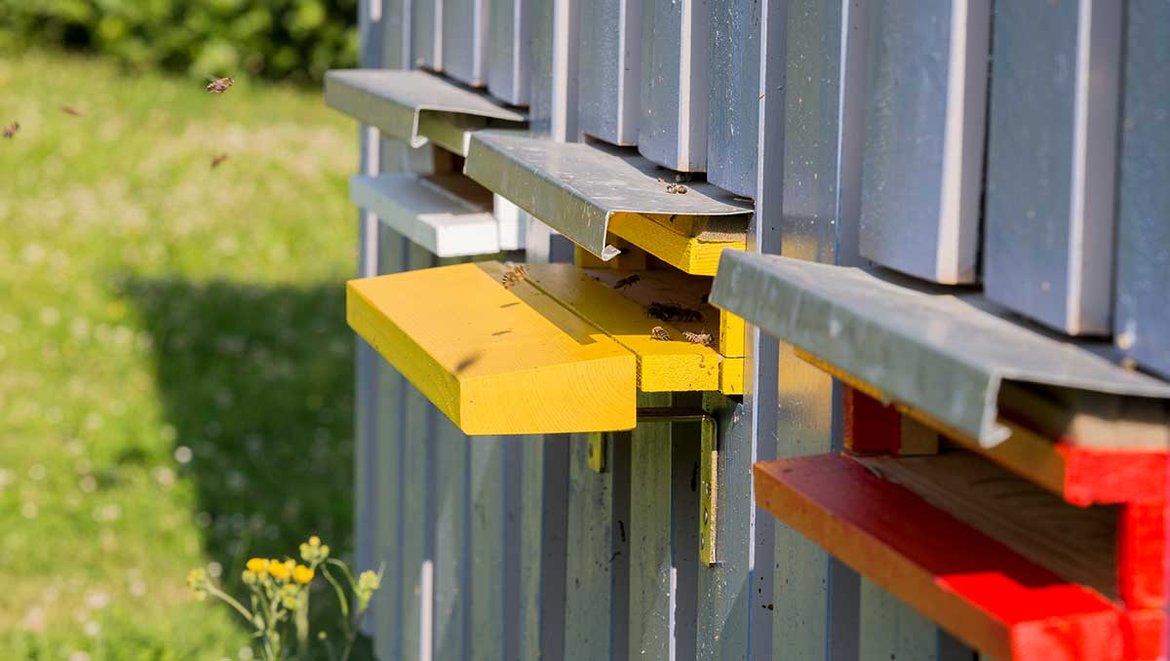 © Hochschule Anhalt

