Prof. Heike Schmidt has been Professor of Strategic Communication and Design at the Department of Design at Anhalt University of Applied Sciences since this semester. In this interview, the organizational and brand developer talks about her path to the university, which skills she considers particularly relevant for contemporary design teaching from a market perspective and how she has experienced the Dessau location in her first few months.
Thinking strategy, design and responsibility together
-
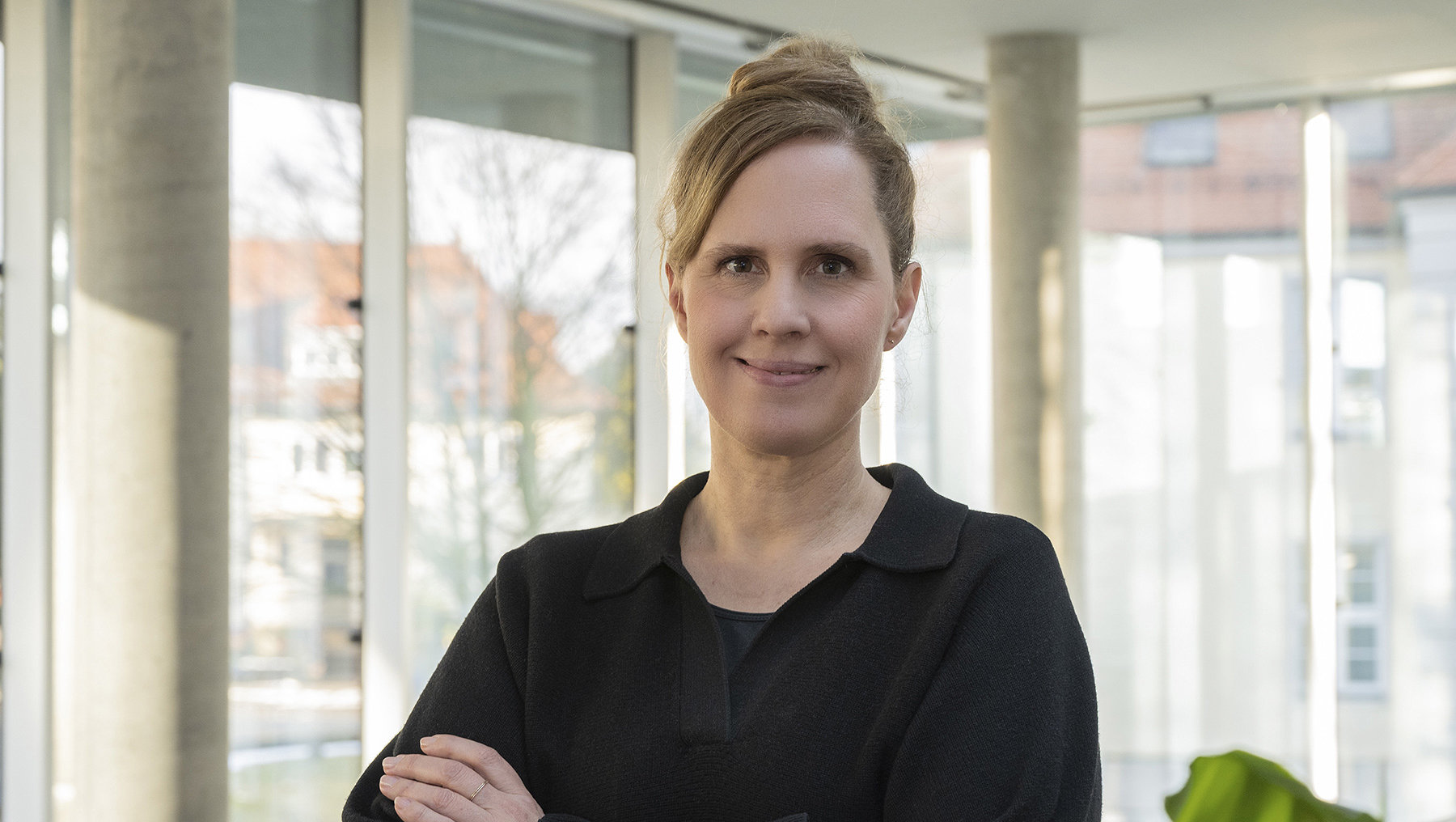 © Hochschule Anhalt/Esther Hoyer
Prof.Heike Schmidt, Fachbereich Design Dessau, Hochschule Anhalt
Ms. Schmidt, you come from an Economics background and have worked with numerous well-known companies and brands. How did you get to the university?
I studied communication design and specialized in brand strategy and communication after my studies. My first employers were internationally renowned agencies such as Pentagram and MetaDesign. As a result, I was lucky enough to be able to advise well-known brands right from the start. This also continued in my own agency.
In practice, I later became increasingly aware that the topic of brand - i.e. what people associate with a company or a product - plays a central role for the internal orientation of companies as well as for leadership, cooperation and cultural development within these organizations.
In order to be able to support companies not only communicatively, but holistically, I decided to complete numerous training courses in the field of systemic organizational development in addition to my agency work. As a result, I am now in a position to combine strategic thinking, creative competence and organizational development and to use these instruments "holistically" for sustainable brand and corporate development. It was precisely with this concept in mind that I applied for the professorship for "Strategic Communication" at Anhalt University of Applied Sciences.
What do you take with you into your teaching?
Everything, actually. I firmly believe that today's design competence no longer lies in giving form to content and function, but in solving complex problems through systemic understanding, strategic thinking and responsible and collaborative action. Design thus becomes a form of strategic thinking. This must be conveyed to students in an understandable and tangible way.
Another important aspect for students - especially when working with artificial intelligence - is the ability to work curatorially: in other words, to consciously structure content, perspectives and processes, to evaluate them and to bring them into a meaningful context.
We designers are increasingly becoming "creative strategists" as well as "creative conductors and curators". This requires an understanding of structures, dynamics and processes within and outside of organizations - and the knowledge of how to move within them.
That sounds like a pretty broad approach. What does that look like in the seminar?
My seminars are strongly practice-oriented. It is important to me that students not only experience processes and strategies as theoretical constructs, but also actively experience and test them. This means working on real issues, trying out different approaches and gaining their own experience in dealing with complexity.
My aim is to provide students with a well-founded set of tools and skills that will enable them to develop strategies for solving the relevant problems of our time.
Design becomes a form of strategic thinking. This must be conveyed to students in an understandable and tangible way.
You have taken on the new module "Strategic Communication and Design". What can students expect?
In the "Strategic Communication and Design" module, students can expect a close interlinking of communication strategy, design and organizational issues.
Basically, the aim is to find out which strategies need to be applied in order to satisfy the needs of users. Here we think from small, for example in the direction of a communication strategy for a product, to very large, such as the question of whether political parties as we know them still exist today or whether new content and communication strategies are needed in politics and how these are then designed.
We are therefore looking at how communication can be used in a targeted and strategic way to provide orientation, support decisions and facilitate developments.
As I mentioned, however, I not only want to impart methodological knowledge, but also make it possible to experience how we can combine design, strategy and cooperation responsibly and effectively in order to develop a professional attitude.
It is important to me that students are aware of and develop their own skills and resources. Intensive self-reflection is therefore always an integral part of the module.
Can you give an example of what you have in mind?
This semester, we are exploring "Feedback culture in a creative context" with a project. For me, feedback is a central prerequisite for enabling continuous learning, innovation and personal and professional development. The aim is for students to routinely deal with feedback from the very first semester and thus actively help shape a culture of openness and innovation.
The focus is on exploring strategies as well as developing and testing skills that enable them to give constructive and appreciative feedback - and to accept it just as confidently.
At the end of the project, the students develop a feedback kit for users based on the knowledge gained: this can be a tool, a game or a method. The result is deliberately kept open, as the focus is on exploring and experiencing feedback processes.
In order to illustrate the relevance of feedback in the corporate context, we also involve external experts - professionals who work with companies on feedback culture. This allows students to experience directly how feedback works in organizations and what difference a reflective feedback culture can make.
I want students to be comfortable with feedback from the very first semester and thus actively shape a culture of openness and innovation.
How have you experienced Dessau so far?
I experience Dessau as a special place - above all due to the atmosphere on campus and the immediate proximity to the Bauhaus (Building 10 - Dessau). For me, this proximity is not only noticeable spatially, but also in the attitude: understanding design as a social task.
What also appeals to me is the manageability and directness. Meetings are personal, distances are short and exchanges are quick. This creates good prerequisites for collaboration, for new ideas and for developing projects together.
All of this is absolutely in line with my view of teaching, design and discourse, making Dessau an ideal place for my work and research as a newly appointed professor.
Thank you very much for the interview, Prof. Schmidt!
Kontakt
Bettina Kranhold
RedaktionVeronika Rivera
The Integrated Design degree programAnhalt University of Applied Sciences offers both a Bachelor's and a Master's degree program in Integrated Design. The degree program combines the three fields of communication design, product design and media design.
Depending on their interests, students focus on individual specializations: In this way, they learn how to use all design media - graphic, typographic, form design, photography, film, audio and interactive.
Applications for the winter semester 26/27 are now open.
More information at www.hs-anhalt.de/des.
