There are new figures on this question from the Anhalt University of Applied Sciences: for suckler cows. The answer will influence how climate policy credits cattle farming and what farms will have to prove by 2030.
How much methane does a cow emit?
-
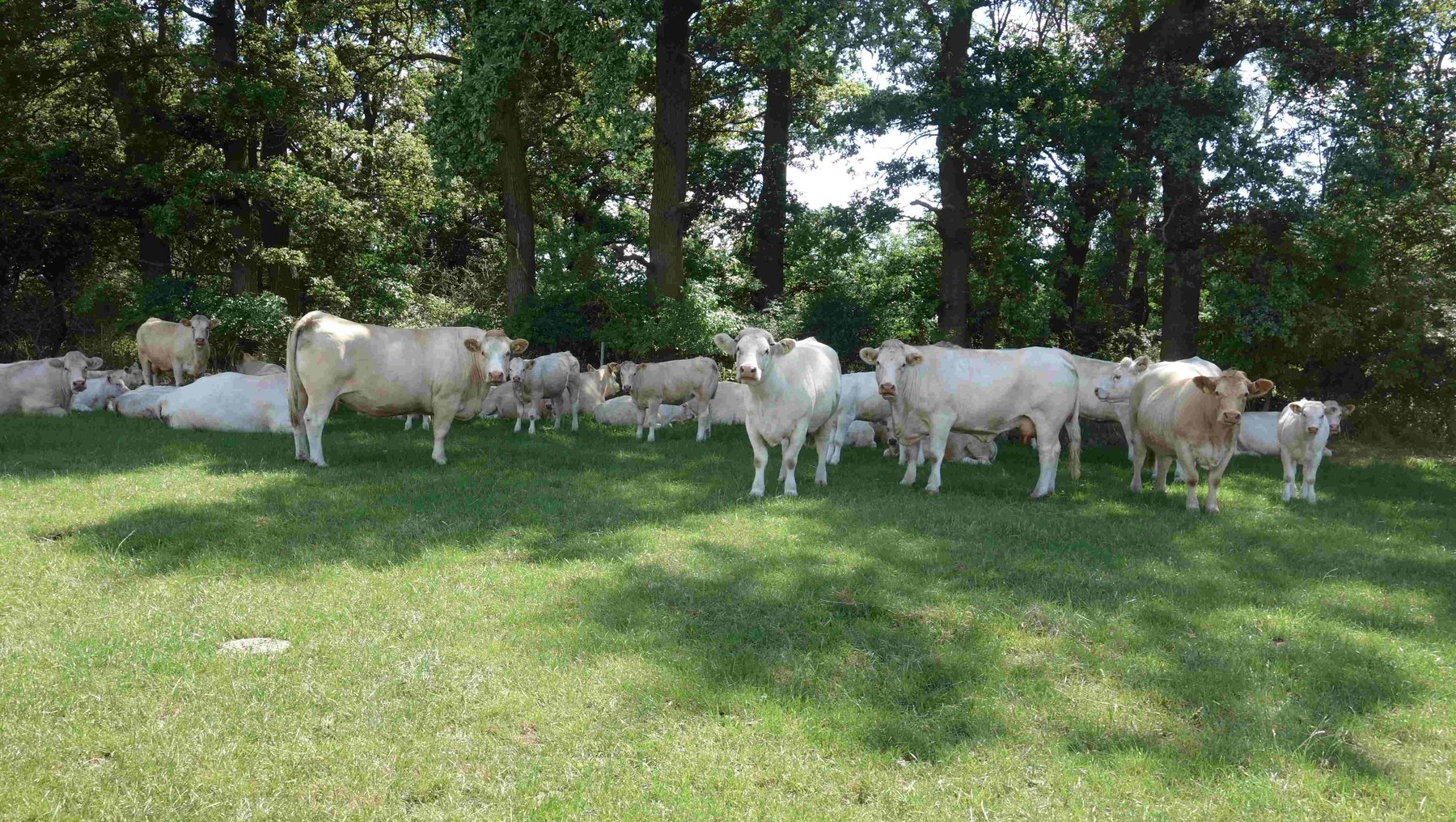 © hochschule anhalt | heiko scholz
Model calculations for methane
247 grams. This is the average amount of methane the researchers measured for a suckler cow per day. Previously, models assumed significantly more, i.e. over 400 grams in some cases. For years, authorities and climate calculations have been based on a formula developed by animal nutritionist Kirchgessner in the 1990s. It derives the methane emissions of a cow from its feed intake - from crude fiber, crude protein and crude fat. However: only for dairy cows. Until now, there was hardly any reliable data available for suckler cows, i.e. beef cows that suckle their calves themselves. What did exist were projections, which suggested that suckler cows emit more methane than dairy cows because they consume more feed. "The model tells me that the amount should actually be much higher," explains Prof. Dr. Heiko Scholz from Anhalt University of Applied Sciences. "But the cows don't do that."
Measured values from pastures and stables
For his investigations, Heiko Scholz carried out measurements together with the University of Halle - on pastures and in barns, under normal conditions, without a climate chamber. The tool used was a mobile laser detector, which is held in front of the cow's nose for five minutes and registers every breath. Over 100 animals on six farms in Saxony-Anhalt and Thuringia were recorded in this way. The result: an average of 247 grams of methane per suckler cow per day. The values were consistently below what the Kirchgessner model would have calculated. "This is important for the farms so that they know what value they need to reduce from in the first place," says Scholz.
Including valuable grassland in the climate calculation
Around 11 percent of the methane caused by humans is attributed to livestock farming. That sounds like a clear-cut case: fewer animals, less greenhouse gas. But the math is not that simple. Two thirds of Agriculture worldwide is grassland and grassland is one of the largest carbon dioxide reservoirs on earth. Where cows graze, soil life remains intact. Where they disappear, the grassland loses its user and thus its function as a CO₂ reservoir in the long term. "Swiss researchers are currently calculating whether the removal of CO₂ by intact grassland offsets the methane emissions of grazing animals," reports Heiko Scholz, who regularly presents his findings at national and international conferences. He also makes the measurement data from Saxony-Anhalt available for global models.
Cattle farming in a changing climate: scope for practical application
"Methane from the digestive tract of cattle cannot be bred out," says Heiko Scholz, "that's biology." However, there are concrete levers. One of them is the feed: pasture grass that has grown too high contains a lot of crude fiber. Crude fiber ferments slowly in the rumen, producing more methane. If the pasture is used at the right stage, current estimates suggest that emissions can be reduced by up to 20 percent.
Another lever is the age of the animals. Keeping cows in the herd for longer requires fewer offspring and thus reduces emissions over their lifespan as well as through husbandry methods and ammonia management. "It's like a mosaic," says Scholz, referring to the various studies carried out at his Department. Together, these measures form a modular system that farms can choose from depending on the situation.
And this is becoming increasingly relevant: Soon, Agriculture livestock farms will also have to submit sustainability reports. Germany has committed to climate neutrality and Agriculture is part of this bill. For this, they need measured values and solutions.
Information on animal husbandry and animal nutrition at Anhalt University of Applied Sciences
"Methane excretion in suckler cows" is the title under which Prof. Dr. Heiko Scholz will be presenting his research from 8 to 10 May at BRALA - the 33rd Brandenburg Agricultural Exhibition - in the Brandenburg Hall at Stand BH 24. Other topics include
- Whole crop silage from grain legumes
- Winter outdoor husbandry of suckler cows
- Development of an automated laying nest
Find out more on the Anhalt University of Applied Sciences trade fair website: https://www.hs-anhalt.de/hochschule-anhalt/aktuelles/fachmessen/brala.html
"Agriculture in a changing climate: Heat stress in suckler cows on pasture" | Project and interview with Prof. Dr. Heiko Scholz on the university's climate blog, including CV and contact details
Studying Agriculture at Anhalt University of Applied Sciences: information about the Department of Agriculture, Ecotrophology and Landscape Development
Redaktion
Claudia Aldinger
Prof. Dr. Heiko Scholz... can be contacted for questions and inquiries by phone: +49 (0) 3471 355 1178 or by e-mail: heiko.scholz(at)hs-anhalt.de
Cover picture: ZAKIR/stock.adobe.com
Prof. Dr. Heiko Scholz will be presenting his research from 8 to 10 May at BRALA - the 33rd Brandenburg Agricultural Exhibition. In the Brandenburg Hall at stand BH 24.
