Objectives of the degree program
The aim of the Online Communications degree program is to enable graduates to apply advanced scientific methods and findings in an interdisciplinary manner, to identify problems and develop solutions (3) by teaching and acquiring theoretical and practical knowledge and skills (1) as well as Online Communications methods (2).
The degree is scientifically oriented yet application-oriented and qualifies graduates to take on demanding management tasks in communication and marketing departments of companies and organizations (4) as well as to take up a doctorate. The main qualification objectives are explained in more detail below:
Teaching and acquisition of theory and practice
As a basis for professional work in the fields of Online Communications, both the theoretical foundations of communication and media science as well as practical implementation knowledge are taught. The theoretical foundations include, for example, the special features of consumer behavior on the Internet - in particular the effects on the purchasing decision process.
Building on the theoretical foundations, practical skills are taught on how companies can react to this changed purchasing decision process with the help of online marketing, for example, in order to increase their own sales figures.
Online Communications Methods
The key qualification objectives also include teaching methodological skills.
The development of online marketing and many areas of internal and external corporate communication on the Internet has been driven primarily by practical use cases. A corresponding methodological foundation is lacking in many places, so that the introduction of new measures is often based on the trial-and-error principle. Graduates of the degree program receive methodological training to close this gap.
The methods taught include, for example, the systematic development of new online markets, the adaptation of management and organization or the innovation of business models.
Recognizing Business Studies problems and developing solutions
With the two previous qualification objectives, students should build up sustainable skills in the field of Online Communications.
In contrast to the rapid development of the underlying technologies and platforms, the combination of practical implementation knowledge with a strong theoretical and methodological education ensures that graduates are equipped in the long term to recognize business problems, analyze them systematically and develop efficient Online Communications solutions.
Management tasks in Marketing and Communications
The digitalization of business processes has led to far-reaching changes across all industries. Marketing and Communications are particularly affected by this. New communication processes between suppliers and consumers are significantly changing all four instrumental areas of marketing and consumer behavior. In addition, the development of Online Communications has also changed many areas of internal and external communication.
The Master's in Online Communications prepares students for the challenging tasks that arise as a result of new communication processes and habits. In practice, it is often the case that specialists and managers are overwhelmed by the effects of digitalization on marketing and corporate communication. Against this background, graduates of the degree program can bring the necessary know-how to companies and take on challenging tasks.
Excursions
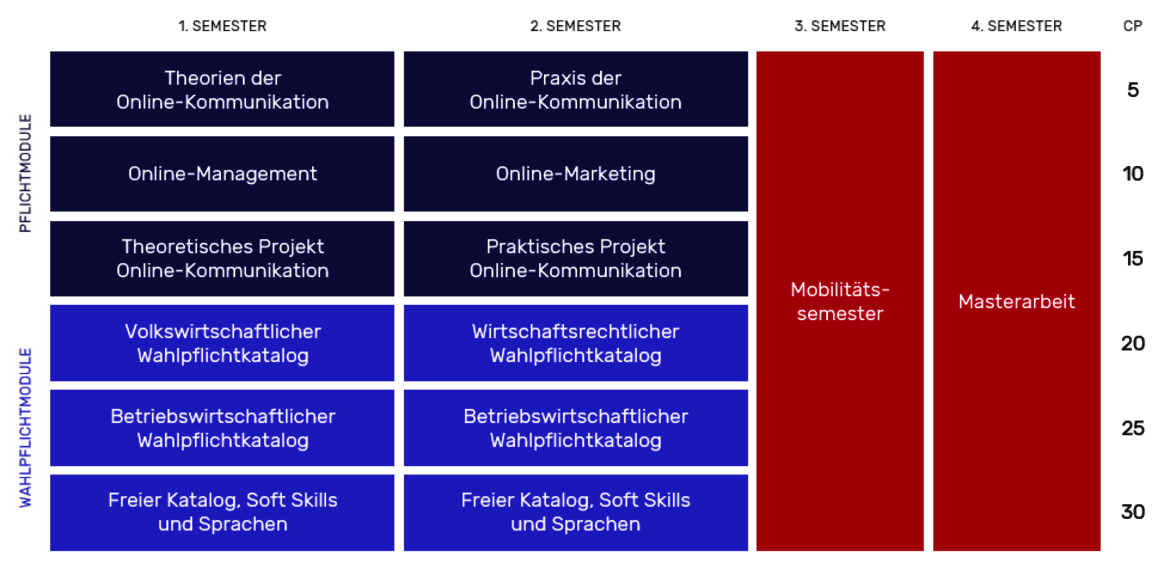
Curriculum
 © Hochschule Anhalt
Thematic focus
In the specialization module "Theories of Online Communications", students learn about the theoretical and methodological foundations of Online Communications. They gain a well-founded overview of current theories, methods and models and learn how they can use the various approaches to solve practical cases/problems. Over the course of the semester, students will put together a theoretical and methodological toolkit that will enable them to systematically develop solutions.
In addition to the theory module, the "Practice of Online Communications" module is designed as a practical module. The focus is on practical applications, such as in internal and external communication, current developments in communication technology, impact and usage behavior of Online Communications. In this module, students learn about the practical use of Online Communications in companies and organizations and are able to assess modes of action, stakeholder groups, areas of decision-making and potential. They are prepared for professional work in companies and organizations and gain an overview of possible areas of application and work in Online Communications.
In the Online Management module, students gain an overview of leadership and management tasks in the area of Online Communications. They are enabled to analyze and actively manage new forms of value creation, new business and revenue models. This applies to traditional companies (large and SMEs) as well as young growth companies and organizations.
Furthermore, you will learn how the management of companies and organizations can deal with open and participative organizational and employee structures.
In the Online Marketing module, students learn about the effects of the internet on the various areas of marketing. Building on the functional areas of marketing management, the special features of online marketing are taught in the analysis of markets, the development of strategies, the design of individual marketing instruments and the analysis of success. Students are enabled to develop marketing concepts for online marketing. They also learn how established marketing activities can be analyzed and systematically developed with a view to the potential of online marketing.
Mobility semester
During the mobility semester, students can gain important practical experience and reflect on, question and deepen what they have learned at university against this background. Students can choose between two options:
Students can choose between two options:
Lab
Lab with an extended scientific project. Most choose this option because it allows them to make practical contacts, gain important experience and often get good ideas for their Master's thesis.
Semester abroad
Study phase at a foreign university. Our students have already made it as far as South Africa. This is exciting and instructive and we are happy to support you in your choice. Further information and assistance for stays abroad can be obtained from the International Office of Anhalt University of Applied Sciences or from AIESEC.
Important components of the mobility semester
During the mobility semester, you will work on a question that is relevant to the MOK and your company in the lab with an extended scientific project. We will be happy to support you in choosing a topic. It makes sense to discuss a topic with the university mentor before the start of the lab and to concretize the approach on site.
Before the start:
- Registration
Please use the form from the mobility semester regulations to reach an agreement with your company and for subsequent documentation of your work by the company - Confirmation for internship company about compulsory internship and enrolment
The confirmation is available in PDF format above or from Mr. Pflug in the SSC. - Tasks
The aim of the extended scientific project is for you to reflect on, expand or investigate what you do in the company from a scientific perspective. Reflect, expand or investigate what you do in the company from a scientific perspective. In the best case scenario, you will be able to use parts of your work in the company and the company will also benefit from the scientific perspective. It therefore makes sense for us to agree on a more general task and for you to get back to us two weeks after the start of the lab with a more concrete proposal.
After the end of the mobility semester:
- Recognition
You submit your extended scientific project to the supervisor together with the confirmation of completion of the specialized internship / practical semester. You will receive 20 credits for the practical project. And you register the two modules that together add up to ten credits and that you want to register for the mobility semester. - Deadlines
There is no deadline for submission in the study regulations, but you should generally submit the report within four weeks of the end of the lab placement.
The report as a whole is the combination of internship report and extended scientific project and represents the result of the mobility semester in the company for the university. The report consisting of project and internship report should have approx. 50,000 characters including spaces (this corresponds to approx. 20 pages).
Please cite in APA style. Any citation management software will help you with this. This is also a good preparation for the Master's thesis. The report on your internship can be included in the introduction and background and should not take up more than 30% of the thesis.
Internship report
During the lab, you will prepare a report on your work and the experience you gained.
The report should contain
- Temporal activity report: an overview of the lab completed so that the work done, the training company, the institution, the departments and the training periods can be seen.
- Content of the activity report: a description of the company and an experience report on each section and the work carried out there
- Special regulations on the confidentiality of the internship report can be agreed with the company. They must be included in the internship agreement. The obligation to report and submit the report to the university mentor remains in place.
Project report
In the extended scientific project, you will work on a scientific question from the company and use the theoretical knowledge of business administration. The topic for this is agreed with the university mentor.
The mobility semester is credited and is included in your degree certificate with 20CP. Commitment is therefore worthwhile. The assessment criteria for the report are as follows:
Approach and motivation
- Clear objective
- Commitment
- Relevance
Weighting 3 out of 10
Content and structure
- Presentation of the necessary basics
- Scientific nature
- Well-founded methodology
- Comprehensible, useful conclusions in the discussion
- Logical structure
- Independence vs. reproduction
- Source work
Weighting 4 out of 10
Formal
- Cover sheet, print image, typesetting
- Spelling, grammar, punctuation, style
- Appropriate scope
- Citation form
Weighting 3 out of 10

For me, the degree program is a mixture of theory and practice. Relevant topics are covered and can be applied in the projects together with the companies.
Johannes Penzel, Student Online Communications
Digital projects in the Online Communications Master's program
Semester projects
Social media campaigns - from theory to implementation
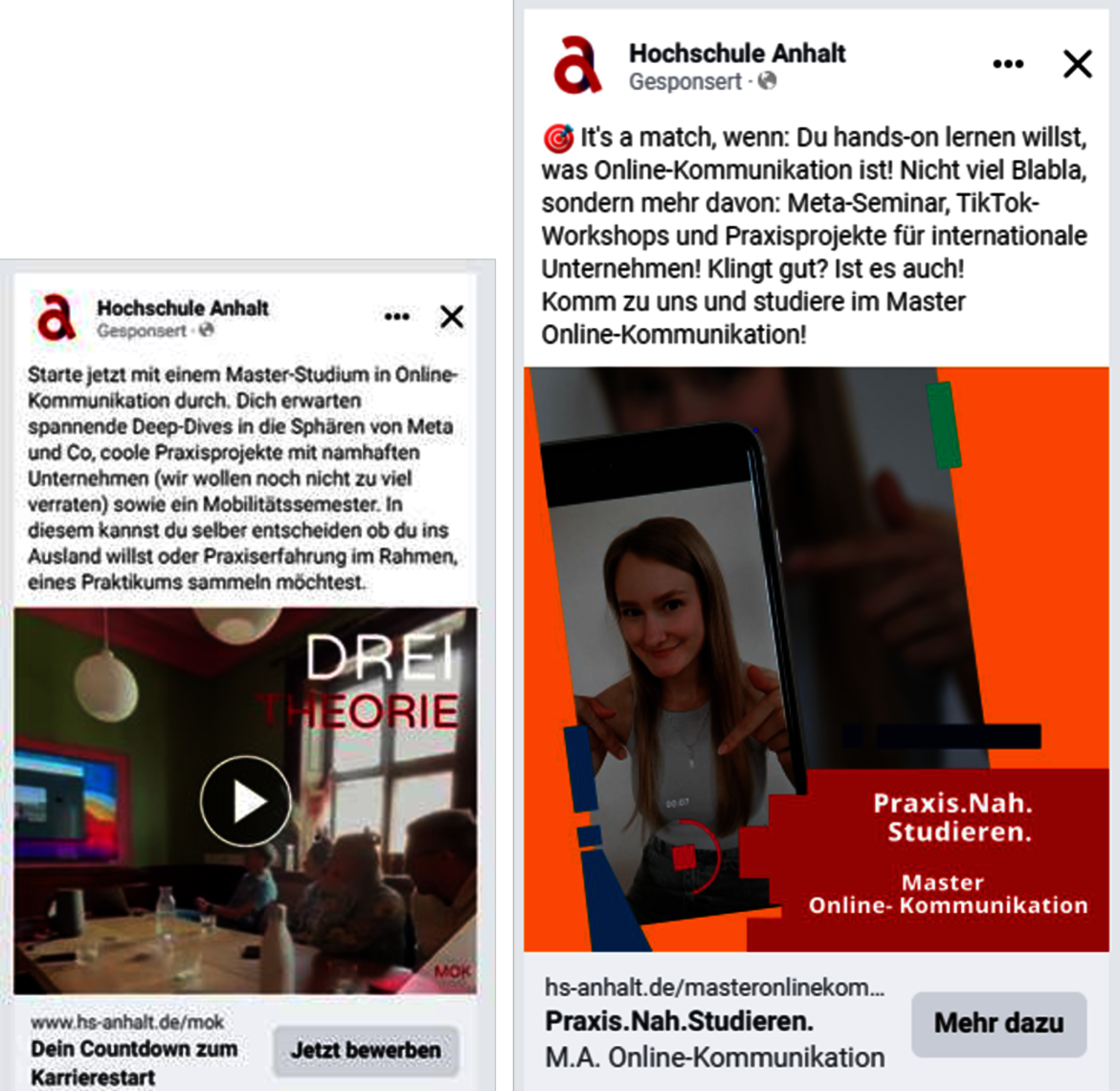
Each summer, students work on their own online campaigns for the entire semester in the Online Communications module, which are placed on the platforms for a few weeks. After the theoretical basics are covered at the beginning of the semester, students learn how to develop contemporary campaigns in practical workshops with partner companies such as Meta or LinkedIn. While the campaigns are running on Instagram or other platforms, important key figures are analyzed and settings are optimized. The examples shown are from a campaign for the degree program itself, but in the past we have also repeatedly developed campaigns for practice partners.
 © Hochschule Anhalt
TikTok workshop: "Don't make ads, make TikToks!"
 © Hochschule Anhalt
Can professors at a university hold good workshops on a topic as topical as TikTok? We asked ourselves the same question and thought we'd better ask our student Marie, who has since set up her own TikTok agency. Marie gave a detailed introduction to the topic, introduced the basics and presented many use cases: "The best advertising is the kind that doesn't feel like advertising. When you look at it, you think "What a cool trend?" and "What are they going for?"
Afterwards, it was the students' turn to produce their first TikToks. Some of the results are really impressive.
 © Hochschule Anhalt
Linkedin guest lecture: Social Campaigning
 © Hochschule Anhalt
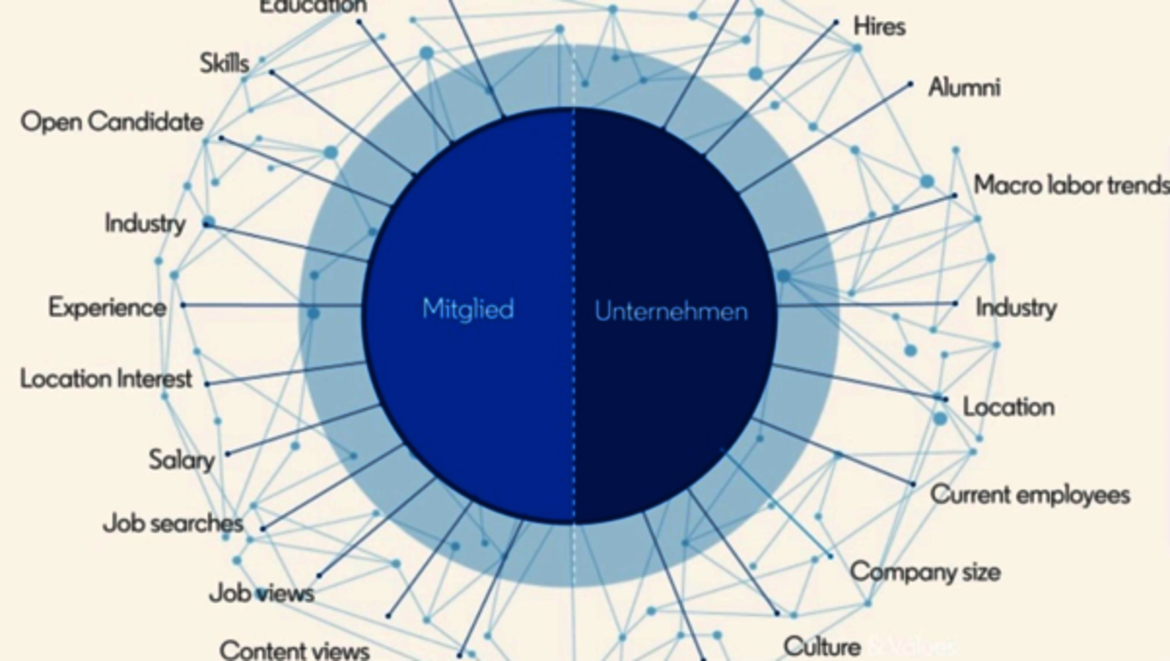
A few years ago, we were able to gain LinkedIn as a practice partner. Since then, Christian Koller from LinkedIn has regularly given us insights into what makes the platform special and how it can be used effectively as an online marketing tool. Among other things, the function of the so-called marketing funnel is relevant for the development of MOK campaigns and which formats LinkedIn offers for companies to use within the funnel. With the help of an 8-step checklist, Christian shows the concrete procedure for implementing campaigns with the Campaign Manager. Within the Campaign Manager, the students were able to see how a campaign is evaluated and what data is provided by LinkedIn.
Meta Spring University: Instagram & Facebook
 © Hochschule Anhalt
The two-day Spring University, which we have been able to offer together with Meta in recent years, focuses on the Instagram and Facebook platforms.
How do social media campaigns on Facebook or Instagram become successful? And what needs to be considered during planning and implementation? There are expert answers to these questions in interactive workshops led by Celina Degen from Meta. Online Communications students learn about the key aspects that need to be considered when planning and implementing social media campaigns. They can then apply the knowledge they have learned directly and put it into practice using a case study. The aim of the case study is to develop a campaign with the aim of generating new customers and increasing sales by 10%. In addition, students will gain an insight into the possibilities for companies to measure the effectiveness of campaigns on social media networks.
Pinterest - the underdog in online marketing?
-
 © Hochschule Anhalt
-
 © Hochschule Anhalt
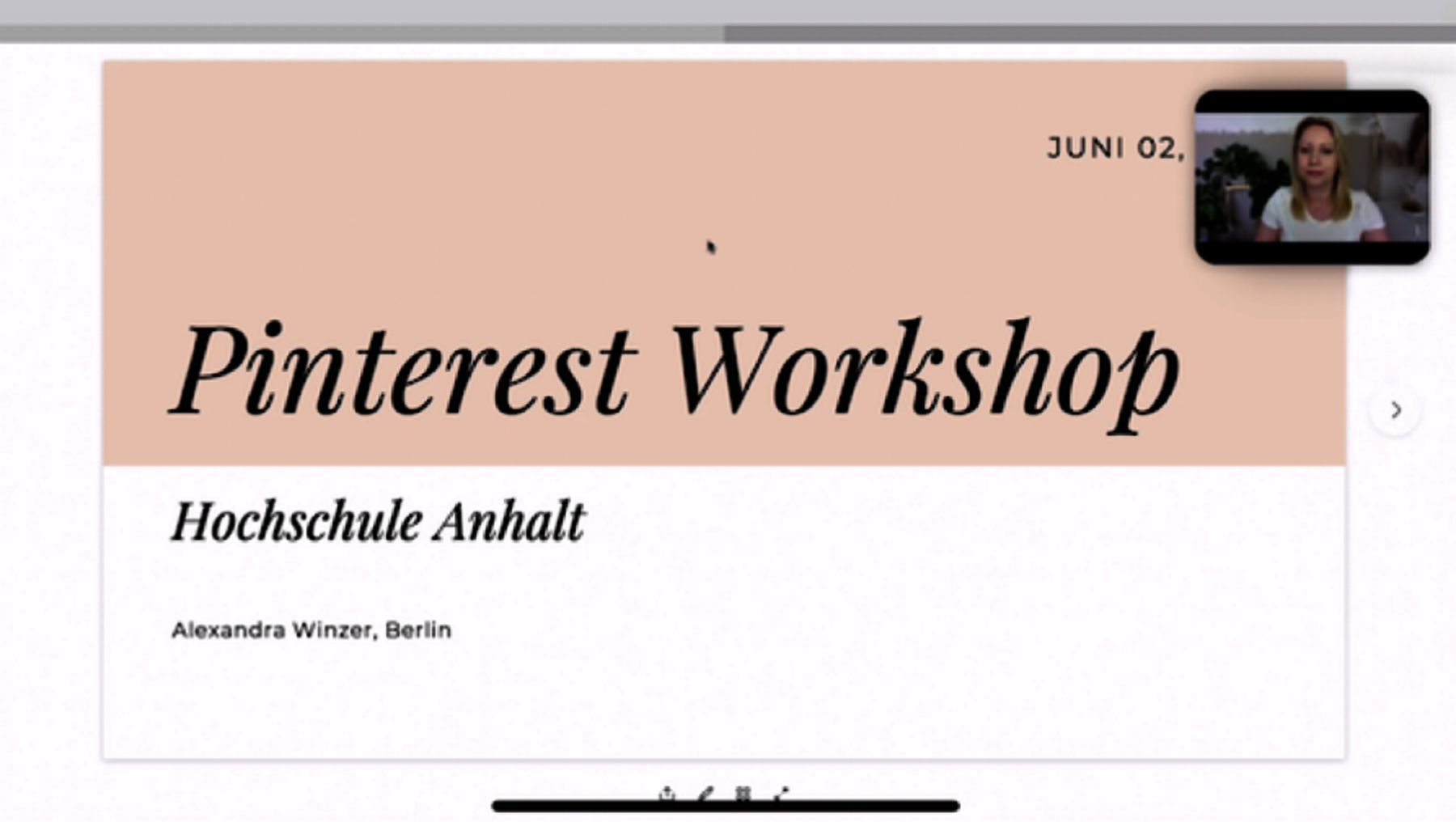
Well-known, often used for inspiration and yet the underdog in online marketing. Yet Pinterest's visual search engine is a real traffic guarantor. Once a year, MOK alumna Alexandra Winzer reveals to students what opportunities and possibilities Pinterest brings for companies, what the requirements for a good strategy are and what the right start to Pinterest marketing looks like.
