Tips for publishing
If you want to publish Open Access, there are a few points to bear in mind. For example, choosing the right license or journal is essential.
Creative Commons licenses (CC licenses)
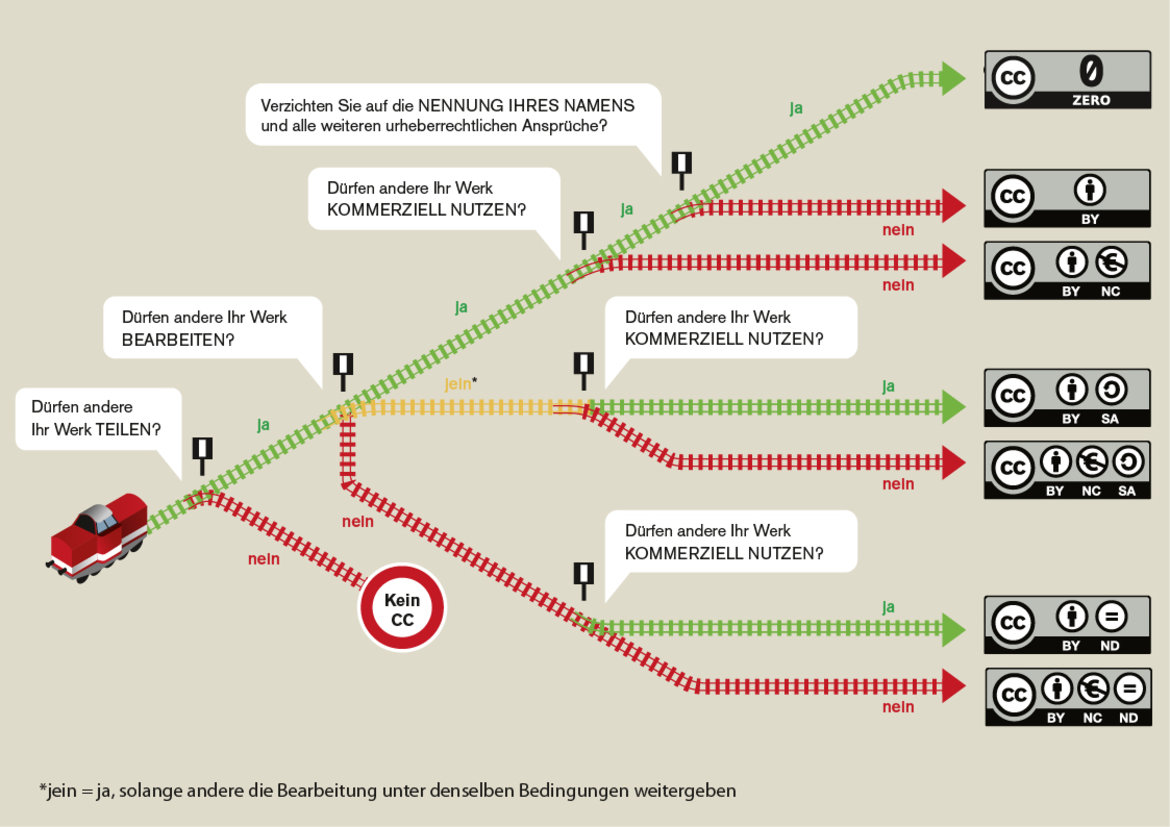 © https://wb-web.de/material/medien/die-cc-lizenzen-im-uberblick-welche-lizenz-fur-welche-zwecke-1.html
Creative Commons is a non-profit organization that provides ready-made license agreements. These license agreements assist with the release of legally protected content and regulate its subsequent use.


Further information and a checklist for determining the appropriate license can be found at the following link.
Predatory Publishing
This refers to business interns who initially appear to be reputable publishers of open access publications and offer corresponding publishing services for a certain fee, but then ultimately fail to fulfill these services or do so inadequately. Essential quality assurance processes such as peer review or the editorial processing of articles are often lacking. In order to recognize such journals and publishers, it is helpful to check the journal in question carefully in advance. Various platforms can be used for this purpose, such as the Directory of Open Access Journals (DOAJ). The university library can provide advice on this topic.
Mirror Journals
Mirror journals are a form of hybrid journal that are similar in name and topic to existing closed-access journals. Articles published there are not eligible for funding, even if the journals are listed in the DOAJ. Publishers want to circumvent the exclusion of funding for open access publication fees.
External services
In addition to the library's offerings, there are many other services that help with research and publishing. We present a small selection here. If you have any questions, please do not hesitate to contact us: publikationen@hs-anhalt.de
 © ORCID
To increase the visibility of your contributions in a scientific context, you can provide yourself as an author with a personal ID:
ORCID is a non-profit organization that assigns unique identification numbers. These facilitate the electronic assignment of publications to the corresponding author/researcher or institution.
Similar to B!SON, oa.finder is a permitted supplementary material that can be used to find suitable publication channels. In contrast to B!SON, oa.finder can also be used to find suitable open access publishers for books. In addition to useful information about the journals, such as impact factor and APCs, oa.finder users can also find out whether the publication costs can be covered by the institution through transformation contracts.
Further information and training dates are available here: https://finder.open-access.network/
The License Chooser is a tool provided by the Creative Commons organization. The tool enables authors to determine the most suitable license by answering questions about re-use step by step.
If different content with different licenses is used for your own publication, you can use the CC Mixer to check which license can be used for your own publication. Further information is available here: https://wirlernen.online/cc-mixer/
iRights.info is a suitable information platform for anyone who wants to find out more about various legal facts relating to their own publication. Various types of publications such as news, dossiers or background reports provide information on diverse topics such as copyright, CC licenses and other areas of law.
B!SON is a recommendation system developed by the TIB Hannover and the SLUB Dresden to help publishers choose the best Open Access journal. You receive a sorted list of journal titles that match the search query.
The system obtains the data mainly from OpenCitations and the DOAJ (Directory of Open Access Journals).
You are welcome to use B!SON to help you choose the right journal!
Further information can be found at: https: //projects.tib.eu/bison/projekt
On the learning platform TOERN you will find free and freely accessible digital educational offers from the Hannover German National Library of Science and Technology (TIB). The catalog mainly comprises interactive self-study courses on the various topics of Open Science, such as Open Access and Open Educational Resources. The platform is primarily aimed at instructors and lecturers at universities and in libraries, as well as anyone else who is interested in open science and teaching practice.
