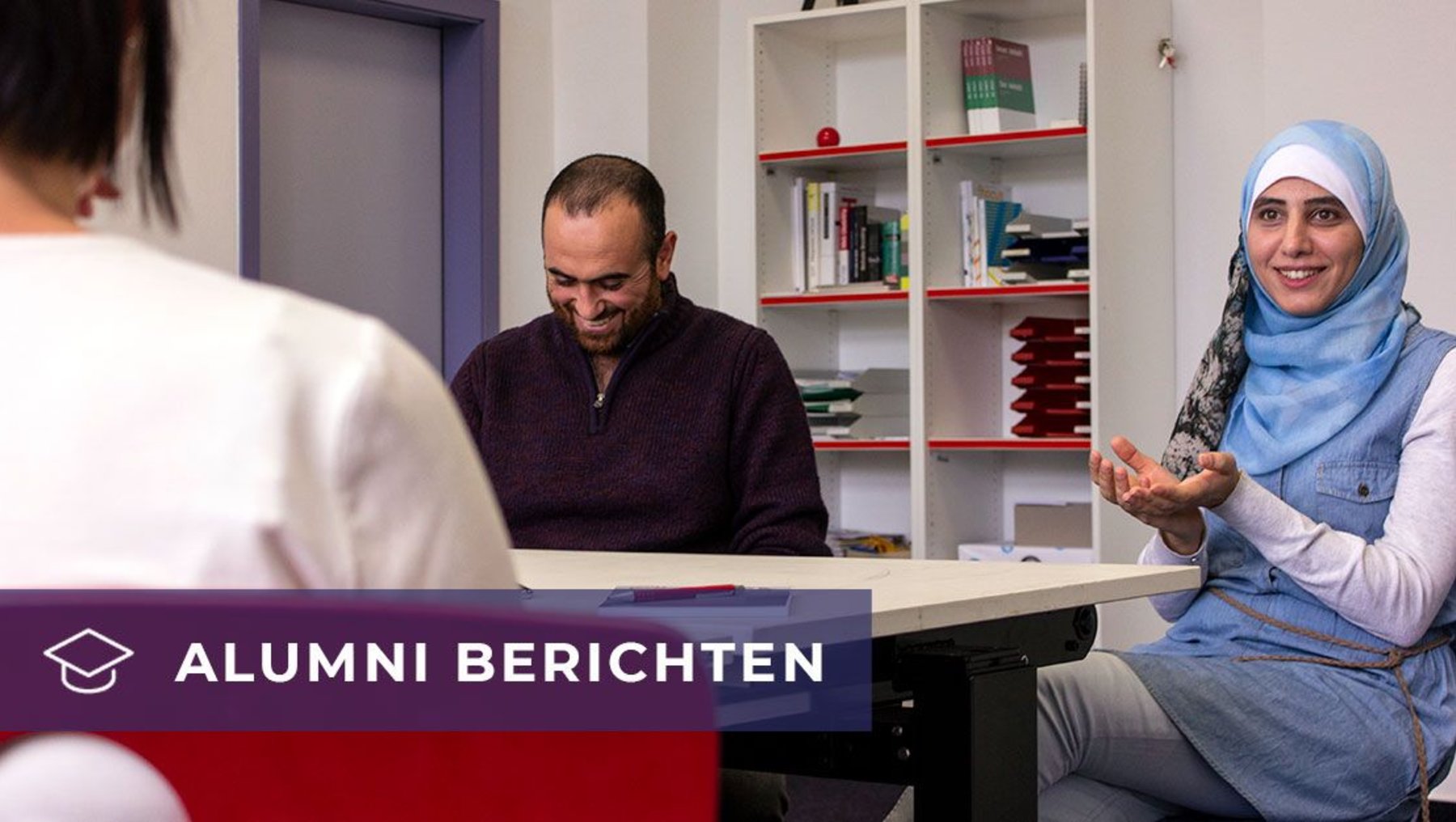
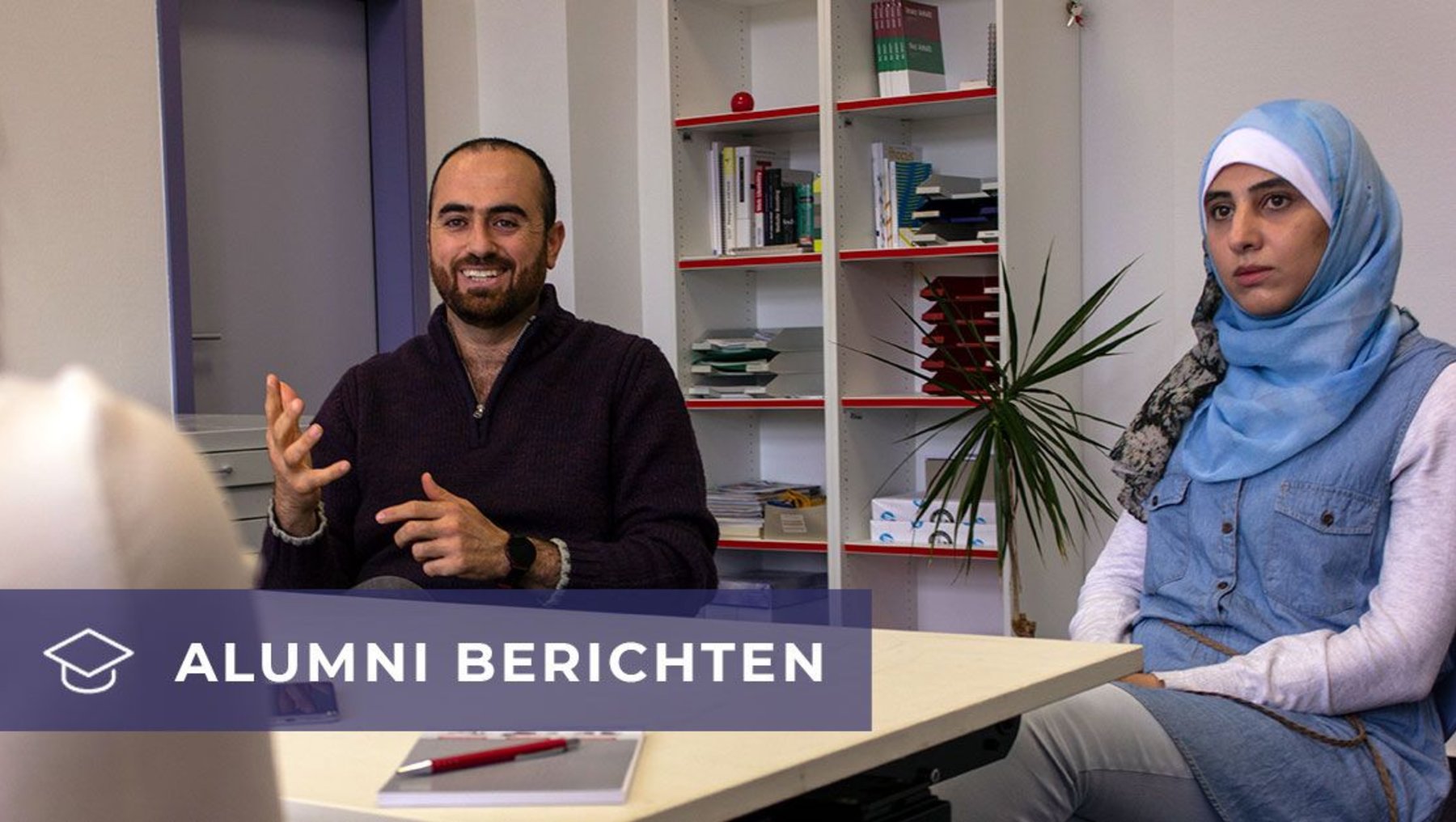
Learning German with Anhalt University of Applied Sciences and then completing a degree: Salam Alasmi and her husband Mohammad Jamal Al Samara were able to successfully follow this path at the universities in Dessau and Köthen. However, the couple had to overcome a number of difficulties before graduating.
The couple lived in Syria and Jordan until 2015. When Alasmi received a three-month student visa for Europe in Jordan at the end of 2015 and an Erasmus Mundus scholarship for the Technical University in Warsaw, the two engineers decided to travel to Europe. However, Alasmi's stay in Poland was shorter than planned as her visa was not extended. She had to cancel her study plans for Poland and joined her husband and son, who were in Germany on their way to Poland. Instead of finding a new home in Poland, the family ended up in Dessau in 2016.
They stayed in the Bauhaus city. Several months later, the young family received a permanent residence permit and had a second child. They soon graduated from the German course at the Preparatory College (Landesstudienkolleg) at Anhalt University of Applied Sciences. The couple successfully applied for the master's degree program in Data Science at Anhalt University of Applied Sciences in Köthen. They successfully completed their Master's degree in March of this year.
The family has settled into life in Dessau and the parents have made a good start to their careers. In this interview, they talk about the highlights of their studies and what helped them gain a foothold in Dessau.
Ms Alasmi and Mr Al Samara, what prerequisites do you need to study the Data Science degree program?
Alasmi/Al Samara: The formal prerequisites for admission to the Master's in Data Science are generally a degree from a recognized and accredited degree program in computer science, mathematics or statistics in Germany or a degree in Data Science.
As the content of the program is often only taught in German, you should have German language skills at DSH2 or C1-Hochschule level. In addition, the university may also offer individual modules in English. English language skills are therefore also important.
As prerequisites in terms of content, you should not lose interest in computer technology, data systems and programming languages during your studies, but should intensively study these contents. The basics of mathematics, statistics, big data, data analysis, data management, data communication and computer science are essential for a Master's in Data Science.
We had the advantage that our studies in our home country lasted 10 semesters. Our work experience in Syria and Jordan in the field of computer science also played an important role. This allowed us to deepen our basic knowledge. As master's degree programs in Data Science are often very practical and project-oriented, it was also an advantage for us that we had already acquired a certain degree of independent work during our studies.
Why did you choose the field of information management?
Alasmi/Al Samara: Data is becoming increasingly important in the digital age. Everyone is talking about big data. Data needs to be handled, analyzed and evaluated sensitively, which is why this degree program was very attractive to us.
What did you learn during your studies?
Alasmi/Al Samara: Through our master's degree program, we learned about the latest findings from research and development in the areas of artificial intelligence (machine learning/information retrieval), statistical methods of data mining, information visualization and visual analytics, data as a commodity (data protection and data ethics), information management, and so on. We also applied what we had learned in practice in two projects and in our final thesis.
Together with our fellow students, we also took part in the international student competition "Data Mining Cup 2019". This allowed us to put our theoretical knowledge into practice and also put us in contact with many companies.
What was the task of the competition?
Alasmi: The starting point was the following scenario:
An established food retailer has introduced a self-scanning system that allows customers to scan their items with a mobile handheld scanner while shopping. This method of payment exposes the retailer to the risk that a certain number of customers will take advantage of the fraud opportunity by not scanning all the items in their basket. Empirical research by suppliers has shown that discrepancies are found in around 5 percent of all self-scan transactions. The research does not distinguish between actual fraudulent intent on the part of the customer, unintentional errors or technical problems with scanners.
The task of the competition was as follows:
To minimize losses, the grocer hopes to identify cases of fraud through targeted follow-up checks. The challenge here is to keep the number of checks as low as possible in order to avoid unnecessary additional costs and not scare off innocent customers due to false accusations. At the same time, however, the aim is to identify as many false scans as possible.
The aim of the participating teams was to create a model to classify the scans as fraudulent or non-fraudulent. The classification does not take into account whether the fraud was intentional or accidental.
What did this solution look like and, more importantly, what helped you?
Alasmi: A data mining approach, which means using historical data to support future decisions.
Strategically, we focused on discovering previously unknown properties of the data and applying ML methods (machine learning methods).
By combining different algorithms, we were ultimately able to achieve our goal. In the competition, our team took first place in Germany and fourth place worldwide.
How did you find your current job?
Al Samara: During the language courses, I did two labs at the Federal Environment Agency and Datel Dessau. During our studies, we received many offers from the family integration team in Dessau and from Dr. Bernd Krause and our professors Dr. Korinna Bade and Dr. Ursula Fissgus, from the Department of Computer Science and Languages. We have a lot to thank them for. In addition to the Data Mining Cup, there was always the opportunity to talk to companies. For example, at the university's company contact fair. We both completed our Master's theses at a company in Halle. At that time, it was already clear that we would work in Dessau after our studies. My wife would work in the Mayor's Department of Statistics and Elections and I would work in the IT security service at Dessau Municipal Hospital.
Was it difficult to start your career after graduation?
Alasmi/Al Samara: The amount of data is constantly increasing. As a data scientist, you are responsible for analyzing the various data streams. It is therefore not surprising that there is currently hardly an industry in which this profession is not in high demand. There are vacancies everywhere, from Economics to public authorities, hospitals, universities and research institutions. We both started our careers straight after graduating.
And can you actively apply the content of your studies?
Alasmi/Al Samara: Our work tasks include several key areas that were also covered in our studies. For example, programming, working with databases and analyzing and visualizing statistical data in order to make better decisions. In this respect, we benefit immensely from our studies and can put our knowledge into practice.
You could have gone to Munich, Hamburg or Berlin: Why did you stay in Dessau?
Alasmi: We have our German teacher, Jean Fahrtmann-Rätz, to thank for that. We didn't just learn German with her. We also spent our free time with her. She made sure that we got to know the city better and integrated ourselves. As a result, we got to know the Federal Environment Agency, where my husband did a lab. We were even invited to family celebrations and Christmas parties. That's how we got to know our current friends. Friends of our teacher who have been like family to us ever since: They support us wherever they can. For the future too!
Do you already have concrete plans?
Alasmi/Al Samara: We can imagine building our lives here in Dessau. In Syria, we grew up in our parents' houses and we ourselves had to leave our own home. Our goal would be to have our own home in Dessau permanently. And we want to continue studying, do a doctorate. But only when the children are a bit older. There is no end to our learning, we have to keep at it.
