Where excavators once dug coal out of the ground, photobioreactors now stand: transparent tubes filled with green cell fluid. This is a vision of the future that the AlgaHub project aims to pave the way for. What needs to be done to ensure that algae actually contribute to structural change in coal-mining regions? With the AlgaHub platform, which recently went live, Anhalt University of Applied Sciences is laying an important foundation for this: a one-stop resource for anyone interested in commercializing algae.
Algae and Structural Change: What AlgaHub Can Achieve in Saxony-Anhalt
-
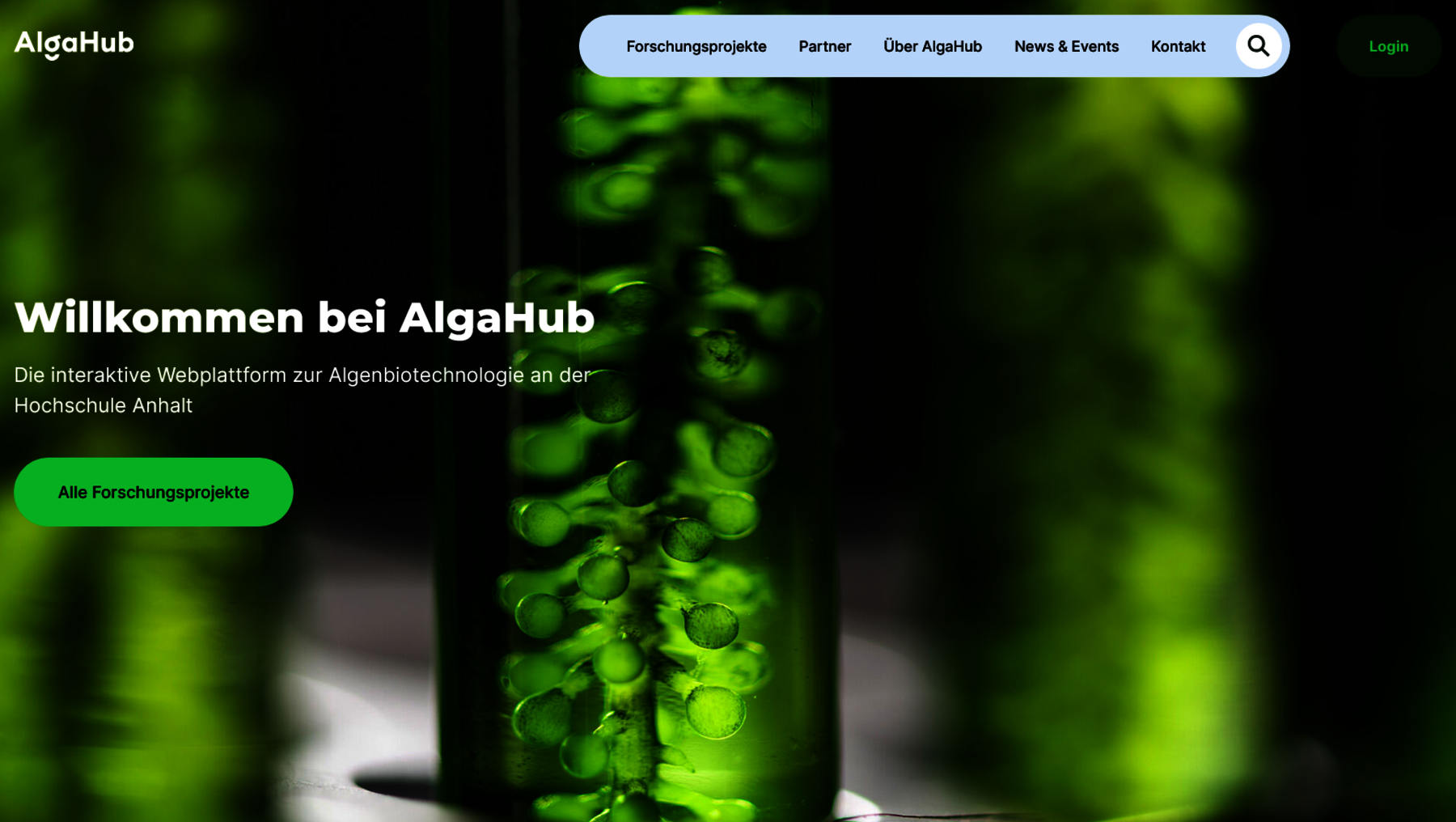 © hochschuleanhalt | screenshot web algahub
Die neue Plattform zur Vernetzung der Algenbiotechnologie: AlgaHub
What AlgaHub Actually Is
AlgaHub is a networking project for algae biotechnology in Saxony-Anhalt. It is funded by the Federal Ministry for Economics and Climate Action under the Structural Strengthening Act, which is intended to cushion the impact of the coal phase-out in the region. The project will run for four years, from April 2025 to March 2029.
At the heart of the project is the “AlgaHub” website. It brings together a project database—currently containing 20 research projects from Anhalt University of Applied Sciences—and a partner database featuring companies across the algae value chain: from plant builders and analytics firms to producers. AlgaHub’s senior project manager, Dr. Peter Ripplinger, describes the goal as follows: “We want to create a one-stop shop—a place where you can find all relevant sources of information on industrial algae biotechnology and ongoing projects.”
The numbers show why such a platform is lacking. The Industrial Algae Biotechnology Section of the industry association Dechema e.V.—in which the project manager himself was active for twelve years—has just 12 to 15 active members nationwide. A supraregional structure that pools knowledge does not yet exist. “If I, as an entrepreneur, want to enter the algae industry right now, I first have to gather a lot of information on my own,” says Ripplinger, who served for many years as managing director of a photobioreactor supplier and had frequent contact with Prof. Dr. Carola Griehl’s algae research at Anhalt University of Applied Sciences.
We want to create a one-stop shop—a place where you can find all relevant sources of information on industrial algal biotechnology and ongoing projects.
Dr. Peter Ripplinger
From Vitamin B12 to Bioplastics
The research projects are as diverse as the possibilities offered by algae. In addition, the levels of technological maturity vary widely. The projects closest to the market involve algae that have already been approved, such as Chlorella. It has been produced in Klötze, Saxony-Anhalt, for ten to fifteen years. A research project at Anhalt University of Applied Sciences is currently investigating the algae’s vitamin B12 content, a quality attribute that can also be marketed.
Other approaches are still in their infancy. Together with the fertilizer manufacturer SKW Piesteritz, the university is conducting research on biostimulants—additives designed to make plants more resilient and reduce fertilizer use. At the same time, preliminary work is underway on algae-based bioplastics, for example, using a special “milking process” to extract extracellular algae oils. These could replace fossil-based raw materials.
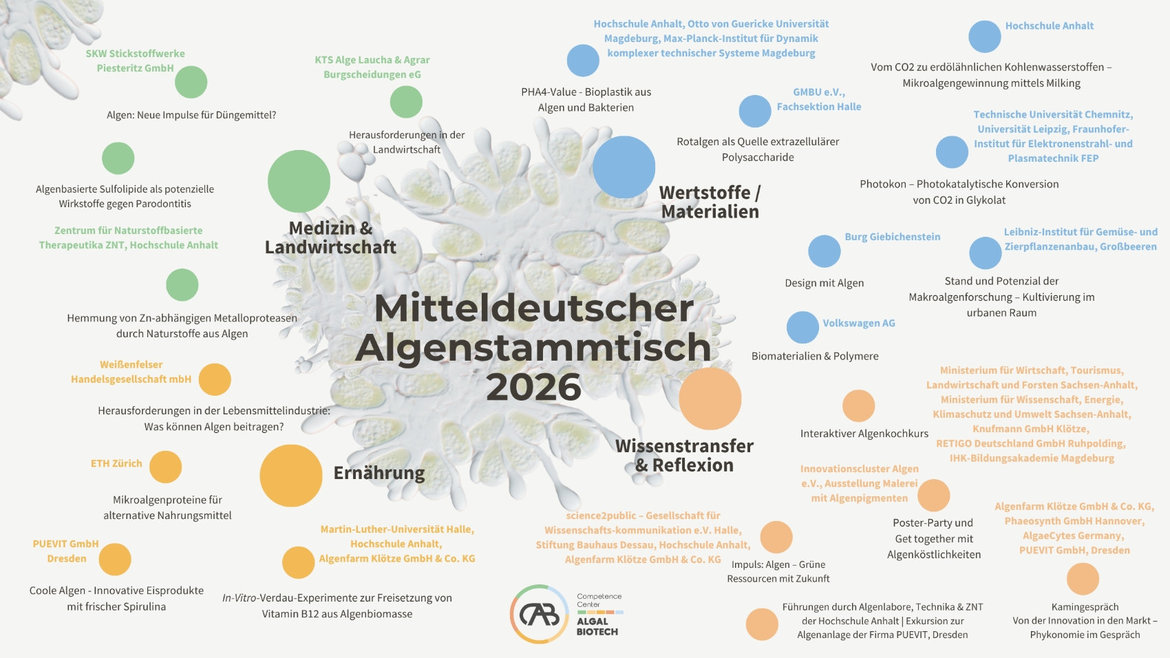 © hochschule anhalt
The 4th Central German Algae Roundtable in May 2026 demonstrated just how extensive and good algae research at Anhalt University of Applied Sciences has become. It also highlighted the great need for ongoing exchange. AlgaHub is intended to serve as an important tool for this purpose.
Economic Impacts on the Region
Peter Ripplinger explains that it is not yet possible to make a reliable prediction about how many business locations and production facilities will ultimately emerge in Central Germany as a result of this research. The most concrete plans at present are those of AlgaeCytes, which intends to produce algae in Dessau-Roßlau for the extraction of omega-3 fatty acids. “Especially in new markets, there are usually many obstacles,” says Peter Ripplinger, pointing out the typical challenges of innovation and transformation.
These include, for example, regulations. Anyone wishing to sell a new type of algae as a food or dietary supplement must have it approved under the European Novel Food Regulation. This process is complex and often nearly impossible for small startups to manage. Added to this is a classification issue that stems largely from historical factors. Legally, algae production is neither traditional Biotechnology nor Agriculture, and thus falls between industry association and funding categories.
“We can’t address every obstacle, but we can tackle issues like the lack of information and networking,” says Ripplinger, as well as providing targeted support with funding applications for research and development. AlgaHub helps companies, for example, with preliminary studies that determine whether a planned use of algae is even technically feasible. Such preliminary studies are already underway with SKW Piesteritz.
We can't address every obstacle, but we can work on issues such as the lack of information and networking.
Dr. Peter Ripplinger
What This Means for the Climate
There is a rule of thumb regarding the climate impact: One metric ton of algae biomass produced is equivalent, in theoretical terms, to 1.8 metric tons of CO2 removed from the atmosphere because the algae sequester the gas through photosynthesis. Facilities such as the planned AlgaeCytes plant in Dessau-Roßlau expect to produce about 50 metric tons of biomass per year in the first phase of expansion; according to plans, production is set to increase to 300 metric tons. The algae farm in Klötze produces 30–50 metric tons of biomass per year, while smaller facilities produce about 20 metric tons.
Compared to the emissions from a lignite-fired power plant, these are relatively small amounts. “To have a noticeable impact on the climate, we need to scale up—that is, make the leap from a lab-scale facility to industrial production,” explains Ripplinger. And most current funding programs in the algae sector support this leap toward increasing the technology’s maturity.
The German government’s High-Tech Agenda also focuses on alternatives for the food of the future, because traditional agriculture is increasingly reaching its limits—especially in terms of available land. Algae have the advantage that their yield per hectare is significantly higher than that of conventional Agriculture. However, this still requires further research and investment in algae biotechnology.
Information & Links
The AlgaHub website is now live and is aimed at researchers, companies, and anyone interested in learning more about algal biotechnology in the region or the use of algae to drive structural change: www.algahub.de
Over the past 25 years, the Center of Excellence for Algal Biotechnology (CAB) at Anhalt University of Applied Sciences has carried out numerous research projects on algal production and algal utilization. With the Central German Algae Center, this research will be expanded even further in the coming years to bring findings to market readiness.
More articles on algal biotechnology on the KlimaBlog:
Microalgae as a Resource for the Future: An Update
Microalgae as a substitute for petroleum: How close are we to industrial-scale use?
Phycology on the Rise: What the 4th Central German Algae Roundtable Reveals
4 Misconceptions About Algae and Nutrition—What Research and Practice Say
Algae Biotechnology in College: Working as a Student Research Assistant
Redaktion
Claudia Aldinger
Dr. Peter Ripplinger… can be reached by email: peter.ripplinger(at)hs-anhalt.de
The AlgaHub portal can be accessed directly via this link: https://algahub.de/
